News Analysis
Ask anyone on Capitol Hill who the main rival to the United States is, and the answer will come at you quickly. It’s China. No other country compares.
In many ways, it looks like the United States before the trade protectionism of the first Trump presidency, whereas a key service sector was struggling (real estate) and the relentless outsourcing of labor made people more cynical and less optimistic.
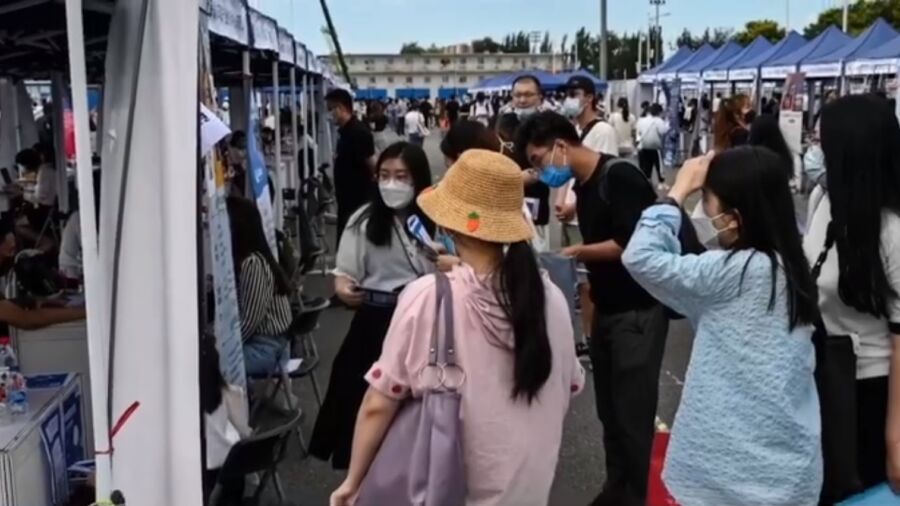
Since the economic fiasco of the pandemic, courtesy of CCP’s draconian lockdown policies and the global supply chain response, hundreds of thousands of businesses have closed. Wage cuts and layoffs continue across China’s manufacturing sectors too. Many young people cannot find work in crowded cities, where wages for entry level work are often depressed thanks to competition from migrant workers from towns further away.
One woman, listed only as Ms. Zhang, was a college graduate from the city of Yuncheng in Shanxi, an interior Chinese province. “I felt there was no hope in going to work anymore,” she told NTD TV. “When I worked in Shenzhen, you earned in Shenzhen and spent in Shenzhen. Nothing was left. I lived paycheck to paycheck.” She returned home to work on the family farm. She now lives with her parents.
No one really knows how precarious the situation is for youth unemployment. Official numbers from the National Bureau of Statistics of China (NBS) has urban youth unemployment (ages 16–24, excluding full-time students) at 17.3 percent in October 2025, similar to September’s 17.7 percent.
The same age group had 18.9 percent unemployment in August, one of the highest readings since the return to reporting of youth unemployment.
This structural transition from export-led growth to a more balanced economic model—something the West has long asked of China—is not without speed bumps.
“The slowing growth and the structural adjustment to high technology have led to reduced demand in traditional industries such as labor-intensive manufacturing, affecting job creation for young workers,” the authors wrote.
China analysts are increasingly connecting youth joblessness with broader structural risks for the economy, and the CCP more broadly.
But now, the tables have turned. China’s labor market is taking the hit.
Left unchecked, high youth unemployment will weigh on China’s long-term growth model and put Beijing leadership to the test.
And it’s not just the under-30 crowd that’s worried about the future.
Since tariffs were first imposed on China in July 2018, Beijing is now witnessing what happens to the labor force when its private industries leave for cheaper markets and invest elsewhere instead of at home. Jobs vanish. Young workers struggle to start a life. Older workers are forced to downsize or rely on the state for help.
The United States has gone through all of this before in no small part because of China. Now it’s China’s turn. The new views on global trade in Washington are the cause of major headwinds for China’s centrally-planned economy.
China’s youth unemployment rate was a record low of 9.6 percent in May 2018 and then kept climbing the following five years under the tariff regimes of both the Trump and Biden administrations.
Although China’s official unemployment rate in 2024 dropped, it remains elevated compared to the historical average, indicating that serious social issues continue to exert significant pressure on the job market and China’s policy makers.
Millions of people in China tolerate their ruling class because, in exchange, they were given upward mobility. Ending that social contract does not bode well for the CCP.
Speaking to NTD TV last month, a 35 year old man who goes by Mr. Wang said he returned to his home province of Shanxi after getting laid off in Beijing. Like many Americans, Wang worked multiple jobs to make ends meet. His health insurance premiums were going up despite his flat income. And eventually, he threw in the towel.
To Americans, all of this sounds familiar.