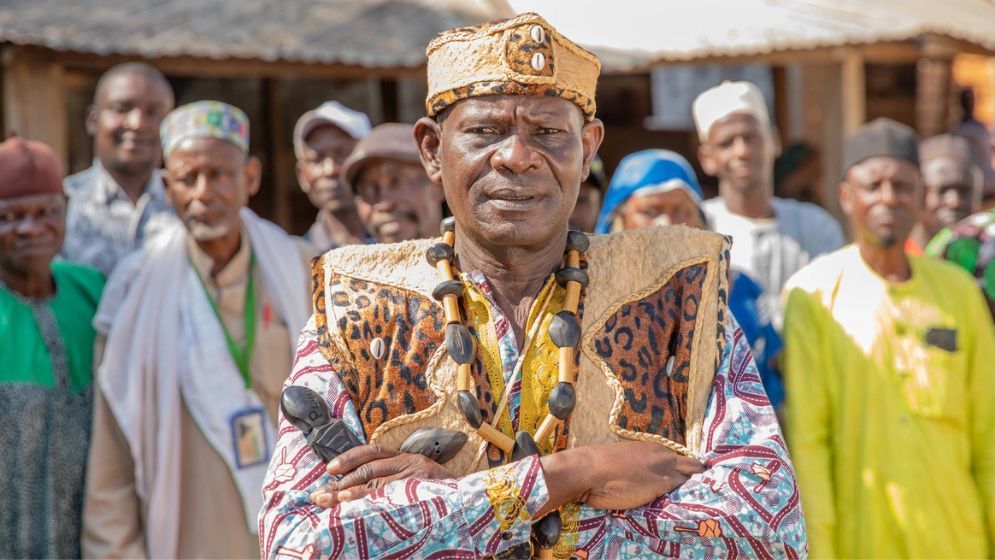
A Cameroonian village chief won the UN refugee agency’s prestigious Nansen Award on Wednesday for sheltering and integrating 36,000 people who fled unrest in the neighbouring Central African Republic.
Under the leadership of Chief Martin Azia Sodea and his family, the 14,000-strong village of Gado-Badzere near Cameroon’s eastern border took in people who escaped the post-election violence in the CAR in 2014 and 2021, UNHCR said.
“The initial idea was to find a way to ensure their survival and health. If they had left the CAR and come to Cameroon, it was in order to save their lives. So we got ourselves organised,” Chief Sodea told AFP.
“We said to ourselves, ‘We need to be in direct contact with the refugees so they can escape their stress and communicate with us’. We established this way of living together, then we gave them land and built shelters,” he said.
UNHCR called Chief Sodea a “visionary leader” whose actions inspired other traditional leaders to support refugees, “helping spark a shift in how refugees are welcomed across the region”, it said.
“His leadership turned a small village into a symbol of solidarity, built on the belief that those who arrive in distress deserve support and space to breathe,” the agency said.
The UNHCR Nansen Refugee Award winner receives a commemorative medal and $100,000 to be reinvested in humanitarian initiatives.
Established in 1954, the annual honour is named after the Norwegian polar explorer Fridtjof Nansen. The 1922 Nobel Peace Prize laureate was the first high commissioner for refugees for the League of Nations, the UN’s precursor.
– ‘Compassion remains undimmed’ –
Four regional winners were also honoured this year. They receive $25,000 each.
Pablo Moreno Cadena, an executive at Mabe, encouraged the major Mexican appliance manufacturer to actively hire and integrate refugees.
Ukrainian organisation Proliska was honoured for providing life-saving aid to more than 3.2 million people, often in the most dangerous and isolated areas.
Taban Shoresh founded The Lotus Flower, a women-led organisation supporting displaced women and girls in Kurdistan, northern Iraq.
And Negara Nazari, an Afghan refugee and co-founder of the Ariana Learning Centre in Tajikistan, built a school for young Afghan refugees unable to access education.
“This year’s laureates remind us that, even in dark times, compassion remains undimmed,” said Filippo Grandi, whose 10-year term as the UN High Commissioner for Refugees ends on December 31.
“They embody the spirit of Nansen — a belief that every person forced to flee, wherever they are, deserves dignity, safety and hope.”
The prize ceremony will be held in Geneva on December 16. Australian actor Cate Blanchett, a UNHCR goodwill ambassador, will speak at the event.
Previous winners include Eleanor Roosevelt, Queen Juliana of the Netherlands, King Olav V of Norway, French President Valery Giscard d’Estaing, the people of Canada, Spain’s King Juan Carlos I, Doctors Without Borders, Luciano Pavarotti and Angela Merkel.