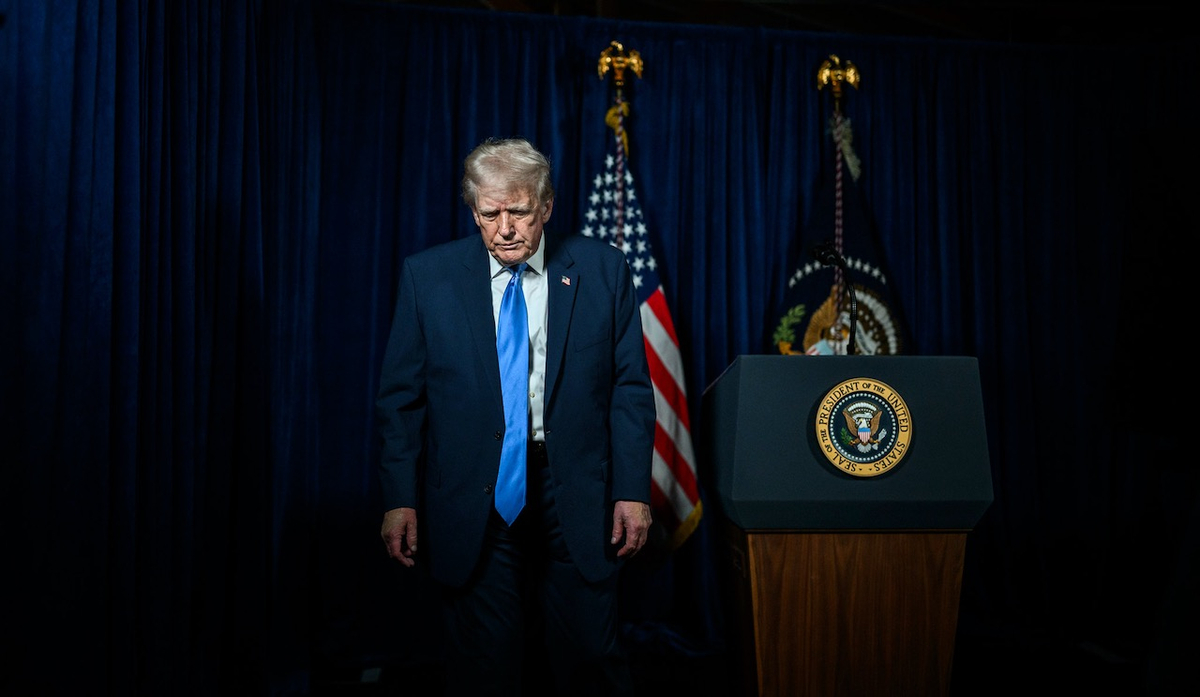
The Trump White House’s new National Security Strategy (NSS) – released last week quietly and without broad internal consensus – represents a fundamental recalibration of American foreign policy.
Gone is the bipartisan framing of great-power competition that guided Trump’s first NSS and carried into the Biden administration. In its place, according to Washington analysts, the document elevates a new antagonist: not Russia, not China, but liberal Europe itself.
Follow our coverage of the war on the @Kyivpost_official.
At a Council on Foreign Relations briefing, senior fellows Rebecca Lissner, Liana Fix, and Paul Stares walked reporters through the NSS’s most jarring departures – and the geopolitical aftershocks already rippling across the globe.
Europe’s shock, Russia’s smile
Across Europe, initial reactions have been “multiple times as shocked” as the uproar following Vice President J.D. Vance’s Munich Security Conference speech, Fix said.
The NSS’s Europe chapter, written in unmistakably Vance-style language, accuses EU governments of undermining Ukraine peace efforts, portrays European regulators as existential cultural threats, and hints that Washington may intervene in intra-EU politics.
Equally striking is what the NSS leaves unsaid: Russia is not explicitly labeled a threat, the document offers no acknowledgment of a Russia-China axis sustaining the war in Ukraine, and it fails to clarify America’s endgame for Kyiv – beyond supporting a vaguely defined “viable” Ukrainian state.
Other Topics of Interest
Zelensky Says US ‘Not Ready to See Ukraine in NATO Yet’ as Kyiv Seeks Bilateral Security Guarantees
Ukraine’s president said the US is not yet ready to see Ukraine in NATO, stressing that Kyiv is seeking bilateral security guarantees with Washington as part of ending the war.
That silence has not gone unnoticed in Moscow. Russian officials have praised the NSS as evidence that Washington may be shifting its focus inward, away from containing Russia and toward policing its own allies.
Fix stopped short of calling the NSS a blueprint for a US-Russia alliance, but she acknowledged the rhetorical alignment. “It’s definitely alignment against what we perceived as being the West in the past,” she said, adding, “It is sort of an end of the West liberal values order as we know it.”
Yet alignment in rhetoric does not automatically translate to policy. Congress has already moved to block troop reductions in Europe, and NATO’s baseline – reinforced during The Hague summit – remains intact.
Still, Fix warned that Europe cannot afford complacency. Russia is likely to probe NATO’s weakest seams, and she cited a particularly dangerous scenario: a potential Russian strike along the Ukraine-Poland border.
“How do we define this in terms of Article 5?” she asked, adding, “Russia is going to try to undermine the alliance.”
Ukraine: Undefined strategy, unending war
Analyst Paul Stares framed the administration’s claim of “settling” eight global conflicts as either “tendentious” or “bombastic,” with Ukraine as the clearest example.
Eleven months into Trump’s second term – and far from his campaign promise of ending the war in twenty-four hours – Russia continues grinding forward on the battlefield, aided by Beijing’s support.
The NSS offers no path to victory for Kyiv, no conditions for negotiation, and no articulation of the borders Washington believes Ukraine should retain. For Europe, analysts believe, that ambiguity is a strategic nightmare; for Russia, it is opportunity.
Inside EU capitals, the NSS has accelerated long-simmering debates over strategic autonomy. If Trump and Vance intend to condition US defense commitments on European internal politics – as administration officials have hinted – Brussels may soon face stark choices: joint borrowing for defense, unlocking frozen Russian assets, or defining contingency plans if US support falters.
Germany, already rewriting its constitution to boost defense spending after Munich, may only be the first of several major policy recalibrations.
Who is actually making US foreign policy?
Perhaps the sharpest question posed at the briefing struck at Washington’s core: who, exactly, is writing foreign policy?
Analyst Michael Froman answered without hesitation: “There’s really only one person who makes policy in the US at the moment, and that’s President Trump.”
Cabinet officials, he noted, monitor Truth Social for daily guidance, and some inside the administration were reportedly surprised by the NSS’s content.
Lissner described the NSS as a “bureaucratic hodgepodge.” Its Indo-Pacific section echoes Trump’s first term – or even Biden-era strategies. The Western Hemisphere chapter is unmistakably influenced by Stephen Miller, the administration’s former immigration architect.
And Europe’s portion bears Vance’s fingerprints. “It is the result of negotiation among different parties,” Lissner said, adding, “all filtered through Trump’s final sign-off.”
While rhetorical alignment with Russia exists, Fix emphasized that practical alignment does not – yet. Troops remain in Europe, Congress is resisting unilateral cuts, and NATO’s structure is still standing.
But Europe cannot count on predictable US responses to the next crisis, especially one triggered by Russia.
The NSS is less a detailed plan than a worldview: post-Western, anti-liberal, suspicious of allies, and ambivalent toward adversaries.
Europe is unnerved. Russia is encouraged. Ukraine is left exposed.
And inside Washington, the contours of American foreign policy increasingly reflect the vision – and whims – of a single figure at the center of a volatile political system.