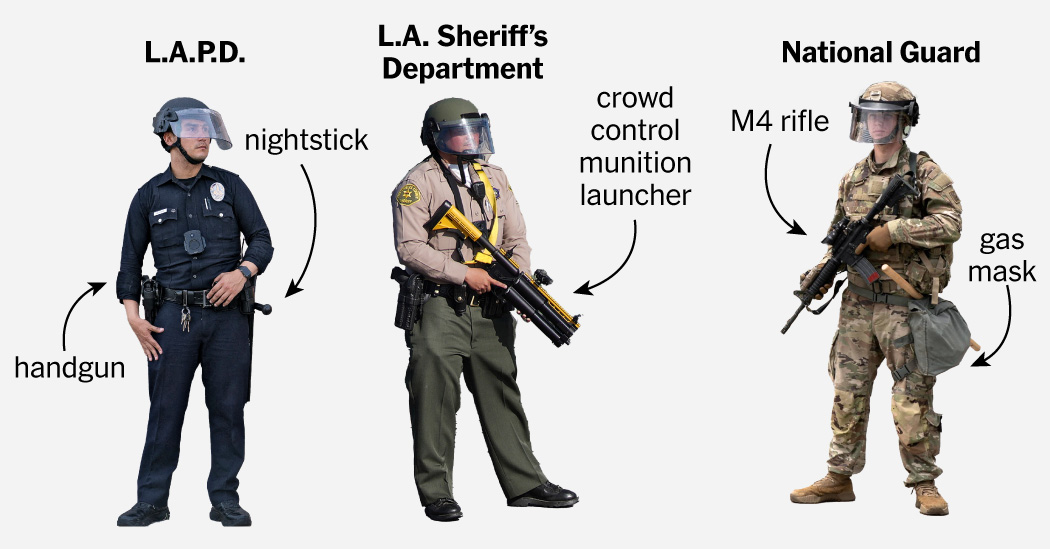
The protests in Los Angeles against immigration raids, now seven days on, have resulted in a considerable law enforcement presence — significant in both its sheer number and its broad representation across local and federal agencies, including military forces.
The New York Times identified more than a dozen groups that were on the ground in the past week. Times journalists reviewed over a thousand videos and images taken of the protests, including drone footage of the downtown area, to determine officers’ locations and movements and the weapons they were carrying.
Where major agencies were seen operating
It is extremely unusual for active-duty military personnel to be deployed to respond to a domestic protest, as the Trump administration ordered last week. President Trump commandeered 2,000 members of California’s National Guard and placed them under federal control, bypassing the opposition of state leaders, and then sent another 2,000 National Guard troops and 700 Marines to the greater Los Angeles area.
The last time a president bypassed a governor to deploy the National Guard was in March of 1965, on the eve of the civil rights march from Selma to Montgomery, Ala. On Thursday, a federal judge blocked Mr. Trump’s deployment of the troops and ordered the administration to return control of the forces to Gov. Gavin Newsom. The administration has appealed the decision.
The array of local law enforcement officers on the ground, on the other hand, is not unusual. California has a so-called mutual aid system in place that allows police and sheriffs’ departments to request backup from nearby areas if necessary. The two Los Angeles agencies were joined by at least 240 officers from neighboring counties and cities, as well as 600 California Highway Patrol Officers sent by Mr. Newsom.
Which agencies are represented, and what gear they have
The Los Angeles Police Department has traditionally been in charge of crowd control at protests. Some officers on the ground in recent days have worn basic uniforms, which include a handgun and a baton. Others have been equipped with full riot gear.
Police officers on horseback have significant physical advantage against crowds.
This week, the L.A.P.D. called for mutual aid from other local municipalities, including:
The L.A.P.D. also requested assistance from the Los Angeles County Sheriff’s Department.
Similarly, the sheriff’s department has called upon neighboring counties to support its efforts, including:
The California Highway Patrol has been leading the efforts to contain crowds as they cross, block or take over major thoroughfares — for instance, when protesters briefly blocked Highway 101 on Sunday.
The Department of Homeland Security, a federal agency, has been performing immigration raids, including those that set off the current wave of demonstrations. Agencies under the department — including Immigration and Customs Enforcement and Customs and Border Protection — carry out the raids, sometimes with the help of the Federal Bureau of Investigation.
Mr. Trump federalized the California National Guard and deployed around 4,000 troops to defend federal buildings and federal agents. On Monday, Trump also mobilized the U.S. Marine Corps, which has not operated on domestic soil since the 1992 Los Angeles riots. As of Thursday afternoon, Marines were training in the greater Los Angeles area but had not been seen on the ground at the protest site.
On Thursday, U.S. Marshals were spotted in the vicinity of the federal building complex, assisting the L.A.P.D with arrests.
How agencies interact
The National Guard has been positioned alongside Department of Homeland Security officers directly outside a federal building complex in downtown Los Angeles where much of the protest activity has occurred. The Guard members have not been authorized to carry out immigration raids or patrol the city’s streets.
They could be seen on occasion this week interacting with crowds when federal property was involved. On Sunday, the National Guard and D.H.S. officers pushed back demonstrators to clear a way for federal vehicles entering the complex, and the D.H.S. officers sprayed the crowd with pepper spray and pepper balls.
When conducting immigration raids, federal agents from the D.H.S., including Border Patrol, and from the F.B.I. often do interact with crowds of angry community members. Federal agents arrived in armored trucks, wearing tactical gear and carrying military-style rifles, for a raid on a clothing wholesaler on June 6 less than two miles from Los Angeles City Hall. Using flash-bang grenades, the agents dispersed a group of people that gathered to protest the raid.
Given the relatively small protest area — which has been concentrated in just a few square blocks — officers from various agencies have frequently ended up in close proximity. In the below photo, taken Monday, officers from at least five agencies stand on a single corner.
An image showing how multiple agencies were stationed outside a federal building during the protests in Los Angeles. Pictured are members of the California National Guard, and officers from the U.S. Customs and Border Protection, Department of Homeland Security, Los Angeles County Sheriff’s office, and the Los Angeles Police Department.
Los Angeles law enforcement agencies, including the Los Angeles County Sheriff’s Department and the city’s police department, have responded to demonstrations throughout the city, at times deploying flash-bang grenades, projectiles and other crowd-control measures. They have been authorized only for traffic and crowd control management, and not to perform immigration raids.
As of Thursday, the L.A.P.D. had already arrested more than 160 people in connection with the demonstrations, most of whom face charges of failure to disperse.
Prominent California leaders, including Mr. Newsom, have accused Mr. Trump of inflaming recent tensions in the state. In a speech on Tuesday, Mr. Newsom sharply criticized Mr. Trump’s deportation agenda, which led to the federal raids last week that set off the protests. He also condemned the administration’s decision to commandeer National Guard troops and deploy Marines, calling it “a brazen abuse of power by a sitting president.”