Gov. Jeff Landry’s administration detailed a major shift in Louisiana’s strategy for addressing coastal protection and restoration on Wednesday, proposing a slate of projects for the next fiscal year that move definitively away from the large-scale river diversions long seen as linchpins in the state’s plans.
The draft project budget for the state’s Coastal Protection and Restoration Authority for fiscal 2027, which begins in July, amounts to $1.27 billion, a significant drop from the current year. But that drop is largely because the state has canceled the controversial Mid-Barataria and Mid-Breton sediment diversion projects while preparing alternatives to take their place.
The state’s coastal leadership made clear that it intends to prioritize other types of projects, particularly large-scale “land bridges” built with dredged sediment in the Terrebonne, Barataria and Breton basins. Barrier island restorations will also be part of the strategy.
The hope is that much of that work could be paid for with funding related to the 2010 BP Deepwater Horizon oil spill, using funds that had been designated for the diversions. But much work remains ahead to evaluate the plans and gain approval from trustees overseeing the BP funds.
“We have more funds available for all these projects … these land bridges, barrier islands, etc, and we’re going to be moving forward expeditiously,” said CPRA chairman Gordon Dove.

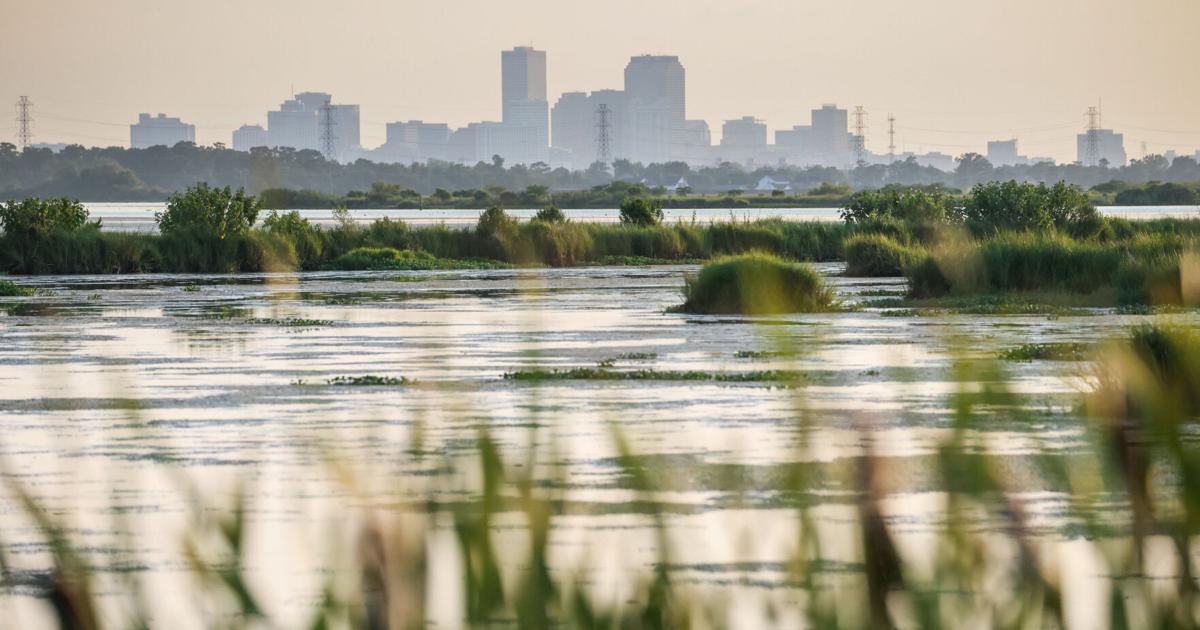
The New Orleans skyline, seen here from Chalmette, is perilously close to the eroding wetlands that once protected the city.
STAFF PHOTO BY SOPHIA GERMER
The CPRA under Landry has faced scrutiny over the changes and concerns that the state’s 50-year coastal master plan, widely lauded for its scientific approach, would be diluted. Dove has defended the change in focus, saying projects using dredged sediment build land more quickly and predictably.
Coastal advocacy groups and scientists that long pushed for the diversions saw them as mimicking how south Louisiana was built in the first place, using the natural flow of sediment from the Mississippi River in a way that works with nature. They also point out that land-building projects erode like the rest of the coast, while diversions could continue to function decades into the future.
The diversions, however, were strongly opposed by the commercial fishing industry and their parish governments due to the dramatic changes the influx of freshwater and sediment would bring to those areas. Landry also criticized the escalating cost of the $3 billion Mid-Barataria project.
More than $600 million had already been spent on Mid-Barataria alone, with the project having broken ground in 2023. The state is hoping to recoup some of those dollars through interest in remaining BP funds.
‘Get those benefits’
While relatively minimal funding is set aside for the large-scale land bridge projects in the new spending plan, that amount would grow substantially if BP dollars are approved for them.
CPRA executive director Michael Hare said focusing on land bridges and barrier islands brings the state’s “flood fight to the coastline.”
“We’re going back and reevaluating alignments that were in previous master plans and finding opportunities to create those acres of marsh right now and get those benefits in place,” said Hare.
The state is also planning to take a fresh look at whether a project to restore the East Timbalier barrier island in Lafourche Parish could be revived. The island was effectively abandoned after millions were spent seeking to restore it to no avail due to a list of complicating factors.
While the diversions have been removed from the upcoming spending plan, many other projects long in the works remain. Of the 130 active projects, bigger examples include:
Another $105 million set aside for the Morganza to the Gulf levee project. The 98-mile network to protect Lafourche and Terrebonne parishes has a total price tag of some $4.9 billion.
A further $39.2 million for the West Shore Lake Pontchartrain levee project for parts of St. Charles, St. John the Baptist and St. James parishes. The total price for that project is $3.4 billion.
Some $50.3 million for restoration of the disappearing Chandeleur Islands, with the total cost expected to be $383 million.
$17.3 million for a project underway that reintroduces Mississippi River water into Bayou Lafourche. The total cost is expected to be $230 million.
Coastal advocacy groups that had pressed for the diversions expressed varying comments on the plan. The Restore the Mississippi River Delta Coalition, which has been outspoken in its criticism of the cancelations, urged the public to examine and weigh in on the state’s strategy.
“We are still reviewing the details of this year’s annual plan to ensure that investments align with the coastal master plan, that the program maintains a strong balance of restoration and protection and that oil spill funds are both fully utilized and directed toward activities that address the devastating injuries Louisiana sustained from the Deepwater Horizon oil spill,” it said.
“We look forward to celebrating the parts of this plan that merit praise, and we remain committed to holding this administration accountable if it strays away from the coastal master plan or undermines public trust.”
The New Orleans skyline photographed over marshlands in Chalmette, La., Wednesday, June 28, 2023. (Photo by Sophia Germer, NOLA.com, The Times-Picayune)
STAFF PHOTO BY SOPHIA GERMER
The Coalition to Restore Coastal Louisiana, the state’s oldest organization committed to addressing land loss, said it “is excited to see an ambitious roadmap, with a focus on delivering projects from the coastal master plan.”
“There is impactful work coming soon to our entire coast, from the massive marsh and hydrologic restoration projects in the southwest to the long-awaited MR-GO ecosystem restoration in the southeast,” said James Karst, the organization’s communications director.
The full plan can be found on the CPRA’s website. Public comments will be accepted until Feb. 17, while a series of public meetings will also be held as follows:
Jan. 6 at 5:30 pm, Coastal Center at Nicholls University, 426 Ardoyne Drive, Thibodaux
Jan. 8 at 5:30 pm, Joseph S. Yenni Building, Second Floor Council Chambers, 1221 Elmwood Park Blvd., Jefferson
Jan 12 at 5:30 pm, LSU AgCenter, 1105 West Port Street, Abbeville
Jan 15 virtual webinar at 1 pm.
The annual plan is not an agency budget, but instead a spending outline for projects. Funding comes from a variety of state and federal sources, as well as oil spill proceeds. The CPRA’s board and the state Legislature must approve the plan.
BP spill money has provided the state with billions in cash for restoration projects, but that money is due to expire at the end of 2031. That will leave the state with a huge budget hole to fill as it seeks to keep up with its devastating land loss crisis and intensifying hurricanes.