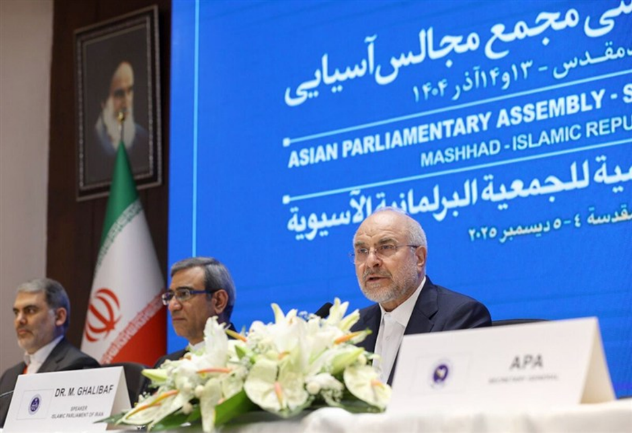
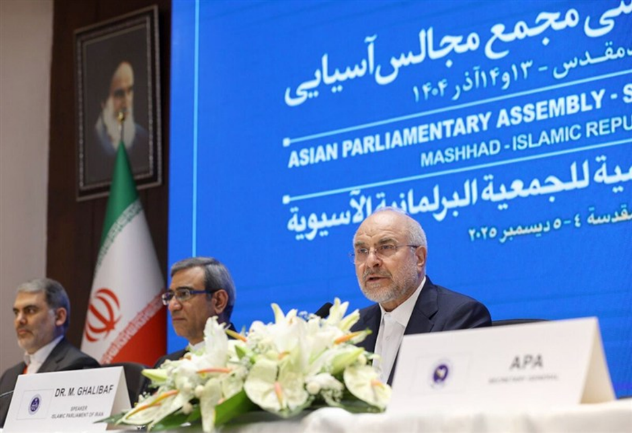
 Majles Speaker Qalibaf (Tasnim, December 4, 2025)
 Meeting of the Iranian ambassador in Baghdad with the governor of Baghdad (Al-Alam, December 6, 2025)
 The crew of the ship Eternity C after their release (Saba News Agency Telegram channel, December 3, 2025)
 Demonstration in support of Hezbollah and the Houthis after the committee’s announcement (Al Arabi TV, December 4, 2025)Highlights[1]
The speaker of the Iranian Majles accused Israel of “systematic genocide” of the Palestinians and stressed his country’s opposition to any attempt to impose a political solution on the Palestinians.
The Iranian media reported extensively on the death of Yasser Abu Shabab, head of the Popular Forces militia in Rafah, and stressed that it was proof of the failure of Israeli policy in the Gaza Strip.
The Iranian foreign minister invited his Lebanese counterpart to visit Tehran. The Iranian Foreign Ministry spokesperson rejected the Lebanese foreign minister’s claim regarding Iranian interference in his country’s internal affairs.
The Iraqi prime minister ordered an investigation after the Terrorist Funds Freezing Committee included Hezbollah and the Houthis on the list of terrorist organizations. The committee chairman claimed that this was a “mistake”.
Iran and the Palestinian Arena
The Speaker of the Iranian Majles, Mohammad Baqer Qalibaf, accused Israel in his speech at the gathering of the Foreign Affairs Committee of the Asian Parliamentary Assembly (APA) in Mashhad of the “systematic genocide” of the Palestinians. He stated that Iran welcomes any initiative and plan that would end the “occupation” and reduce the suffering of the Palestinians, but rejects any attempt to impose unjust peace on the Palestinian people and any agreement that does not guarantee justice for the Palestinians. Qalibaf added that the Palestinian people’s right to determine their destiny is non-negotiable and that no foreign power or state can decide the fate and future of their country for them. He reiterated Iran’s proposal to hold a referendum on determining the political future of “Palestine” with the participation of the “original inhabitants” of “historic Palestine” (Tasnim, December 4, 2025).
Majles Speaker Qalibaf (Tasnim, December 4, 2025)
Iranian Foreign Minister Abbas Araghchi spoke with Egyptian Foreign Minister Badr Abdelatty and discussed relations between the two countries and developments in the region, especially the situation in Lebanon and the Gaza Strip. The Iranian Foreign Ministry said in a statement that the two stressed the need for immediate action by the international community to stop the “crimes of the Zionist regime” in light of Israel’s continued “aggression” and repeated violations of the ceasefire (Iranian Foreign Ministry Telegram channel, December 6, 2025).
The Iranian media reported extensively on the death of Yasser Abu Shabab, head of the “Popular Forces” militia in Rafah, stressing that his death proves the failure of Israeli policy in the Gaza Strip. An editorial published on the hardline news site Alef under the headline “The Black Death of the Traitor to His Homeland” claimed that Abu Shabab’s death proves that the “resistance stream” in the Gaza Strip is still alive and dynamic, and that his death significantly strengthened Hamas’s popularity and legitimacy among Palestinian public opinion. According to the site, the death of the militia commander sent a clear message to the rest of the “Zionist regime’s mercenaries in the Gaza Strip” that they too will meet a similar fate and that the “Zionist regime’s” support does not guarantee their security. Moreover, the death proved that the “Zionists’” plans aimed at harming the Palestinian people and the “resistance” cannot develop or take root in Palestinian society, and that all the dreams woven against Hamas will lead nowhere and will not change reality (Alef, December 6, 2025).
The IDF and the Israel Security Agency (ISA) exposed documents indicating that Hamas operates a covert money-changing network in Turkey under Iranian direction. According to the statement, this is a network of money changers composed of Gazan expatriates, exploiting Turkey’s financial infrastructure for terrorist purposes. According to the IDF and ISA, the changers transfer hundreds of millions of dollars to Hamas and its senior officials in cooperation with Iran (Arabic Telegram channel of the IDF Spokesperson, December 7, 2025).
Iran and the Lebanese Arena
Iranian Foreign Minister Abbas Araghchi sent a written message to his Lebanese counterpart, Youssef Rajji, stressing that Iran would continue to support Lebanon’s sovereignty, national unity, territorial integrity, security, and stability, especially in the face of the aggression of the “Zionist regime.” Araghchi invited Rajji to visit Iran for consultations on expanding relations between the two countries and to examine regional and international developments. He expressed his confidence that the Lebanese people and government would succeed in overcoming the threats and challenges they face (Iranian Foreign Ministry Telegram channel, December 4, 2025).
At his weekly press conference, Iranian Foreign Ministry spokesperson Esmail Baghaei rejected Lebanese Foreign Minister Youssef Rajji’s claim regarding Iranian interference in Lebanon’s affairs. He noted that the fact that Iran cares about peace and security in the region and expresses its positions regarding the threats of the “Zionist regime” should not be considered interference in the internal affairs of any country. He added that Hezbollah, which has influence in Lebanese society, makes its decisions completely independently. Baghaei stressed that Iran is willing to hold talks with the Lebanese authorities regarding relations between the two countries, and that decision-making on issues related to Lebanon, including its defense strategy, is an issue that must be determined through internal Lebanese dialogue and based on understanding between the various components of the country. According to him, the issue of “resistance” weapons is among the matters whose decision rests with Lebanon and Hezbollah (Iranian Foreign Ministry Telegram channel, December 7, 2025).
Iranian Majles Speaker Mohammad Baqer Qalibaf met with a Lebanese parliamentary delegation headed by Hezbollah MP Hassan Fadlallah, who arrived in Mashhad to participate in the APA Foreign Affairs Committee gatherings. The delegation conveyed to Qalibaf the greetings of Lebanese Parliament Speaker Nabih Berri and thanked Iran for its support for Lebanon. For his part, Qalibaf stressed Iran’s consistent position in support of Lebanon (Tasnim, December 4, 2025).
Iran and the Iraqi Arena
Iran’s ambassador to Iraq, Mohammad Kazem Al-e Sadeq, met with Baghdad governor Atwan al-Atwani and congratulated him on his appointment as governor of the province. Al-Atwani referred to the potential for expanding cooperation between the Baghdad Province and Iranian provinces and stressed the need for the continuation of ties and the transfer of experience among the provinces in order to deal with the existing challenges. The two also discussed the latest developments in Iraq (Al-Alam, December 6, 2025).
Meeting of the Iranian ambassador in Baghdad with the governor of Baghdad
(Al-Alam, December 6, 2025)
The Houthis in Yemen
On December 3, 2025, the Houthis announced they had released the crew of the ship Eternity C, which had been attacked and sunk in July 2025 near Al-Hodeidah. According to the announcement, the release was carried out through Omani mediation, and the crew members departed on a flight from Sana’a to Muscat (Houthi movement Telegram channel, December 3, 2025).
The crew of the ship Eternity C after their release
(Saba News Agency Telegram channel, December 3, 2025)
The pro-Iranian Militias in Iraq
The issue of militias’ weapons
Iraqi Prime Minister Mohammed Shia’ Al-Sudani stated that the disbanding of militias in Iraq would not be limited to a demand by a government body but would take place through a political agreement (Al Rabiaa TV, December 8, 2025). Foreign Minister Fuad Hussein said on the sidelines of the Doha Forum in Qatar that the question of the militias’ weapons is an internal issue under discussion in Iraq, but emphasized that ultimately, the issue of weapons must be under the state’s control (Al Arabi channel, December 7, 2025).
Akram al-Kaabi, secretary-general of the pro-Iranian Al-Nujaba Movement, condemned what he described as “blatant American-Zionist interference” in Iraq’s internal affairs. He especially emphasized the involvement of the US envoy to Iraq, Mark Savaya, who had urged the Iraqi authorities to resolve the issue of the militias’ weapons, calling him “a traitor who robs Iraq of its sovereignty and hands it over to the United States.” Al-Kaabi expressed astonishment at the “shameful” positions of certain Iraqi figures in the face of this “blatant interference” and threatened that if Savaya is not silenced, “the Islamic resistance will silence him [literally, “put a stone in his mouth”] and restore its sovereignty that was taken away” (Akram al-Kaabi’s X account, December 3, 2025).
Including Hezbollah and the Houthis on the terror list
On November 17, 2025, the official Iraqi gazette published that the Terrorist Funds Freezing Committee in the cabinet secretariat had decided at its October 2025 meeting to freeze the funds and economic assets of various entities and figures, including Hezbollah and the Houthis, due to their “involvement in carrying out terrorist crimes” (Official Iraqi Gazette of Laws and Parliamentary Decisions, November 17, 2025).
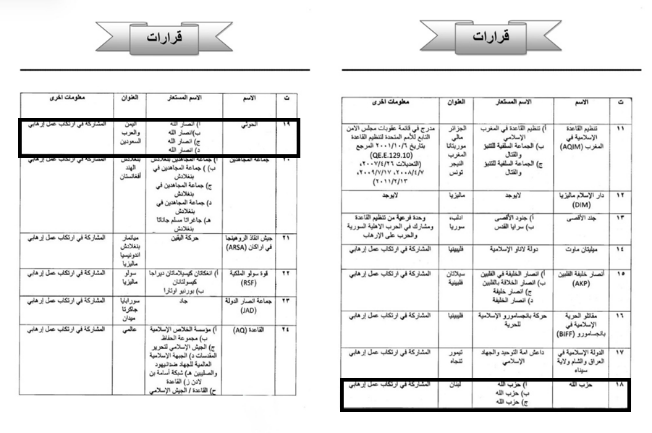
Hezbollah (bottom right) and the Houthis (top left) on the list of terrorist organizations whose assets are frozen, according to the change in the resolution (Baghdad Today, December 4, 2025)
A few hours later, the committee issued a clarification stating that the asset freezing applied only to entities and figures connected to ISIS and Al-Qaeda, and that the inclusion of other entities resulted from publication of the list before it was updated. The committee said that an investigation would be conducted to clarify the circumstances of the mistake (Iraqi News Agency, December 4, 2025). At the same time, a “secret and urgent letter” sent by the committee chairman was exposed, in which he requested that Hezbollah and the Houthis be specifically deleted from the official gazette. He claimed that the committee had not approved freezing their assets and that they apparently had been “included by mistake among the documents” (Al-Ahd, December 4, 2025). Subsequently, the committee published an official correction in accordance with the chairman’s decision (Al-Ahd, December 9, 2025).
Iraqi Prime Minister Mohammed Shia’ Al-Sudani also ordered an urgent investigation to identify those responsible for the errors in the decision. A statement from his office said that the decision contained “inaccurate statements,” since the Iraqi side had agreed only to include entities and individuals connected to ISIS and Al-Qaeda (Office of the Iraqi Prime Minister X account, December 4, 2025). Despite this, marches and protests were held throughout Iraq, especially in Baghdad, Samawah, and Basra, in protest against the publication of the decision (Al Arabi TV, December 4, 2025).
Demonstration in support of Hezbollah and the Houthis after the committee’s announcement
(Al Arabi TV, December 4, 2025)
[1 The weekly study includes the activities of Iran, the Shiite militias in Iraq, and the Houthis in Yemen.
Related Articles