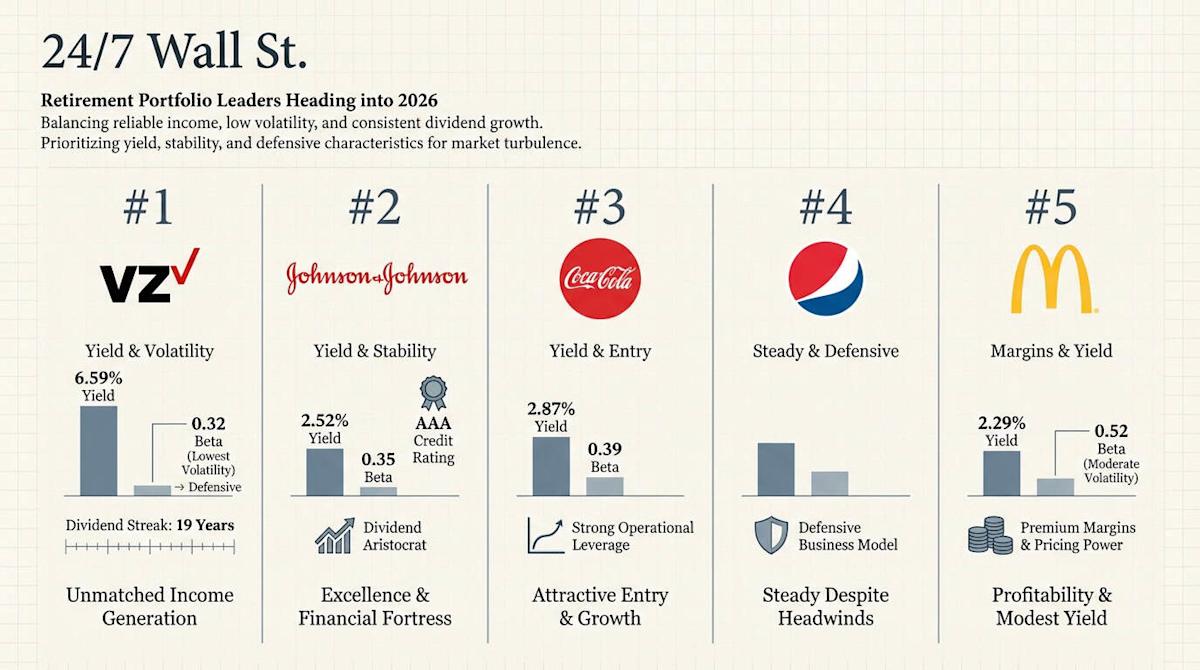

24/7 Wall St
Verizon offers the highest yield at 6.59% with a 0.32 beta and 19 consecutive years of dividend increases.
McDonald’s posted a 46.90% operating margin but carries a negative book value of $3.04 per share from buybacks.
Johnson & Johnson raised its dividend 4.8% to $1.30 quarterly and lifted fiscal 2026 sales guidance to $93.7B.
If you’re thinking about retiring or know someone who is, there are three quick questions causing many Americans to realize they can retire earlier than expected. take 5 minutes to learn more here
For investors approaching or in retirement, the right stock portfolio balances reliable income, low volatility, and consistent dividend growth. Among six prominent dividend-paying stocks, five stand out for their financial stability, income generation, and defensive characteristics that help retirees navigate market turbulence.
The evaluation prioritized dividend yield, dividend growth consistency, earnings stability, low volatility measured by beta, and strong cash flow generation. Secondary factors included profit margins, debt levels, and market position. Here’s how the top five retirement stocks rank heading into 2026.
McDonald’s claims fifth with a 2.29% dividend yield and $7.08 annual payout per share. The fast-food giant’s beta of 0.52 indicates moderate volatility, making it less defensive than other contenders but still suitable for conservative portfolios.
What sets McDonald’s apart is profitability. The company posted a 46.90% operating margin and 32% profit margin in its most recent results, demonstrating pricing power few restaurant operators can match. Third-quarter 2025 revenue reached $7.08 billion, up 3% year-over-year, while earnings grew 1.60%.
The company’s resilience shines through its pandemic recovery. Revenue climbed from $19.208 billion in 2020 to $25.920 billion in 2024, a 35% increase, while net income nearly doubled from $4.731 billion to $8.223 billion. With a market cap of $221.78 billion and analyst consensus price target of $331.20, Wall Street maintains confidence in McDonald’s stability. However, the company’s negative book value of -$3.04 per share, resulting from aggressive share buybacks and dividend payments, requires monitoring.
PepsiCo ranks fourth despite facing headwinds that would concern growth investors. Third-quarter 2025 results showed revenue of $23.94 billion, beating estimates of $23.85 billion, with earnings per share of $2.29 topping expectations of $2.26. However, net income declined 11.16% year-over-year, the most significant earnings weakness among these six stocks.
Story Continues