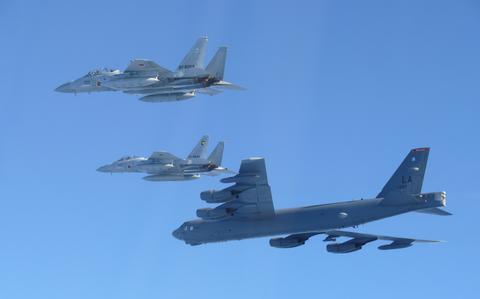
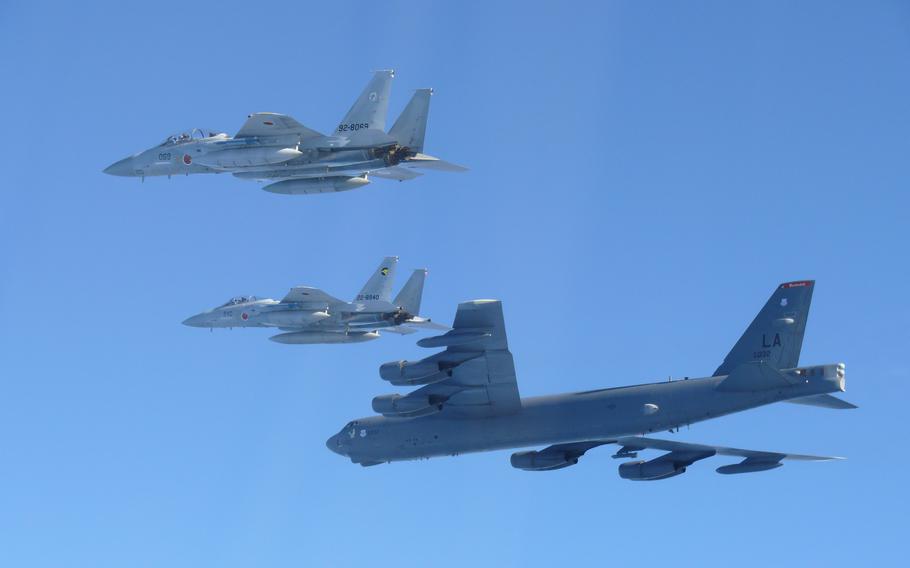
Japanese F-15s escort a U.S. Air Force B-52 Stratofortress over the Sea of Japan on Dec. 10, 2025. (Japan Joint Staff)
TOKYO — Japanese fighters and United States strategic bombers made a show of force together Wednesday, a day after 11 Chinese and Russian aircraft flew routes close to Japan and South Korea.
Japan also lodged “grave national security concerns” through diplomatic channels about ongoing activities around Japan by the Russian and Chinese militaries, including their Tuesday flights, according to Japan’s Chief Cabinet Secretary Minoru Kihara.
“We intend to continue to take all possible measures to ensure vigilance and surveillance and to take measures against airspace intrusions in order to resolutely protect our country’s land, waters, and airspace,” Kihara said at a news conference Wednesday.
The Japan Joint Staff posted photographs Thursday on social media platform X of Japanese F-15 Eagles in formation over the Sea of Japan with two U.S. B-52 Stratofortress bombers.
“[Japan Self-Defense Force] and the U.S. Armed Forces conducted a bilateral exercise amid an increasingly severe security environment surrounding Japan,” the joint staff said in the post.
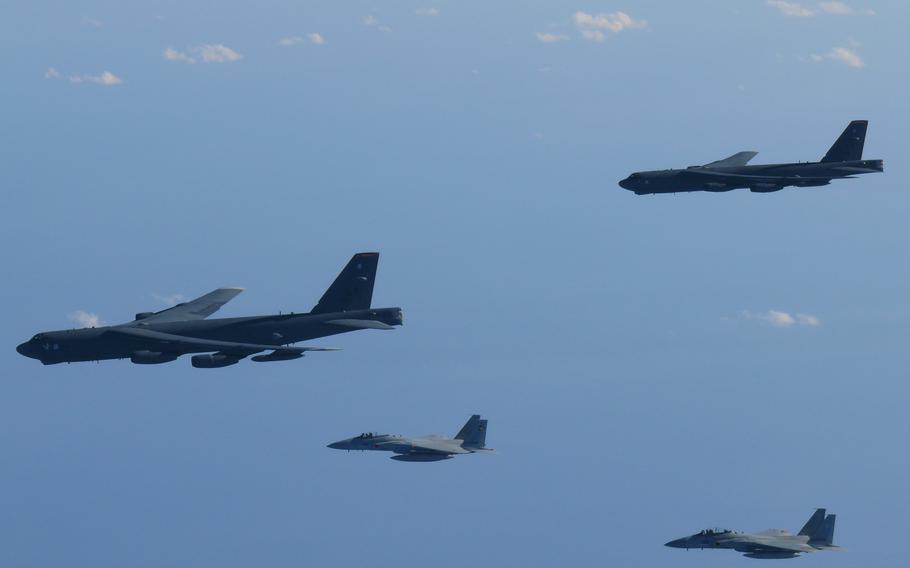
Japanese Self-Defense Force F-15s and U.S. Air Force B-52 Stratofortress bombers fly together over the Sea of Japan on Dec. 10, 2025. (Japan Joint Staff)
The Chinese aircraft carrier Liaoning, operating close to Okinawa since Dec. 5, had launched and recovered as many as 50 fighters Sunday, according to public broadcaster NHK on Monday.
Japan on Sunday alleged that a Chinese J-15 launched from the Liaoning intermittently locked radar on two Japan Air Self-Defense Force F-15s, which had scrambled in response to potential airspace violations near Okinawa.
The joint staff post on X about Wednesday’s airpower demonstration alluded to recent events.
“This bilateral exercise reaffirms the strong will between Japan and U.S. not to tolerate unilateral changes to the status quo by force,” it said.
Three F-35 Lightning II multirole fighters from Japan’s 3rd Air Wing and three F-15s from the 6th Air Wing took part, along with two B-52s, according to a news release Thursday from the joint staff.
The B-52s’ tail markings indicate their home station is Barksdale Air Force Base, La.
Chinese and Russian fighters and bombers on Tuesday flew past Okinawa and around the southern end of Japan.
China’s Ministry of National Defense described the joint patrol as part of the two militaries’ annual cooperation plan, according to the ministry.
Both Japan and South Korea scrambled fighters to keep watch on the Russians and Chinese.
South Korea alleged the combined patrol entered the Korean Air Defense and Identification Zone. Neither Japan nor South Korea alleged violations of their territorial airspace.
Japan tracked two Russian Tu-95 Tupolev bombers, an A-50 early warning aircraft and two Su-30 fighters, according to a joint staff news release Tuesday.
The A-50 and Su-30s flew a box in the Sea of Japan while the bombers flew south and rendezvoused with two Chinese H-6 bombers and four Chinese J-16 fighters, according to the joint staff.
The group continued through the Miyako Strait, after which the fighters doubled back and the bombers continued northeast to a point opposite Kyushu, the southernmost main island of Japan. They returned on the same route, according to the joint staff.
South Korea on Wednesday protested the flights to the two countries’ military attaches in Seoul.
U.S. Forces Japan referred questions Thursday to Pacific Air Forces in Honolulu, which did not respond immediately to an email from Stars and Stripes.
B-52s have made routine appearances in the Pacific as bomber task forces, an Air Force strategy to deliver air power over long distances anywhere on the globe. In July, two B-52s were escorted by South Korean and Japanese fighters during an airpower demonstration off the Korean Peninsula.