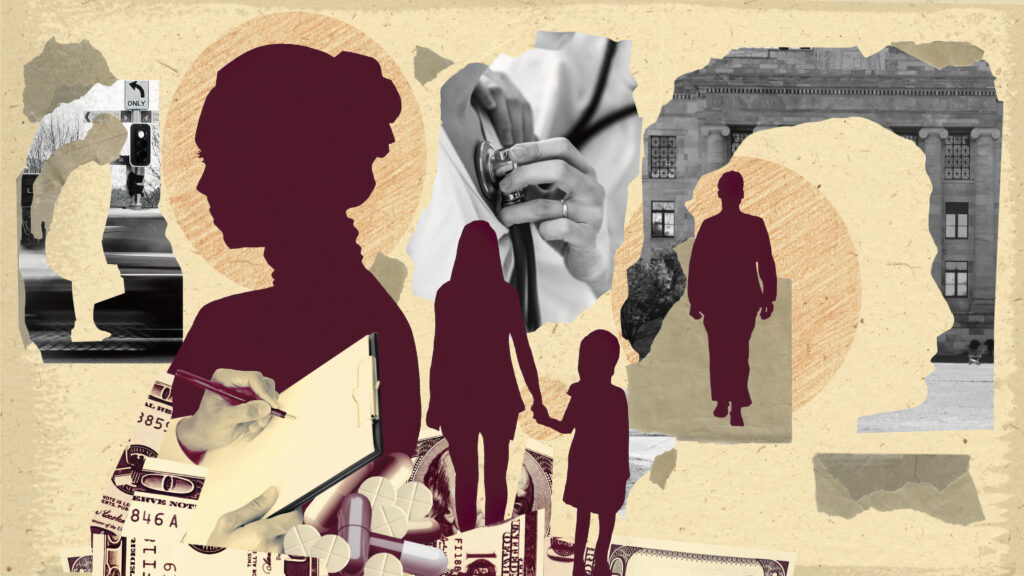
Over the course of 2025, STAT interviewed scientists, patients, university administrators, federal health workers, and others whose lives were disrupted by the Trump administration’s spending cuts, frozen and terminated grants, layoffs, and more. They included a young researcher suddenly worried about finding a job, a cancer patient confronted with a treatment delay, an Air Force veteran who’d lost her position at the Food and Drug Administration, and an epidemiologist who began tracking National Institutes of Health grant terminations, only to have his own funding cut.
We caught up with them in recent weeks to hear what has happened since we last spoke. Here are their stories.
Let go by the FDA, a veteran found another way to help
In the lead-up to losing her federal job on April 1, Karen Hollitt started feeling her PTSD symptoms creeping back. She’d enlisted in the Air Force at 17, and long before she got anywhere near a war zone, another trainee raped her in her dorm room. After years of therapy and medication, she’d moved on from both, only to feel her mental health slipping at the threat of losing her livelihood. Then, it happened.
Snagging a new job wasn’t easy — but eventually, she found one, as a trainer for a credit union that serves military families. She loves the workplace culture, the diversity, the fact that she gets to help active-duty military members, veterans, and their families. The one downside is a salary nearly half of what she was making at the FDA. She had to move into a one-bedroom; when her kids are with her rather than her ex, she and her 9-year-old share a room. Still, Hollitt feels fortunate: By her count, of the eight people who’d worked in her office at the FDA, only she and one other have managed to find a job.
— Eric Boodman
Epidemiologist leaves Harvard but keeps eye on threats to science
A lawyer by training, when Scott Delaney began watching the sweeping, haphazard termination of NIH research projects, he knew having a rigorous accounting of what had been lost would be necessary — for the historical record as well as for any lawsuits that would be filed. As an epidemiologist at Harvard, he was caught up in the wave of grant cuts. Now it’s cost him his job.
More in American Science, Shattered
A judge eventually overturned the terminations at Harvard, but Delaney had already been notified that he was set to be laid off, and he decided to leave so that he could focus on Grant Witness, the database he and another scientist had built into an authoritative public accounting of cancelled NIH grants. He secured private funding to keep it going, and started a consulting business with three colleagues, two of whom worked at the Environmental Protection Agency, to do work on health disparities related to the environment.
“I’m excited that Grant Witness found a way to stay in the fight. The threat to American science, the threat to public health, the threat to environmental science remains,” he said. “I know I can advocate for that science better by investing in Grant Witness than I can as a research scientist at Harvard.”
— Anil Oza
She persisted in her optimism, despite cancer and red tape
Brooke Kajdy seemed always optimistic. She received an experimental treatment early this year for her cancer, stage 4 diffuse large B cell lymphoma. She was originally going to get the therapy through a clinical trial at the NIH, but the start kept getting delayed, in part because Trump’s executive order on “defending women from gender ideology” meant some trial language had to be updated. Her physician in Alberta, Canada, where she lived, eventually found a way to get her the drugs off-label.
Kajdy, a 24-year-old mother of two, told STAT in April she was hopeful about the treatment, and that she felt it was working. Her voice was bright as she recalled speaking with other patients who had received the same treatment and were in remission. “I’m feeling very good,” she said in April while receiving her second round of the drugs. “Two lumps, one on my chest, one on my side, and they’re shrinking.”
But the response didn’t last. Kajdy later went on another clinical trial, a CAR-T therapy, in June. That also didn’t provide her with a lasting remission, and the cancer continued progressing. Kajdy and her husband, Gabe, began looking for more options. “We tried looking in America, but they had nothing,” he told STAT. The couple also sought out options in Mexico and Germany, but Gabe said that Kajdy had become too sick to travel. It seemed they had run out of options, he said, and the doctors shifted to keeping her comfortable. She passed away on Sept. 19, 2025.
“She loved her kids and family more than anything, and even in her last couple days, she smiled and never accepted defeat,” her husband said.
— Angus Chen
University administrator feels constant threat of federal cuts
For Andrew Read, rest is a distant memory, vacation a fleeting illusion — work even followed him to New Zealand for his mother’s 90th birthday. Pennsylvania State University’s senior vice president for research still struggles to understand the administration’s vision for American science. Uncertainty, including the still-looming threat of research overhead payment cuts, he said, is “a huge wet blanket,” leading to a hiring freeze on research administration staff and stalled investments in quantum computing and semiconductors. One silver lining: Penn State’s NIH funding rose from $165 million to $182 million between the 2024 and 2025 fiscal years.
— Jonathan Wosen
After leaving the NIH in protest, he’s still looking for the next right thing
Leading efforts to translate research into treatments at the NIH had felt, for physician Josh Fessel, like the way he could help the most people. But a month into the second Trump administration, he walked away “on moral grounds,” fed up with canceled grants and the firing of colleagues, and unwilling to carry out a directive he found repugnant.

He’s at peace with his decision, but the one thing he wishes he could have prepared himself for was how difficult it would be to find another job as satisfying. “It is unquestionably the most difficult job market by many measures” that he has seen in his career, he said, adding that he feels he is losing the sense of purpose that drove him all of those years at the NIH.
Plan A was to go into pharma; as a former academic, it was the part of the research ecosystem he had yet to work in. But he’s still looking, and has had to expand the kinds of positions he’s considering. “I wanted to broaden my skill set,” he said, so that he can return to the federal government or public-private partnerships to be a “maximally effective part of the repair and rebuild effort” at NIH.
— Anil Oza
A postdoc’s liftoff was aborted. But he’s found his own momentum
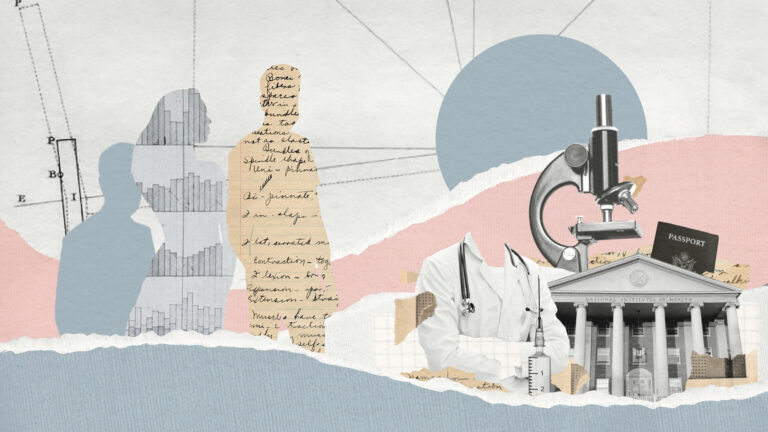
Sam Degregori saw his future thrown into disarray when the NIH abruptly terminated his postdoctoral grant program earlier this year. The program, called the Institutional Research and Academic Career Development Awards, or IRACDA, provided funding and training to help guide postdocs like Degregori on a path towards professorships. When IRACDA got cut, Degregori started scrambling for ways to preserve his dream.
“Since then, I have been applying to fellowships nonstop,” he said in a recent interview.
Early-career trans researchers reconsider their futures amid lost funding and fear
He had some luck, he told STAT. Certain IRACDA grants were also reinstated due to the outcomes of two lawsuits against the Trump administration. Programs will not continue after their funding cycle ends, however. For the University of California, San Diego, where Degregori works, that means the IRACDA program will continue to support postdocs until next summer.
Degregori has persisted, though. He received a Hartwell Foundation Fellowship that will provide him with funding for the next two years. He’s also applying to faculty positions, though the competition is stiffer than ever. “Now it’s like, if there’s one opening, everyone knows about it,” he said. “I feel very scared, entering the job market at the worst public time as a scientist.”
On the other hand, Degregori said, the past year has also been fuel for his science. “I feel this new energy like, by doing my job I’m fighting back somehow,” he said. “And that feels good, in a weird way, it’s making me more productive and doing more science now.”
— Angus Chen