2025 CHRISTMAS CAMPAIGN
Help Aleteia continue its mission by making a tax-deductible donation.
In this way, Aleteia’s future will be yours as well.
The topic of Marian devotion has returned to the forefront of the Church in recent months, driven by a series of clarifications. On November 4, the dicastery for the Doctrine of the Faith (formerly CDF) published the doctrinal note Mater Populi Fidelis (Mother of the Faithful People), clarifying certain titles attributed to the Virgin Mary — notably those of “Co-redemptrix” and “Mediatrix.”
This document clarifies the Church’s position on the status and role of Mary, recalling that according to the Catholic faith, “only God can bestow grace.”
Rome warns against any consideration of the Virgin that “distracts us from Christ or that places her on the same level as the Son of God.”
However, the goal of the document is not to “correct” the “piety of the faithful People of God,” but to “appreciate, admire, and encourage it,” the text states. Indeed, it emphasizes Mary’s special “cooperation” in Jesus’ work of salvation as a “spiritual motherhood” towards human beings.
Although its reception has been the subject of much discussion, Mater Populi Fidelis was not initiated by Leo XIV, since it was written during the pontificate of Francis. However, the text was approved by the new pope — and even, unusually, twice.
Cardinal Robert Prevost (the future Leo) approved the text as a cardinal member of the dicastery on March 26 — before Francis’ death — and then as pope on October 7.
Consistent with his past approach
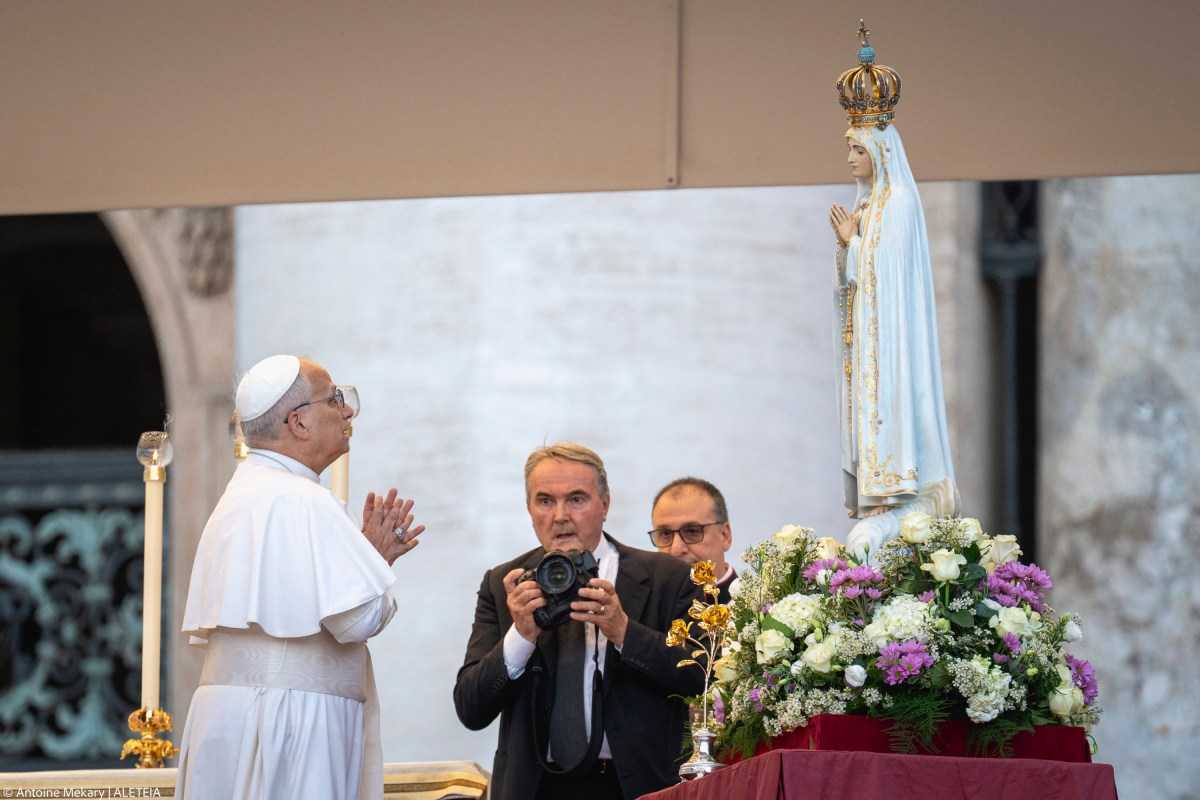
A few weeks before its publication, during the Holy Mass for the Jubilee of Marian Spirituality, dedicated to groups and movements attached to the Virgin Mary, the Pontiff commented that “Marian spirituality, which nourishes our faith, has Jesus as its center.” These words had the same tone as the later document.
In her book Leo XIV, portrait d’un pape péruvien (Leo XIV, Portrait of a Peruvian Pope, 2025, Fayard), theologian Véronique Lecaros testifies to the “very pragmatic attitude” that Father Robert Francis Prevost adopted towards the alleged visions and messages from the afterlife when he was a missionary in Peru. According to one of his close associates, César Piscoya, the Augustinian warned: “Think that 103 times these visions come from the imagination. It’s possible that the 104th time, it’s an inspired message … “
Series of yeses or nos
Other clarifying documents have been published by the Vatican in recent weeks. On July 9, the DDF granted its nihil obstat to the Marian apparitions on Mount Zvir in Slovakia, while warning against certain ambiguous messages attributed to the mother of Jesus. On November 12, the “Guardian of Dogma” decreed that the phenomenon of the alleged apparitions in Dozulé, Normandy, “must be considered, definitively, as non-supernatural.”
Again, these verdicts are nothing new. In May 2024, under Pope Francis’ pontificate, a new method of evaluating mystical phenomena was introduced.
These standards established a scale of six “levels” of assessment, allowing both positive and negative aspects of the same phenomenon to be highlighted. The study of these cases is therefore continuing under the pontificate of his successor.
A papal coat of arms with the Marian lily
From the very beginning of his pontificate, Pope Leo XIV expressed his personal affection for the Virgin Mary. Greeting the crowd from the balcony of St. Peter’s Basilica, just after his election, the new pope emphasized that May 8 marked the day of the Supplication to Our Lady of Pompeii. “Our Mother Mary always wants to walk at our side, to remain close to us, to help us with her intercession and her love,” he said before inviting the faithful to pray a Hail Mary.
In her book, Véronique Lecaros comments on the choice of the papal coat of arms—the same as Robert Prevost’s episcopal coat of arms—which features the characteristic symbols of the Augustinians, notably the fleur-de-lis, “the Marian symbol par excellence.” “Marian devotion, in a sapiential and meditative form, fits well with the spirituality of the Augustinians and also represents a personal dimension of Leo XIV,” she writes.
The day after his election, Pope Leo XIV’s first trip outside Rome also had a Marian theme: he went to Genazzano to pray at the Shrine of Our Lady of Good Counsel, which was founded in the 15th century by an Augustinian nun, Blessed Petruccia.
God’s tenderness
During the jubilee of Marian spirituality, the successor of Peter declared that “authentic Marian spirituality brings God’s tenderness, his way of ‘being a mother,’ to light in the Church.” “Marian spirituality immerses us in the history upon which heaven opened. It helps us to see the proud being scattered in their conceit, the mighty being cast down from their thrones and the rich being sent away empty-handed,” he added, elaborating on the themes of the Magnificat.
At the end of the celebration, Leo XIV recited a prayer to the Immaculate Heart of Mary, presenting her as “the perfect disciple of the Lord” and entrusting to her “the whole world and all humanity.” “Mother of the Church, welcome us with kindness, so that under your mantle we may find refuge and be sustained by your maternal help in the trials of life,” he pleaded.
Support Aleteia’s mission with your donation