– Advertisement –
Nigeria’s total public debt was estimated to be N144.67 trillion as of the fourth quarter of 2024, a figure that many experts blamed for preventing governments at both the national and sub-national levels from investing in critical climate infrastructure and demanding accountability in borrowing practices to address the issue.
On Tuesday, December 9, 2025, at an event hosted by the Centre for Inclusive Social Development (CISD) in partnership with the Heinrich Böll Foundation (HBF) in Abuja, the stakeholders bemoaned the fact that persistent borrowing puts government instruments at risk.
They contended that, even in cases where governments must borrow, these funds should only be used to finance revenue-generating, self-liquidating, and vital infrastructure projects with clearly defined economic returns.
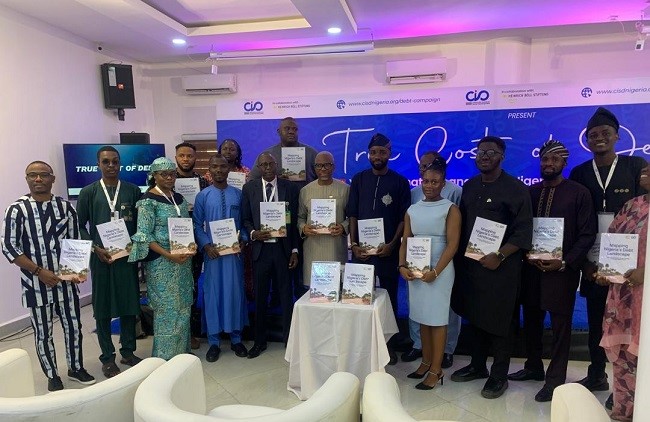 Participants at the launch of the Mapping Nigeria’s Debt Landscape: A Burden on Youth, Climate Change & National Development report in Abuja, Nigeria’s capital.
“The true cost of debts is the out-of-school child, the out-of-school girl, and that woman who has to do business and loses her life because of lack of access to basic maternal health care,” Folahan Johnson, the Executive Director of CISD, said.
Johnson evoked empathy during his speech on the event’s theme, “Youth, Climate Change, and Nigeria’s Development Crisis”, when he described the participants as elites, who represent hope for vulnerable climate victims.
He claims that the burden of debt acts as a deferred tax on women and young people, especially girls who have a higher school dropout rate because of rising costs or a lack of basic amenities. It also restricts the government’s ability to create an environment that is conducive to the growth of the private sector, denying the youth access to good jobs and limiting their long-term economic prospects.
In a similar vein, HBF’s Programme Manager, Donald Ofoegbu, highlights the significance of addressing the country’s debt situation and stresses the repercussions for those who are most at risk if the necessary action is not taken.
Ofoegbu went on to decry the high interest rate on debt and the lack of accountability and called on citizens to demand transparency in the management of public finances.
He linked the debt issue to climate disasters like the floods that affected more than 33 states across Nigeria some years back and destroyed vital national infrastructures worth over $9.12 billion.
“Nobody is coming to save Nigeria except us. This is where we belong. This is our home. And we’re going to fix Nigeria by repair or whatever means,” he stated.
Mr. Joseph Amenaghawon, BudgIT’s Acting Country Director, complained that borrowing was not translating into development.
“The result is debt without development, leading to a cycle where the burden grows but the benefits do not,” he asserts.
According to him, loans were being used for recurrent spending rather than transformative projects, thereby excluding the role of youngsters in the climate dialogue.
“Borrowing should build infrastructures at rising rates, systems of high use, climate-resilient communities, and a diversified and productive economy,” he noted.
The development expert submitted that a generation borrowed but did not invest, and for every loan that remains unaccounted for, a potential generation of youth is left behind.
Some of the major highlights of the event include two panel sessions and the release of a report on “Mapping Nigeria’s Debt Landscape: A Burden on Youth, Climate Change & National Development”.
The report proposed as the way forward that addressing the crisis requires immediate, decisive action in enforcing strict fiscal discipline and implementing aggressive and efficient revenue mobilisation, as well as ensuring transparency and accountability in borrowing practices.
By Etta Michael Bisong, Abuja