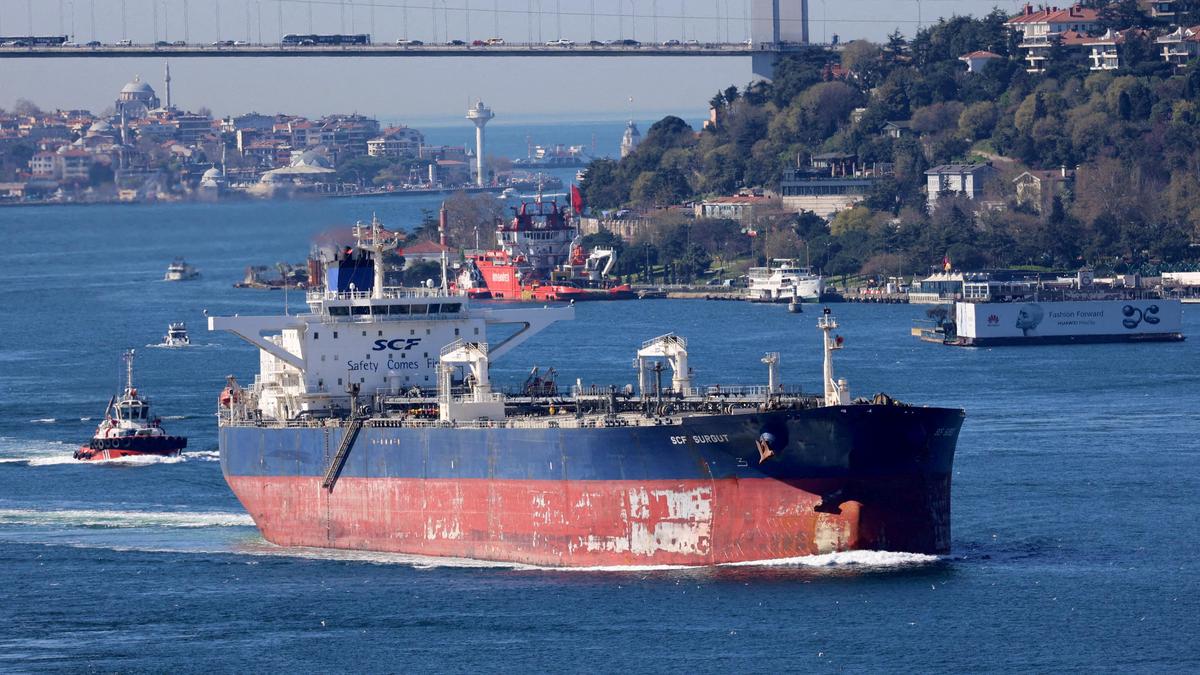

India imports for nearly 89% of its domestic crude oil requirements.
| Photo Credit: YORUK ISIK
The Ministry of Petroleum and Natural Gas (MoPNG) should work closely with the Ministry of External Affairs (MEA), and other concerned government agencies, to strengthen diplomatic engagement with oil-producing countries, secure favourable investment terms and address tax and regulatory hurdles faced by public-sector enterprises (PSEs) abroad, the parliamentary committee on public undertakings (2025-26) stated in their latest report tabled Wednesday.
Stressing on the need for diversification of crude oil sources, the committee observed notwithstanding proactive efforts being made in this regard, challenges persist due to sanctions, financial market volatility, and regulatory changes in host countries where overseas projects are located. “These issues not only affect India’s energy import bill but also impede the ability of CPSUs to secure overseas exploration and production assets, thereby limiting long-term energy security,” it noted.
According to the committee headed by member of parliament from Kendrapara (Odisha) Baijayant Panda, India imports for nearly 89% of its domestic crude oil requirements. In this context, it observed, “Recent global events, including the Russia-Ukraine conflict and tensions in the Middle East, have underscored the vulnerability of India’s energy supply chain and its dependence on international trade flows.”
To this effect, it recommended intensifying efforts towards diversification of sources both “geographically and contractually”, risk management practices as hedging and flexible term contracts and enhancing alternate import routes, among other suggestions.
‘Optimising capex investments and enhancing efficiency’
Additionally, the committee in their review also recommended that capital expenditure (capex) allocations must be closely linked to “measurable production enhancement outcomes”. This could be attained by means of accelerated development of newly discovered fields, wider adoption of enhance oil recovery (EOR) techniques and efficiently maintaining existing assets.
The committee observed capex expenditures by state-owned petroleum and natural gas companies, increased from more than ₹1.33 lakh crore (2020-21) to approximately ₹1.70 lakh crore projected for 2024-25. Although, crude oil production declined from 34.2 million metric tons (MMT) in 2018-19 to a projected 28.7 MMT projected for 2024-25. Natural gas output has shown “modest growth” during the same period.
Addressing ageing fields
The committee also observed that a “significant portion” of domestic oil production is derived from ageing fields which have entered “natural decline phase despite heavy investments”. The committee, whilst acknowledging efforts of state-owned upstream major (Oil India and ONGC) to lift production, sought they further expedite field development activities and prioritise exploration in frontier basins, among other things.
“The committee emphasise that with sustained investments, systematic reservoir management, and global technology tie-ups, India’s upstream oil and gas sector should aim to reverse declining trends and increase domestic production in the medium to long term,” it noted.
Published – December 11, 2025 09:06 pm IST