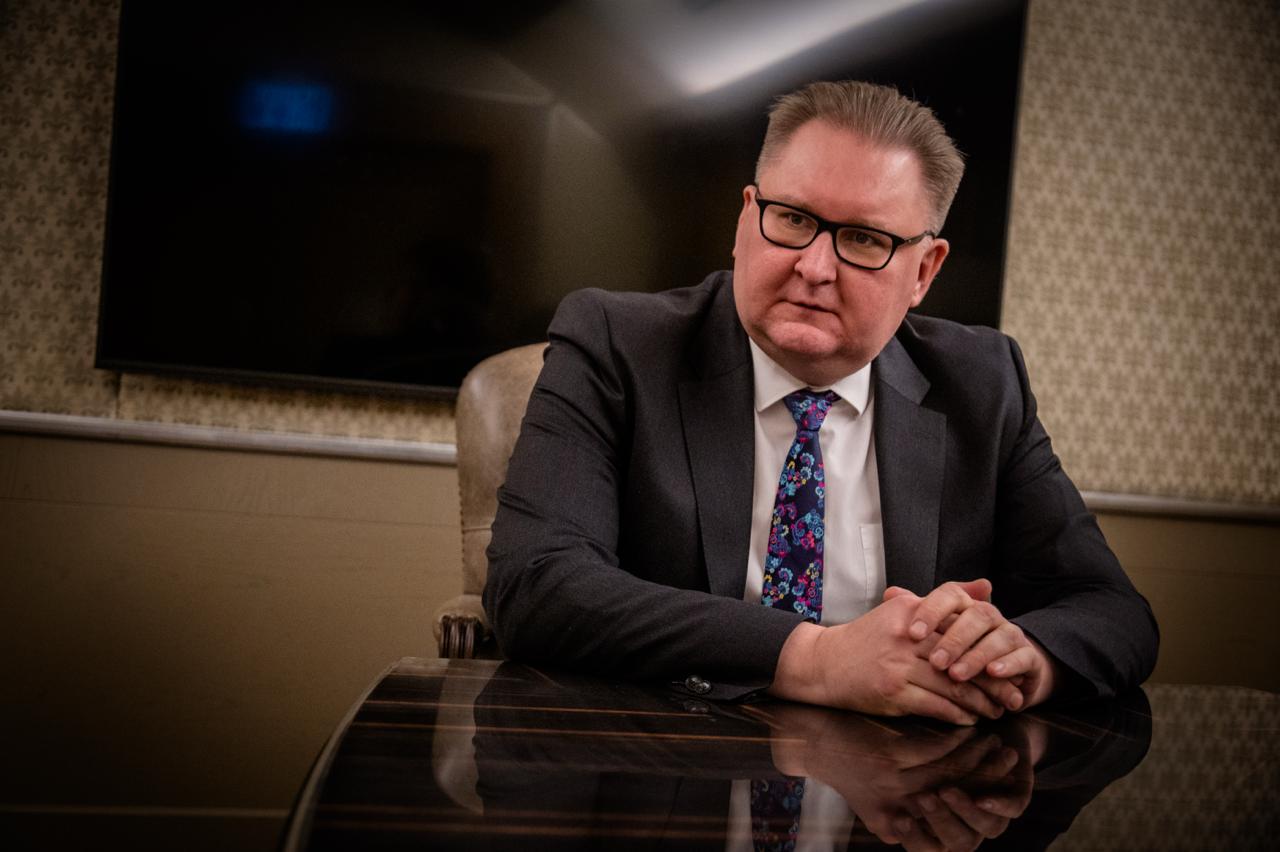
Changing its tone after years of frustration over Jerusalem’s stance on the war with Russia, Ukraine is warming to Israel, and looking to it as a model for navigating US pressure to sue for peace with a recalcitrant enemy.
Visiting Jerusalem last week, Deputy Prime Minister Taras Kachka told The Times of Israel that he was satisfied with bilateral ties of late.
Still, a few days later, Prime Minister Benjamin Netanyahu boasted of his relationship with Russian President Vladimir Putin, sparking a short-lived diplomatic kerfuffle and demonstrating the persisting challenges the relationship continues to navigate.
Kachka was the most senior Ukrainian official to visit Israel since the war broke out. He was leading a delegation to convene the first meeting of the Israel–Ukraine Intergovernmental Economic Commission since 2021.
“It’s a good sign of really good cooperation between our governments,” said Kachka.
Ukraine is looking to expand Israel’s humanitarian support to frontline municipalities and the rehabilitation of soldiers and civilians injured in the war, he said. The two countries are also discussing water and food technology, cooperation energy and cyber protection as well.
Military support is being discussed between the two defense establishments and political leadership, he said.
“We are looking for greater support and we are ready for greater support to Israel as well,” said Kachka.
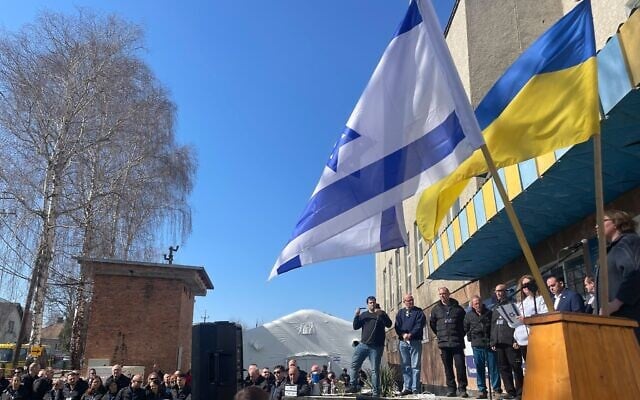
A ceremony to open an Israeli field hospital in Mostyska, Ukraine, on March 22, 2022 (Carrie Keller-Lynn/Times of Israel)
He indicated that Ukraine would also vote with Israel more in international forums like the United Nations: “We have more and more topics where we have a common understanding. I think that there will be more and more understanding between us in our voting as well.”
While providing humanitarian aid to Ukraine, Jerusalem has pursued a relatively restrained response to the 2022 invasion of Ukraine due to Russia’s widespread military presence in Syria, Israel’s northern bellicose neighbor, and has sought to balance security interests at home and policy abroad while maintaining relations with both Moscow and Kyiv. However, with the fall of the Russia-allied Bashar Assad regime in Syria last year, a moderate warming of ties between Kyiv and Jerusalem has taken place.
It is now expanding.
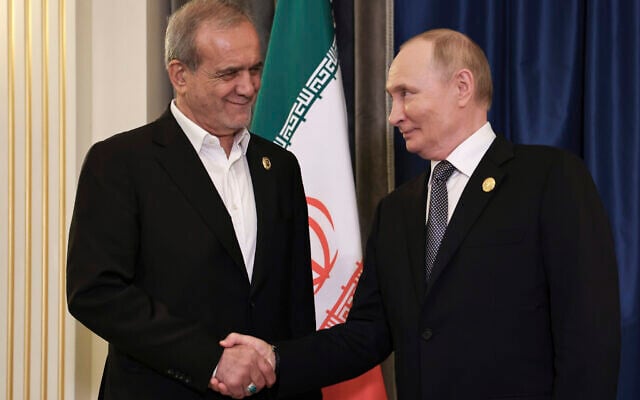
Iranian President Masoud Pezeshkian, left, and Russian President Vladimir Putin, right, shake hands during their meeting on the sidelines of the Shanghai Cooperation Organisation summit in Tianjin, China, September 1, 2025. (Alexander Kazakov, Sputnik, Kremlin Pool Photo via AP)
Kachka stressed that Israel and Ukraine must work together against the common threat both countries face in Iran.
“Iran supports our enemy and supports aggression,” said Kachka. “That’s why for us it is important to understand how we can counteract together and how we can coordinate our efforts.”
Iran is avowedly committed to Israel’s destruction and backs many of the country’s most strident opponents, including an axis of proxies who attacked the Jewish state repeatedly during the Gaza war. Israel and Iran fought a direct war for nearly two weeks in June, setting back the Islamic Republic’s nuclear program.
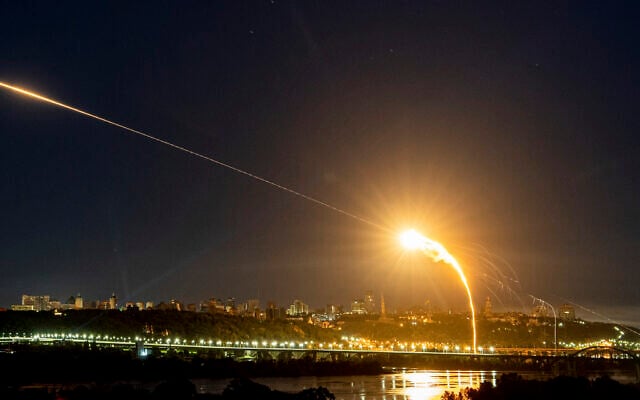
Ukrainian air defense intercepts an Iranian-made ‘Shahed’ drone mid-air in in Kyiv, Ukraine, May 30, 2023. (Evgeniy Maloletka/AP)
Tehran has also provided Moscow with hundreds of exploding drones for use on the battlefield in Ukraine and helped launch their production in Russia, according to Kyiv and Western intelligence. The Iranian drone deliveries, which Moscow and Tehran have denied, have allowed for barrages of long-range drone strikes on Ukraine’s infrastructure.
Russia and Iran signed a “comprehensive strategic partnership” treaty in January.
During Foreign Minister Gideon Sa’ar’s visit to Kyiv in July, he announced that Israel and Ukraine would launch a strategic dialogue on the Iranian threat.
“Iran not only threatened Israel,” said Sa’ar. “It threatened regional and global security. It threatened Ukraine. Our actions against its weapons and technology contribute to European security — and to the security of Ukraine.”
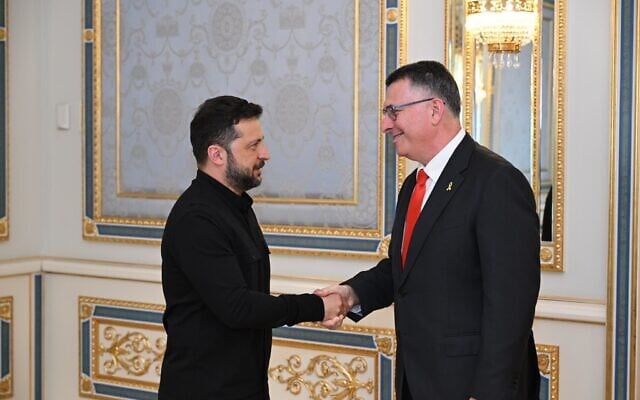
Foreign Minister Gideon Sa’ar (right) meets with Ukrainian President Volodymyr Zelensky in Kyiv on July 23, 2025. (Shlomi Amsalem/GPO)
Kachka said bilateral cooperation is “of utmost importance” to Ukraine, and called Iran’s support for Russia “absolutely unacceptable.”
The dialogue meeting is expected to take place “in several weeks,” according to Kachka, and will be headed by the foreign ministers of the two countries. There will be military representatives and other government agencies.
Despite the encouraging trends, there are ongoing strains in the bilateral relationship, including a marked lack of chemistry between Netanyahu and Ukrainian President Volodymyr Zelensky.
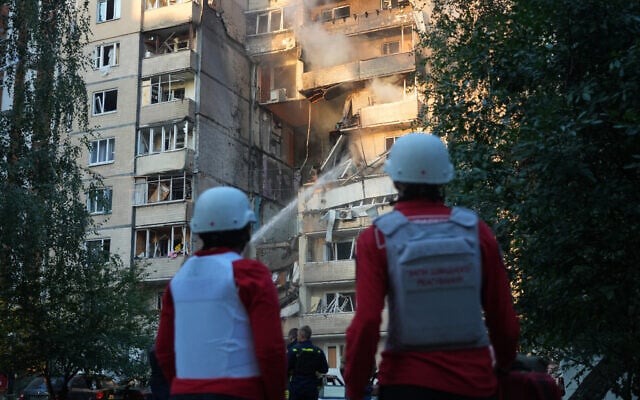
Firefighters work to extinguish a fire as paramedics stand in front of a heavily damaged residential building following Russian drone and missile strike in Kyiv on September 7, 2025, amid the Russian invasion of Ukraine. (OLEKSII FILIPPOV / AFP)
It’s been almost a year since the two leaders last spoke by phone in January.
“I think that the interest to meet is there,” insisted Kachka. “I don’t know whether it is scheduled or not, but it’s constantly on our radars. We discuss it, like with all ministers we met.”
Meanwhile, Netanyahu spoke on Monday of his close contacts with Putin, which he said were of strategic value for Israel.
“I speak with President Putin on a regular basis,” Netanyahu said in the Knesset, “and this personal relationship of many years serves our vital interests.”
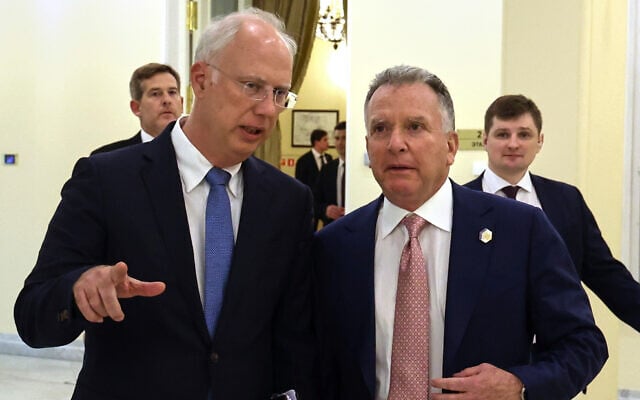
Russian President Vladimir Putin’s envoy Kirill Dmitriev, left, and US President Donald Trump’s special envoy Steve Witkoff attend talks in St. Petersburg, Russia, on April 11, 2025. (Vyacheslav Prokofyev, Sputnik, Kremlin Pool Photo via AP)
Ukrainian Ambassador to Israel Yevgen Korniychuk hit back at the premier for appearing to back Putin, saying in an interview with Ynet that he “was surprised by Netanyahu’s remarks, especially considering what Israel endured on October 7. One must stand on the right, moral side of history.”
Korniychuk was summoned to the Foreign Ministry on Wednesday over his remarks. The ministry says in a statement that the envoy was summoned “for a reprimand meeting” with the deputy director general for Euro-Asia, Yuval Fuchs.
Fuchs “made clear to the ambassador that his comments were entirely unacceptable and deviated from diplomatic protocol. Moreover, the ambassador’s remarks ignore Israel’s clear position since the outbreak of the war in Ukraine – a position demonstrated, among other things, by Foreign Minister Gideon Sa’ar’s visit to Kyiv this year and Israel’s votes at the United Nations,” the statement continued.
Israeli guidance on US peace plans
Kachka’s visit came amid an intensive American push to end the fighting in Ukraine, but unlike his predecessor Joe Biden, the current US president is not seen as unequivocally supportive of Kyiv or willing to meet its defense needs indefinitely.
Last week, after a draft of a US peace plan that seemed to echo Russia’s stance leaked, Trump’s envoys met Putin for five hours in Moscow, then held talks in Miami with Ukraine’s senior negotiator.
Kachka said Kyiv broadly supports Trump’s efforts to broker an end to the war, but is wary of his insistence that Ukraine cede territory to Russia as part of a settlement.
“We are glad that we have constructive dialogue between Ukraine and the United States for finding the proper approach in all elements of peace solutions. But in any case, the core problem is Russia itself because Russia is aggressive and Russia can stop this aggression anytime. So that’s why what is important is to increase pressure on Russia.”
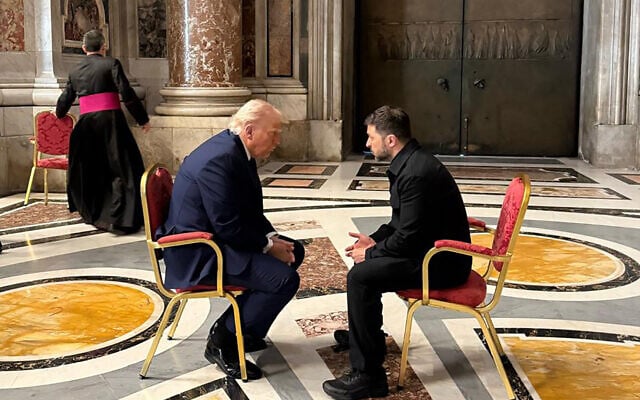
In this handout photograph taken and released by the Ukrainian Presidential Press Service on April 26, 2025, Ukraine’s President Volodymyr Zelenskyy (R) meets with US President Donald Trump (L) on the sidelines of Pope Francis’s funeral at St. Peter’s Basilica at the Vatican. (Handout / UKRAINIAN PRESIDENTIAL PRESS SERVICE / AFP)
He intimated that Israel could offer some insights into how to handle American — or perhaps Trump’s — pressure to accept a deal Ukraine wouldn’t approve otherwise.
“The closest example is Israel and the history of your settlement with neighbors,” said Kachka. “Since Israel and the US have a really strong bond and connections in all dimensions, the Israeli government can as well advise on what might be appropriate in this kind of plan. But the discussion is ongoing between the Ukrainian delegation and the United States.”
Trump was seen as instrumental in pushing Netanyahu to agree to a ceasefire in Gaza in October, a goal that the Israeli premier had resisted previously, absent the destruction of Hamas. Though shaped by interlocutors Egypt, Qatar and Turkey, the deal that emerged is widely seen as hewing closely to many Israeli demands.
Since Israel and the US have a really strong bond and connections in all dimensions, the Israeli government can as well advise on what might be appropriate in this kind of plans.
On the issue of recognizing Russian sovereignty over territory Moscow captured in the war, Kachka declared, “We’re never going to give up territory. So this is something that I think is clear and I think for Israelis it is a core topic. We are not going to give up on anything that belongs to Ukraine.”
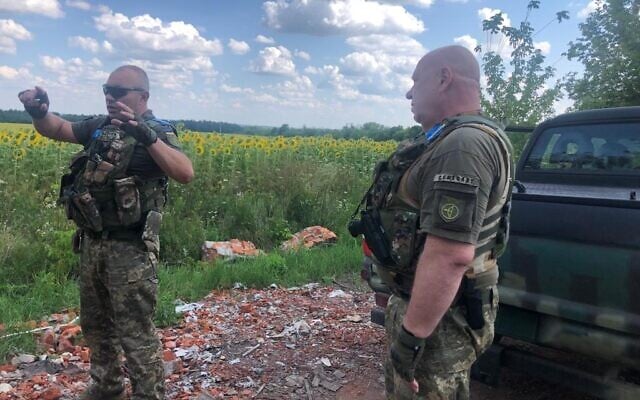
Members of the 128th Territorial Defense Brigade on the road to Eskhar, Ukraine, July 28, 2022 (Lazar Berman/The Times of Israel)
At the same time, he hinted that Ukraine would have to accept major concessions for peace, saying that the countries recognize “what could be the price of longstanding and just peace. We will see.”
But to get Russia to agree to end the war, he argued, it will take pressure, not gifts to Putin.
“We need more sanctions, we need more weapons to defend, we need more diplomatic pressure,” he said.
He drew a parallel between the ongoing threat that both Russia and Israel’s enemies pose to the two countries, noting the challenge of reaching an agreement that takes that into account.
A peace deal has to recognize that “Russia will not stop being an aggressor, whether in actual aggression or threatening of aggression,” said Kachka. “So it’s like Israel. You can have an active phase of war, or you can have sporadic attacks, but the hostile behavior toward Israel is not ending.”
Ukraine, like Israel, needs security guarantees, he stressed, including the ability to maintain a “strong and capable army to deter Russia.”
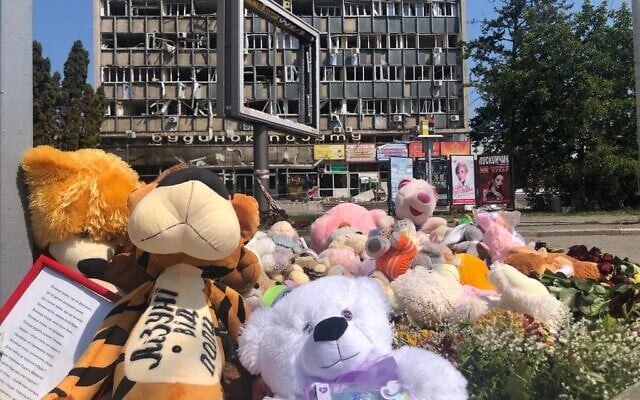
A makeshift memorial at the site of a deadly Russian rocket attack in Vinnytsia, Ukraine, July 2022 (Lazar Berman/The Times of Israel)
Ukrainians and their Western backers often describe an “Israel model” for their country’s future — armed and mobilized, as it simultaneously develops an advanced economy based on innovation and technology.
Kachka expressed a similar vision for Ukraine’s future: “I think that for a generation people will definitely need to maintain Ukraine properly defended for many years to come, before Russia will change its behavior and will become a peaceful neighbor.”
The nearly four years of war have taken their toll on the country, and on its Jewish community, whose prewar size was estimated to be at least 47,000.
Ukrainian Jewry managed to flourish despite multiple crises, including the 2014 Russian annexation of Crimea and the 2005 Orange Revolution, along with the political and financial instability it brought. Dozens of synagogues, mikvahs, Jewish schools and kindergartens opened in the past 30 years.

Rosh Hodesh (new month) prayers in Tsori Gilod Synagogue (also known as Beis Aharon V’Israel Synagogue) in Lviv, Ukraine, March 4, 2022. (Lazar Berman/Times of Israel)
But thousands of Jews fled the country during the war, many to Israel.
Kachka was optimistic about the future of the Jewish community in Ukraine.
“We have more Jews, more Jewish communities and synagogues in Ukraine than any of our neighbors,” he said. “We have a lot of politicians with Jewish origins as well as a lot of Israeli politicians having Ukrainian origin. So we have a lot in common and we have a lot of Jewish communities helping the Ukrainian army.
“The threat to all of us in Ukraine — Ukrainians, Jews, other nations — is Russian missiles and Russian soldiers that are killing us.”