
Support for the Center Party rose to 21 percent in December, its strongest showing since 2019 and driven by new gains among Estonian-speaking voters, Kantar Emor said.
The Center Party’s 21 percent support in Kantar Emor’s December survey marks its highest rating since just before the Riigikogu elections in March 2019.
While past gains largely came from non-Estonian-speaking respondents, backing among Estonian voters has also begun to rise since the party returned to power in Tallinn.
Isamaa still leads the monthly rankings at 24 percent, but the gap between the two parties has narrowed.
Kantar Emor survey chief Aivar Voog said the Center Party’s support “has begun to grow among Estonians.” He noted that the party polled at just 5 percent among ethnic Estonians a year ago, compared to 10 percent in the latest survey.
Voog also said the new coalition in Tallinn may be helping, as the alliance with Isamaa has made the Center Party more palatable to Estonians. He added that some of the party’s gains may have even come at Isamaa’s expense as the two parties’ voter bases have drawn closer.
The Social Democrats (SDE) followed in support with 15 percent, the Reform Party with 14 percent, and Conservative People’s Party of Estonia (EKRE) with 12 percent support.
The nonparliamentary Parempoolsed held sixth place at 9 percent.
All other parties, meanwhile, remained below the 5 percent election threshold: Eesti 200 at 3 percent; the nonparliamentary Estonian Nationalists and Conservatives (ERK) at 2 percent; and both the Estonian Greens and Koos, likewise nonparliamentary parties, at 1 percent each.
The combined rating of Estonia’s governing Reform-Eesti 200 coalition reached 16.3 percent in December.
In all, 25 percent of survey respondents indicated no party preference.
When counting respondents without a stated preference, Isamaa polled at 18 percent support in December, followed by the Center Party at 16 percent, the SDE at 11 percent, Reform at 10, EKRE at 9 and Parempoolsed at 7 percent.
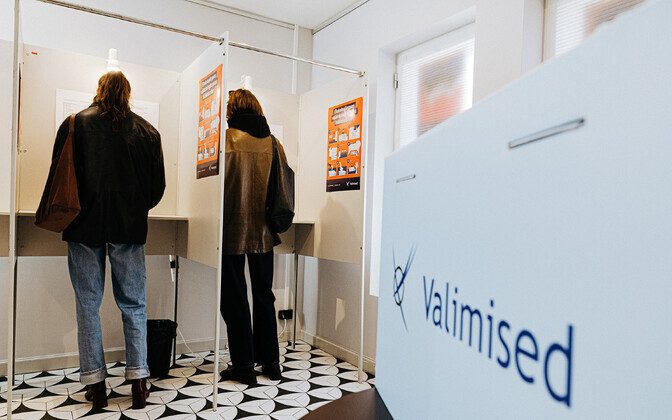 Voting in Nõmme, Tallinn, at the 2025 local elections, Sunday, October 19, 2025. Source: Priit Mürk/ERR
By ethnic group
Among Estonian respondents in October, Isamaa led with 27 percent, followed by the SDE at 17 percent, the Reform Party at 16 percent, EKRE at 14 percent, and both Parempoolsed and the Center Party at 10 percent. Eesti 200 drew 3 percent support.
Among non-Estonian respondents, the Center Party remained dominant with 73 percent support. Isamaa polled at 7 percent in this group, and Koos at 6 percent, while support for other major parties ranged from 2 to 4 percent.
By age group
Isamaa had previously led nearly all age groups, but December’s results were more mixed and left Isamaa the top choice in only one age group.
The Social Democrats were most popular among voters aged 18–24 (34 percent) and 25–34 (27 percent).
The Center Party led among voters 75 and older (25 percent) and in the 35–49 age group (26 percent).
Among those aged 50–64, support for Isamaa and the Center Party was even at 23 percent, while Isamaa led the 65–74 group with 25 percent support.
However, Isamaa ranked as the second-most popular option in the 18–24, 25–34, 35–49, and 75+ groups.
Changes since early 2025
Compared with the January survey, the Center Party posted the biggest rise of the year, climbing from 13 percent to 21 percent support.
Parempoolsed also edged up, with polled support increasing from 7 percent in January to 9 percent during each of the last three months.
Support for other parties remained steady or dipped slightly: Isamaa from 26 to 24, the Reform Party from 16 to 14, the Social Democrats from 16 to 15 and EKRE from 14 to 12, with Eesti 200 holding steady at 3.
From December 3–10, Kantar Emor surveyed 1,621 voting-age citizens nationwide from online and by phone. The margin of error is ±2 percentage points.
—