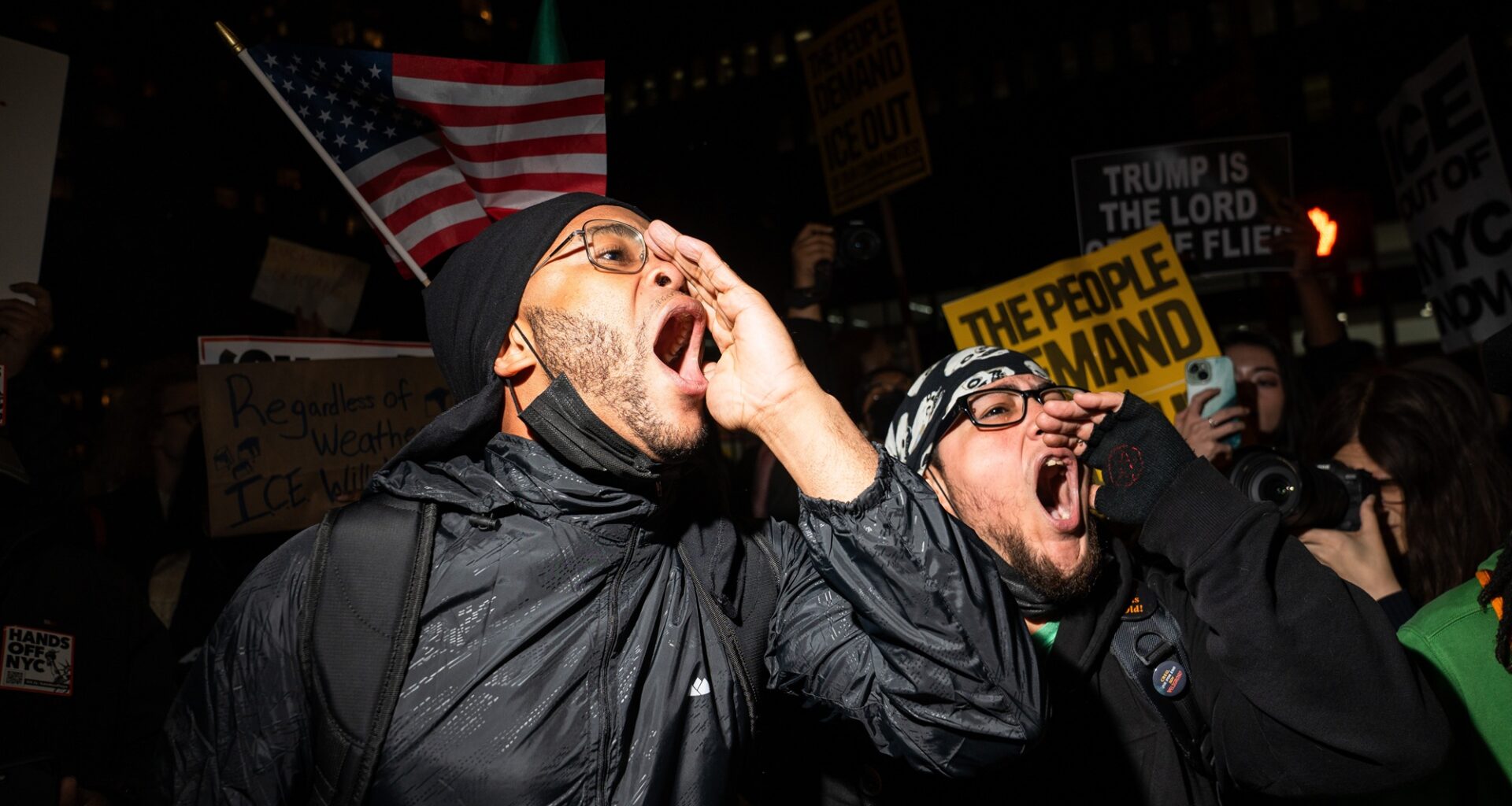
In broad daylight on October 21, amongst the hustle and bustle of Canal Street in New York City, more than 50 federal agents arrived, via military-style trucks and on foot. In moments, agents accosted and detained multiple street vendors, all of whom were of African descent. Nine immigrants hailing from various African countries were taken into ICE custody, the agency stated, in a “targeted, intelligence-driven enforcement operation … focused on criminal activity related to selling counterfeit goods.”
However, amid the flurry, federal agents also arrested several people who were either citizens, or possessed documentation of their legal immigration status. A video taken by an observer showed a Black man, who persistently says that he was born in New York, being forcibly detained by ICE agents.
Just weeks earlier, on the predominantly Black South Side of Chicago, locals were awoken in the middle of the night by the sound of a helicopter above their homes and multiple unmarked vehicles, including moving trucks packed to the brim with ICE agents. Reports detail armed men bursting into dozens of apartments in a complex that housed a mixture of Black U.S. citizens and migrants from Latin America, zip-tying men and women, and after sorting them by race, detaining them for hours in vans and on the sidewalk. Babies and children who were “nearly naked” were also zip-tied, as their parents received no information about the nature of the raid, or if they were free to go.
Both instances represent two key issues that have remained largely unrecognized in conversations about immigration in the U.S. First: The conception that immigrants hail mainly from Latin America and are the primary targets of immigration enforcement is false. Second: The persecution of undocumented immigrants has affected and will continue to affect U.S.-born individuals, particularly members of marginalized groups. It is not only Hispanic people with legal status who may be affected by immigration enforcement activity: Black people, regardless of immigration status, are vulnerable.
Policy conversations regarding the criminal justice system and the immigration system rarely intersect; Black immigrants are disproportionately impacted by both.
Black immigrants make up 5.4 percent of the undocumented population in the U.S, but they also constitute up to 20.3 percent of immigrants facing removal based on criminal convictions. What’s more, 76 percent of Black immigrants are deported due to contact with police, not immigration enforcement, according to a report by the Black Alliance for Just Immigration (BAJI).
These numbers are starkly similar to the rates of arrest and incarceration among Black Americans: As of 2020, the arrest rate was more than double that of white Americans, with around two million Black Americans being arrested on average every year. Consequently, Black immigrants remain constrained by a “double bind” of sorts: experiencing racist treatment espoused by the U.S.’s top two major legal systems.
NEARLY 4.4 MILLION BLACK NONCITIZENS live in the U.S., constituting around 20 percent of the country’s Black population. Black immigrants are not a monolith: 46 percent hail from the Caribbean, 42 percent from African countries, and 8 percent from South or Central America. Despite various levels of educational attainment, ethnic backgrounds, and wealth, all Black immigrants living in the U.S. experience the impact of anti-Black racism.
Policy conversations regarding the criminal justice system and the immigration system rarely intersect, which has muddled the understanding of how Black immigrants are disproportionately impacted by both. “Immigration is essentially about membership and belonging, and the way the U.S. has been built, has excluded people of African descent,” says Karla McKanders, the director of the Thurgood Marshall Institute.
It’s impossible to talk about citizenship without the context of race and the legacy of slavery. The Naturalization Act of 1790 (which was the first law to define who could be a citizen) restricted naturalization to “free white persons.” It wasn’t until 1868, when the 14th Amendment was ratified, that Black people were no longer considered three-fifths of a person and were given equal protections under the law.
Discrimination against Black people in immigration law is not a new occurrence under the Trump administration, but it certainly has been exacerbated by recent political changes. This September, in Noem v. Perdomo, the Supreme Court lifted restrictions that had previously stopped ICE from using factors such as race, ethnicity, and language as cause to detain individuals. This set a dangerous precedent: ICE agents are now legally permitted to use racial profiling, which affects more than just undocumented immigrants. All minorities, particularly those who are Hispanic and Black, now face higher risks of wrongful detention and possible deportation.
“You can’t really tell someone’s immigration status when you look at them, or even when they speak, and authorizing ICE to use broad, sweeping policies to pull someone over … leads to the prison-to-deportation pipeline,” says McKanders.
For many Black immigrants, the experience begins with something typical, such as a traffic stop. Black communities are disproportionately targeted in traffic stops, with research showing that Black drivers are pulled over more frequently, are more susceptible to searches, and are more likely to experience violence at the hands of police. “With this administration, you’ve seen the proliferation of 287(g) agreements,” says McKanders, referring to a partnership between ICE and state/local law enforcement, which enables local officers to engage in some immigration duties, such as identifying noncitizens with criminal convictions. Over 1,000 of these partnerships were recorded in 2025.
Therefore, individuals who are taken into custody for a minor infraction such as an unpaid parking ticket can suddenly find themselves facing the wrath of both the criminal justice system and immigration enforcement. Even if one has lawful permanent resident status, ICE can request that local police hold noncitizens for up to 48 hours, and people who have already been arrested can be questioned about their immigration status. From then onward, an individual who is found to be a noncitizen can either be transferred into ICE custody or funneled into the criminal legal system, and later face deportation.
We know that ICE faces pressure to meet quotas for daily arrests, and Black communities that are targeted by the criminal justice system are more likely to represent an opportunity for ICE to up their numbers.
RACISM RELATED TO MASS INCARCERATION goes beyond jails and prisons. Immigration detention centers have long remained a locale riddled with anti-Blackness. A 2022 report from Freedom for Immigrants (FFI) unearthed a disturbing tradition of abuse against Black migrants in private immigration detention centers, contracting jails, and government-run detention centers. At the time, Black migrants only accounted for 6 percent of the total ICE detention population, yet 28 percent of all abuse-related reports made to FFI came from this population. Black migrants also constituted 24 percent of all people in solitary confinement, which is similar to research that has shown that Black people are more likely to experience solitary confinement while incarcerated in prisons and jails.
Although there are considerable oversight issues in the criminal corrections system, the immigration detention network has practically no oversight at all. “In the immigrant detention system, since it’s not meant to be punitive, it’s just to hold people supposedly, there’s practically no standards or oversight over the implementation of standards,” says Valerie Lacarte, a senior policy analyst at the Migration Policy Institute. “It leads to very strange and poor outcomes for the people who are being held.”
Instances of severe human and civil rights violations are a dime a dozen in detention centers, at border crossings, and during ICE-facilitated transportation initiatives. Most recently, an Amnesty International report detailed use of the confinement box, a torture technique used during the so-called war on terror, at “Alligator Alcatraz,” the since-shuttered Florida detention facility that Homeland Security Secretary Kristi Noem has called a model for the nation.
Although noncitizens from all backgrounds can be, and are, affected by the violent and inhumane characteristics of ICE activity, Black people experience the disproportionate brunt of this activity. “The immigration prison system was created for Black people,” says Guerline Jozef, co-founder and executive director of the Haitian Bridge Alliance. “It is also a mirror of the realities of the prison-industrial complex in general in the U.S. that was created to incarcerate newly freed Black people.”
Some of the Trump administration’s most highly publicized targets for detention and deportation are immigrants who are racialized as Black. During his presidential debate with former Vice President Kamala Harris, Trump claimed baselessly that Haitian immigrants “are eating the pets of people that live” in Springfield, Ohio. Even though city officials and residents repeatedly refuted the story, bomb threats were called in so frequently that schools, City Hall, and a motor vehicles office were forced to close. Trump never apologized for his rumormongering, and shortly after his return to the White House, revoked Temporary Protected Status for thousands of Haitians (among other immigrants from countries in crisis).
After two National Guard members were shot in Washington, D.C., by an Afghan national, the Department of Homeland Security announced that there would be a pause on reviewing all pending applications for citizenship, green cards, and asylum from 19 countries. Over the summer, Trump had announced a travel ban that impacted those very same countries, ten of which are located in Africa. All the while, Trump has kept on espousing relentless xenophobic and racist rhetoric against immigrants, and recently targeted Somali immigrants from the Oval Office, saying that the U.S. would “go the wrong way if we keep taking garbage into our country.”
Understanding that the struggles of Black immigrants and African Americans are inexplicably intertwined is essential, says Jozef. “Immigration is a Black issue, is a racial justice issue, is a social justice issue, is a civil rights issue, because when we are talking about Black America, we always find Black immigrants at the center of all the fights … Our history and our future are all interconnected.”
Recommended Reading