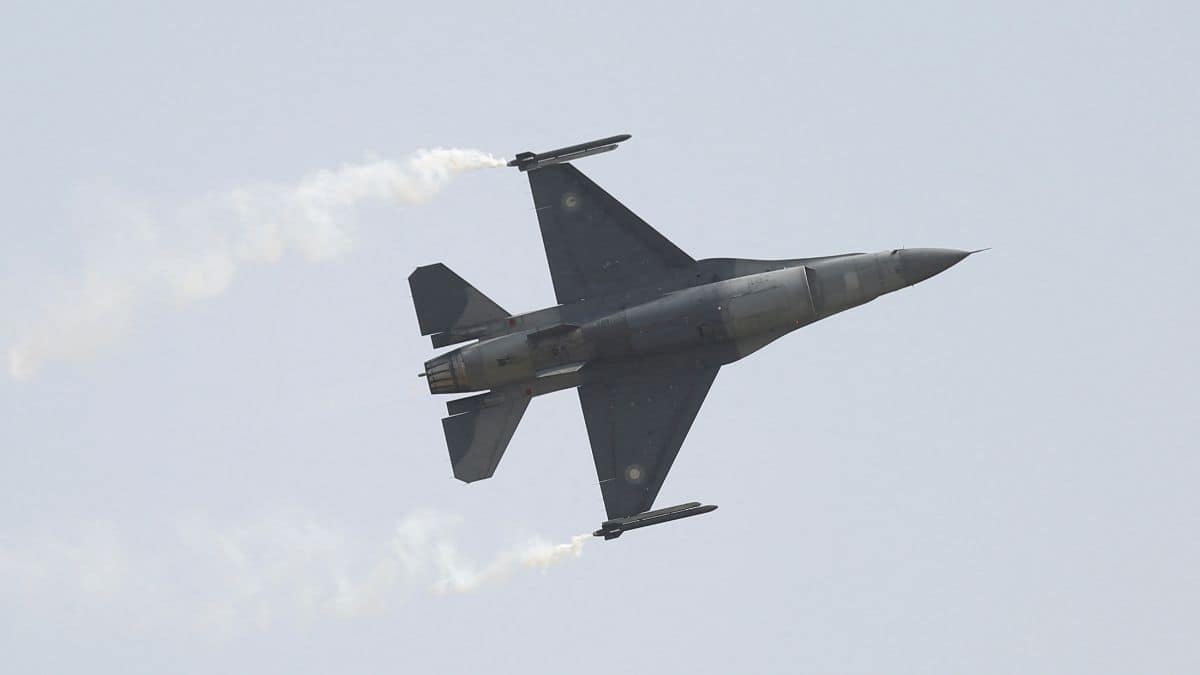
The United States has approved a $686-million package to upgrade Pakistan’s F-16 fighter jets. The latest deal is now before the US Congress, with lawmakers having 30 days for review and scrutiny.
The Defense Security Cooperation Agency (DSCA) sent a letter to the Congress earlier this month notifying of the sale of advanced technology and upgrades for Pakistan’s ageing F-16 fighter jet fleet. India will be closely watching the developments.
Here’s why.
What is the F-16?
The F-16 Fighting Falcon, or the Viper, is a single-engine aircraft manufactured by US defence and aerospace manufacturer Lockheed Martin. The aircraft has undergone several updates since it first flew in 1974.
The
F-16 jets are deployed for air-to-air combat and air-to-surface attack by the US and its allies.
As many as 29 countries are operating F-16 planes, according to Lockheed Martin’s website. These include the US, Pakistan, Ukraine, Turkiye, Israel, Egypt, Poland, Greece, Taiwan, Chile, Singapore, Belgium, Denmark, the Netherlands and Norway.
Pakistan reportedly has 70-80 working F-16s, including older but upgraded Block 15 models, former Jordanian F-16s, and newer Block 52+ models. These jets make up the core of the Pakistan Air Force’s multirole combat capabilities.
US deal for Pakistan’s F-16s
The Donald Trump administration has green-lit a $686 million sustainment and modernisation package for Pakistan’s F-16 fighter planes.
The US offer includes hardware and software updates, along with support services, and the Major Defence Equipment (MDE), which are key military items on the US munitions list.
The MDE list comprises 92 Link-16 systems and six Mk-82 inert 500-pound bombs.
The Link-16 is a secure military tactical data link network used for real-time communication between military aircraft, ships and ground forces.
The US has also okayed selling six Mk-82 inert 500-pound (226.8kg) general-purpose bomb bodies to Pakistan. These bombs, which are unguided training weapons, are deployed only for testing integration and release.
The US package also consists of Advanced Identification Friend or Foe (IFF) system, which enables pilots to differentiate between friendly and enemy aircraft; advanced avionics, cryptographic equipment; training; and full logistical support.
Pakistan has 70-80 F-16 fighter jets. File Photo/Reuters
The US will also provide navigation upgrades, simulators, spare parts and repairs to Pakistan.
The upgrades will be for Block 52 and Mid-Life Update F-16 variants to address”critical flight safety concerns” and increase their service life through 2040.
Speaking to Al Jazeera, Praveen Donthi, a senior analyst at the Brussels-based non-governmental organisation (NGO) International Crisis Group, said the approval is part of a 2022 maintenance deal, under which the US agreed to sustain Pakistan’s F-16 fleet.
“The F-16 deal remains a key part of the broader US-Pakistan bilateral relationship, which is why there has been continuity from President [Joe] Biden to President Trump, despite some delays. Both sides emphasise the fleet’s utility in joint counterterrorism operations in the region.”
Why India will be watching
The US has been increasingly leaning towards Pakistan since Trump returned to the White House in January.
The latest deal indicates the US’ continued support for Pakistan’s defence capabilities.
In February, the Trump administration approved a $397-million deal to maintain F-16 jets, citing counterterror measures.
Two months back, Washington approved the sale of 120 Advanced Medium-Range Air-to-Air Missiles (AMRAAM), which can be integrated with F-16s to provide more precise and longer-range engagement options.
The timing of the US’ nod for Pakistan’s F-16 upgrade has got India worried.
During
Operation Sindoor in May, Pakistan’s Air Vice Marshal Aurangzeb Ahmed said they deployed 42 “hi-tech aircraft”, including the F-16s, against India.
The latest deal has stirred concerns in New Delhi.
Former foreign secretary Kanwal Sibal wrote on X, “While China has long armed Pakistan against India, the US is now doing the same. This was expected after Trump’s close ties with Pakistan’s military leadership. We must carefully reassess our defence ties with the US in light of these developments”.
The development comes as the Trump administration is pushing India to buy more weapons from the US.
Michael Kugelman, a South Asia analyst based in Washington, DC, told Al Jazeera: “I wouldn’t overstate the India angle here. Certainly one may look at this deal as the latest attempt by Washington to use its largesse to Pakistan as a pressure point to get India to make more concessions to the US in trade talks.”
However, he said the deal “has a logic of its own that’s not tied to India”.
Recognising regional stabilities, the US has stressed that the package does not add new offensive capabilities. The DSCA said in its letter that “the proposed sale of this equipment and support will not alter the basic military balance in the region.”
While the current package does not include the sale of more weapons, such a deal cannot be ruled out in future.
With inputs from agencies
End of Article