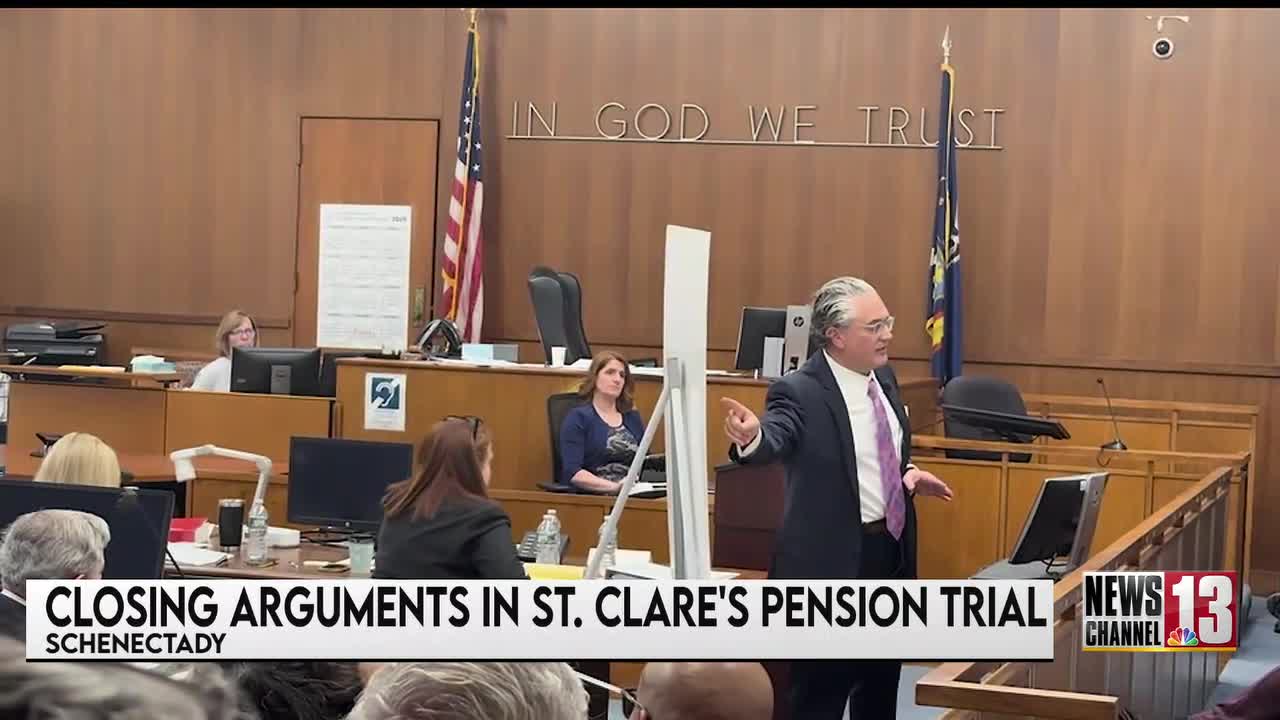
Closing argument’s take place in the fight of former St. Clare’s employees to get back their pensions.
SCHENECTADY, N.Y. – Closing arguments took place on Thursday in the weekslong trial of the former St. Clare’s employees fighting to get their pensions back.
The roughly 1,100 pensioners claim that the fund was mismanaged – before it ultimately collapsed in 2018. New York State Attorney General’s Office and the AARP Foundation brought the suit.
The defense attorneys argued that St. Clare’s was on shaky financial footing for many years before it ultimately closed in 2008.
Defense attorney Brian Whiteley said the hospital had trouble keeping staff and even keeping the lights on. The board was not putting required contributions into the plan.
Anthony Cardona, also arguing for the defense, said the problems existed long before Bishop Edward Scharfenberger took his position in 2014. Cardona laid the blame at the state’s Berger Commission. The commission’s report, released in late 2006, identified ways that improve efficiency in health care. They recommended that St. Clare’s Hospital and Ellis Hospital merge under a single governance structure.
RELATED: St. Clare’s pension trial starts today in Schenectady
RELATED: Court hearing held for former St. Clare’s employees fighting for pensions
RELATED: St. Clare’s pension case gets judge’s approval to continue
Cardona claimed that the Department of Health said it was not going to bail out St. Clare’s. It was going to be forced to merge with Ellis.
“The state – not a bishop – control this entire process. Everything that followed from that point forward – the financial collapse, the pension underfunding, the loss of contributions – flowed from that decision,” he said.
The hospital got state funding as part of the merger with Ellis. Prosecutors said that they asked the Department of Health for $28.5 million, which they knew was not enough to cover the complete pension fund deficit – which was more like $43 million by 2006.
St. Clare’s closed in 2008.
Monica Connell, which presented for the Attorney General’s Office, said that the St. Clare’s board had plenty of opportunity to reverse course when they knew the pension plan was sinking.
Prosecutors argued that then-Bishop Howard Hubbard and the hospital board of directors ignored the warning signs. They knew that the plan would not be fully funded.
Hubbard did not hold a board meeting from 2001 to 2005, according to the prosecution.
“He just simply didn’t pay attention. That’s a breach of duty,” Connell said.
In addition, Connell said that the hospital leadership and board at the time did not tell the pensioners that the plan was seriously underfunded or that they were considering changes.
“If the pensioners aren’t warned, they can’t take the alternate steps to plan for their future,” she said.
In addition, the pension company offered potential lifelines that the board ignored, according to Connell.
Closing arguments were still going on as of late Thursday afternoon. The jury may get the case on Friday.
Check back at NewsChannel 13 on air and online for updates.
For Related Stories: Trial St. Clare’s Hospital