From reproductive rights to climate change to Big Tech, The Independent is on the ground when the story is developing. Whether it’s investigating the financials of Elon Musk’s pro-Trump PAC or producing our latest documentary, ‘The A Word’, which shines a light on the American women fighting for reproductive rights, we know how important it is to parse out the facts from the messaging.
At such a critical moment in US history, we need reporters on the ground. Your donation allows us to keep sending journalists to speak to both sides of the story.
The Independent is trusted by Americans across the entire political spectrum. And unlike many other quality news outlets, we choose not to lock Americans out of our reporting and analysis with paywalls. We believe quality journalism should be available to everyone, paid for by those who can afford it.
Your support makes all the difference.
Read more
Japan was struck by a new 6.9-magnitude earthquake on Friday morning, hitting a similar area of the Pacific coast to Monday night’s powerful 7.5-magnitude tremor.
The new quake off Aomori prefecture triggered a fresh tsunami advisory from the Japan Meteorological Agency, which warned of the potential for 1 metre tsunami waves along much of the Pacific coast of Hokkaido, Aomori, Iwate and Miyagi prefectures.
That advisory was lifted around two hours later, but a number of communities along the coast were evacuated.
The extent of damage or injuries from the new quake wasn’t immediately clear.
Japan had earlier warned of possible aftershocks following Monday’s 7.5-magnitude tremor. Monday night’s earthquake injured at least 51 people and triggered widespread tsunami warnings, with waves of up to 70cm reported in several coastal communities.
On Tuesday, Japan’s weather agency issued its highest-level warning that a megaquake – an earthquake of magnitude 8 or higher – could follow Monday’s powerful tremor. The notice, which remains in place until 16 December, was the first time this top-tier alert has been issued since the warning system was launched in 2022.
Tohoku Electric Power Company reports that the Higashidori nuclear power plant in Aomori Prefecture and the Onagawa plant in Miyagi Prefecture are operating normally, with no abnormalities detected, NHK Japan reported.
Tokyo Electric Power Company confirmed that Fukushima Daiichi and Daini nuclear plants are stable, with radiation monitoring posts showing no unusual readings after this morning’s 6.7-magnitude earthquake.
Japan’s Nuclear Regulation Authority added that there are “no immediate signs of abnormalities” at nuclear facilities in the region affected by the quake.
Maroosha Muzaffar12 December 2025 11:45
The tsunami triggered by Monday night’s powerful 7.5-magnitude earthquake off Japan’s northeast coast could have caused significantly more damage if its largest wave had arrived at high tide, according to disaster researchers.
The biggest wave – a 70-centimetre surge recorded at Kuji port – reached the coast about 90 minutes after the first tsunami warning.
“It was lucky that the highest tsunami in the Monday quake came at low tide, which means that the tide level is 1.5 metres lower than at high tide,” Shunichi Koshimura, professor at Tohoku University’s International Research Institute of Disaster Science, told the local media.
He added that the timing reduced the risk of flooding. If the same wave had come at high tide, the impact could have been much more severe, he says.
Kuji port also recorded Japan’s highest tsunami following the 30 July Kamchatka earthquake, when a 141-centimetre wave struck the area.
Koshimura also warned that the strongest tsunami waves do not always arrive first. Monday’s peak wave was the fifth to hit Kuji.
“We have to be careful about the biggest wave, which may come late.”
Maroosha Muzaffar12 December 2025 11:15
An earthquake struck at around 7.05pm local time, with shaking felt across several prefectures, according to NERV – an app that provides real-time disaster prevention updates.
It said on X that the strongest tremors – rated intensity 4 on Japan’s seven-tier seismic scale – were recorded in northern and southern Ibaraki, southern Tochigi, southern Saitama and northwestern Chiba.
Milder shaking, rated intensity 3, was observed in parts of Fukushima’s Nakadori region, southern Gunma, northern Saitama and northeastern Chiba, among other areas.
This comes after this morning’s magnitude 6.9 earthquake off the coast of Aomori.
A few hours later, at about 12.21pm, a magnitude 5.7 tremor hit the same region, according to the Japanese weather agency’s website.
According to the USGS website, four tremors of magnitude 5.5, 4.7, 4.6 and 4.9 struck Japan’s Pacific coast after today’s 6.9 magnitude earthquake.
Maroosha Muzaffar12 December 2025 10:45
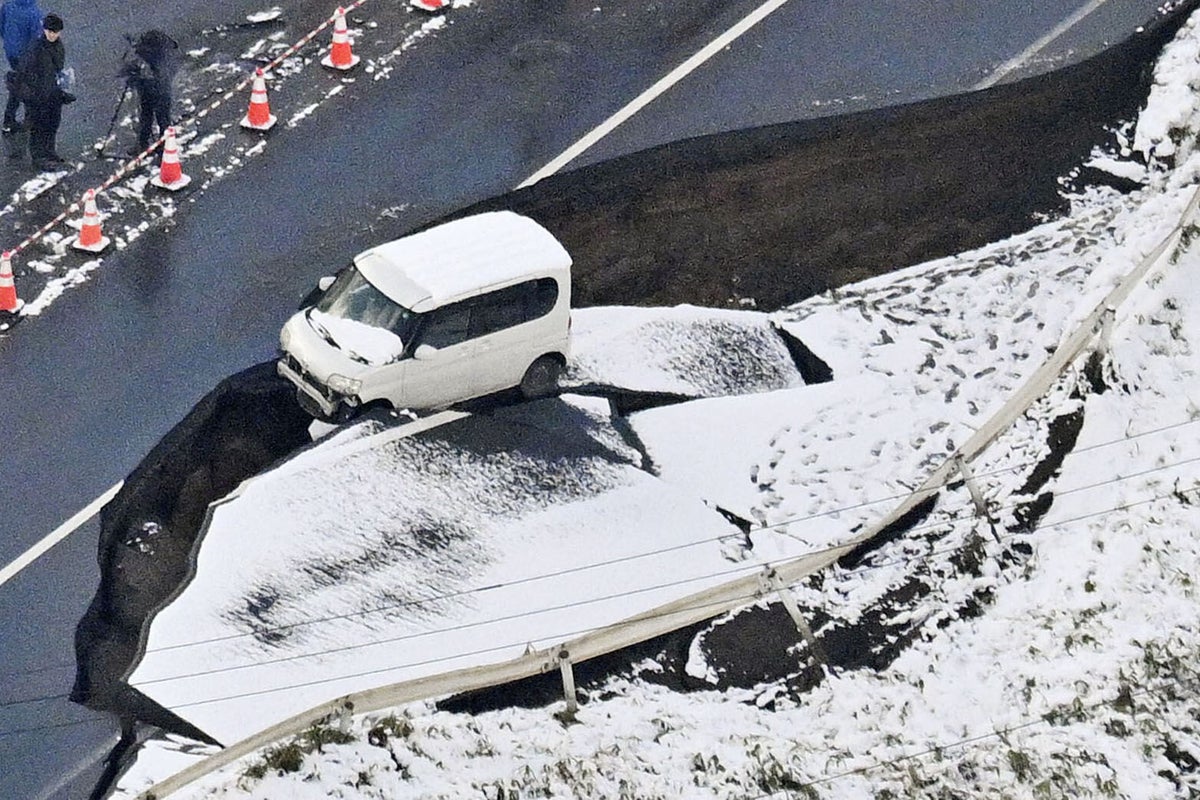
The Pacific coast is at risk because the recent quakes are occurring along a historically active offshore zone where major earthquakes tend to occur in sequence, an expert has said.
Monday’s 7.5 quake struck in the northern part of the same fault area that produced the deadly 7.9 quake in 1968.
Friday’s 6.9 magnitude earthquake hit a similar area of the Pacific coast to Monday night’s powerful 7.5-magnitude tremor.
The southern portion of that zone already ruptured in 1994 with a 7.6 quake, and another strong 6.9 quake struck just south of it in November this year.
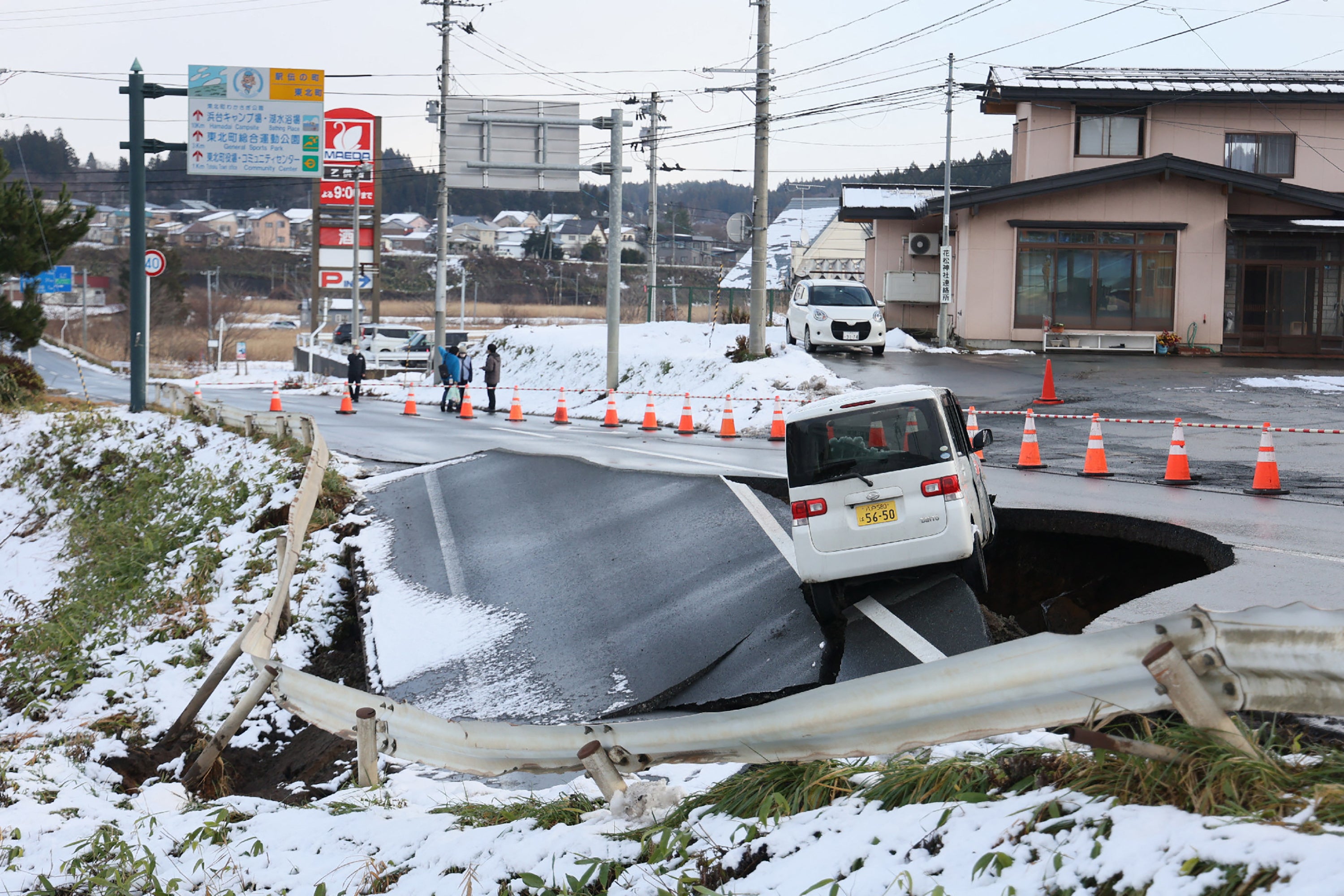
A vehicle rests on the edge of a collapsed road in Tohoku town in Aomori Prefecture on 9 December 2025, following a 7.5 magnitude earthquake off northern Japan (AFP via Getty Images)
Fumiaki Tomita, associate professor at the International Research Institute of Disaster Science of Japan’s Tohoku University, suggests that stress along the offshore fault system is shifting northward.
“Earthquakes with magnitudes of 8 could strike the area (if large-scale slips occur between the two plates),” he warned.
According to him, the northern area off Iwate is now the only segment of this seismic zone that has not released a large earthquake since 1968.
Because unruptured segments can accumulate strain, they are more likely to produce powerful quakes and tsunamis, he says.
Maroosha Muzaffar12 December 2025 10:15
A Tohoku University disaster science researcher has warned that more major earthquakes – potentially as strong as magnitude 7 or 8 – could follow Monday’s 7.5 quake off Aomori.
Fumiaki Tomita, associate professor at the International Research Institute of Disaster Science of Japan’s Tohoku University, has urged communities along the Pacific coast from Hokkaido to Chiba to stay alert for both strong shaking and possible tsunamis.
“Earthquakes with magnitudes of 8 could strike the area (if large-scale slips occur between the two plates),” he warned, according to The Japan Times.
The Japan Meteorological Agency’s megaquake advisory for a possible huge earthquake remains in effect until midnight Tuesday, but the expert said that people should remain prepared even after the advisory expires.
Maroosha Muzaffar12 December 2025 09:45
Tohoku Electric Power Company reports that the Higashidori nuclear power plant in Aomori Prefecture and the Onagawa plant in Miyagi Prefecture are operating normally, with no abnormalities detected, NHK Japan reported.
Tokyo Electric Power Company confirmed that Fukushima Daiichi and Daini nuclear plants are stable, with radiation monitoring posts showing no unusual readings after this morning’s 6.7-magnitude earthquake.
Japan’s Nuclear Regulation Authority added that there are “no immediate signs of abnormalities” at nuclear facilities in the region affected by the quake.
Maroosha Muzaffar12 December 2025 09:15
Japan sits at the junction of several tectonic plates, making it one of the most seismically active regions in the world. While earthquakes are common, some of the most powerful and dangerous ones originate from ocean trenches.
Monday’s magnitude-7.5 earthquake in northern Japan has brought attention back to the Japan Trench and the Chishima Trench.
A trench earthquake occurs along a deep crack in the ocean floor, called a trench, where one tectonic plate slides beneath another in a process known as subduction.
Over years or decades, stress builds as the plates get stuck.
When that stress is suddenly released, it can produce a powerful megathrust earthquake.
Because these earthquakes occur under the ocean, they often generate tsunamis, which can be extremely large and destructive.
The Japan Trench, off the east coast of Honshu, and the Chishima Trench, off northern Hokkaido and stretching toward the Kuril Islands, are key locations for these events.
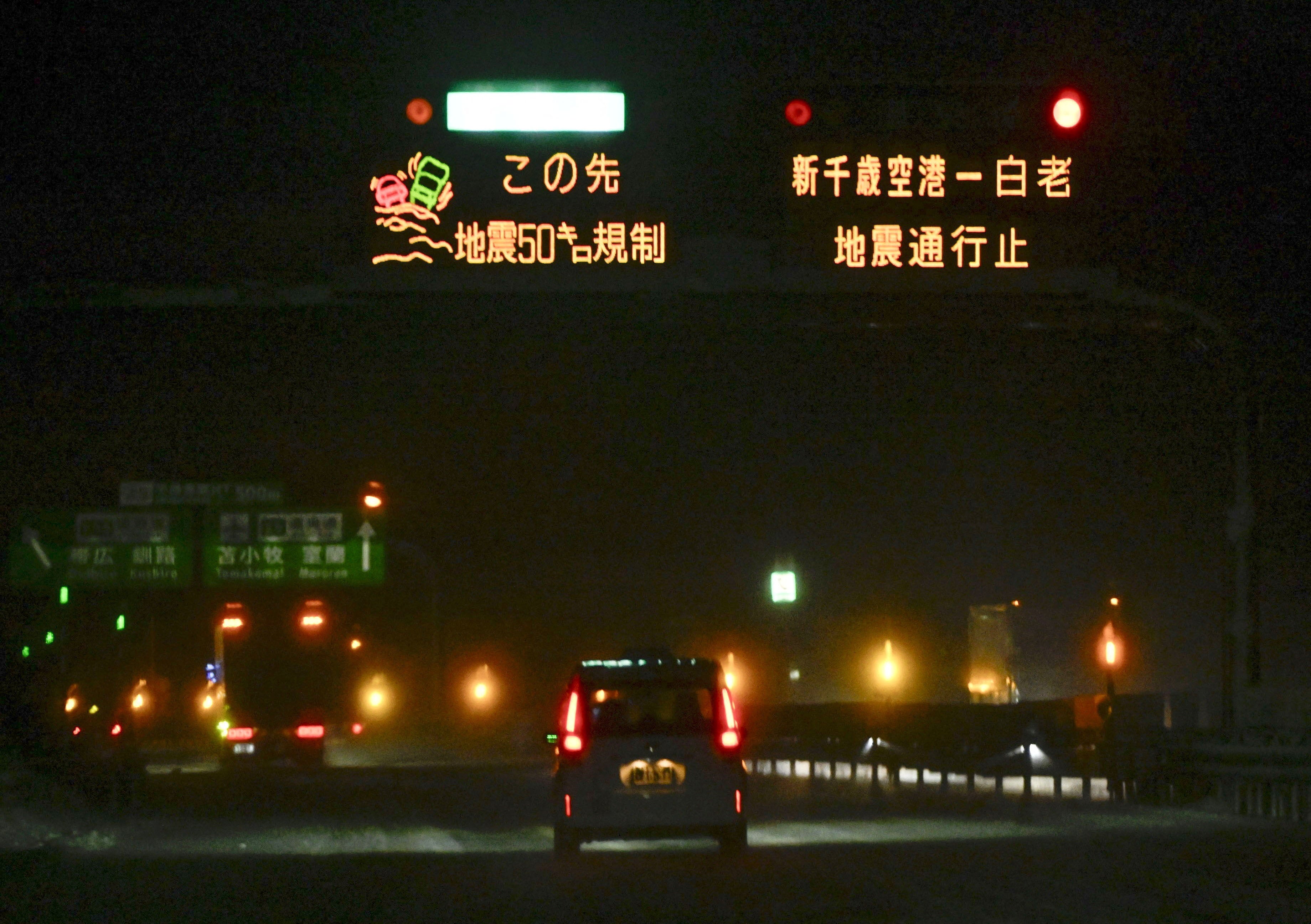
A sign displays information about a road closure due to the earthquake on a highway in Chitose, Hokkaido, Japan, 9 December 2025, in this photo taken by Kyodo (via REUTERS)
These trenches have produced some of Japan’s most devastating earthquakes, including the 2011 Tohoku earthquake, a magnitude 9.0 megathrust quake that triggered massive tsunamis along the coast.
Historical patterns show that magnitude-7 or higher quakes in these regions can be followed by even larger earthquakes, according to the Japanese Meteorological Agency (JMA).
This is why Japan established a megaquake advisory system – a special alert to warn residents of northern Japan when the risk of a major trench-type earthquake and tsunami is elevated.
Maroosha Muzaffar12 December 2025 08:45
The Japanese authorities have put in place a megaquake advisory after a magnitude-7.5 earthquake struck northern Japan.
It warns that the chances of a huge earthquake of magnitude 8 or higher are greater for roughly a week after Monday night’s sizeable tremor.
A post on the Japan Meteorological Agency website provides some projections for what the impact might be if a particularly large megaquake strikes an ocean trench off Japan.
It says a megaquake of the highest class is an extremely rare event, occurring “once every thousand years or even less frequently”.
The damage and casualties caused would vary depending on the season, time of day, and weather conditions.
The forecasts show that Hokkaido could face tsunamis between 10 and 20 metres, with Erimo Town possibly seeing nearly 30 metres. Western Hokkaido areas like Tomakomai and Hakodate might get around 10 metres.
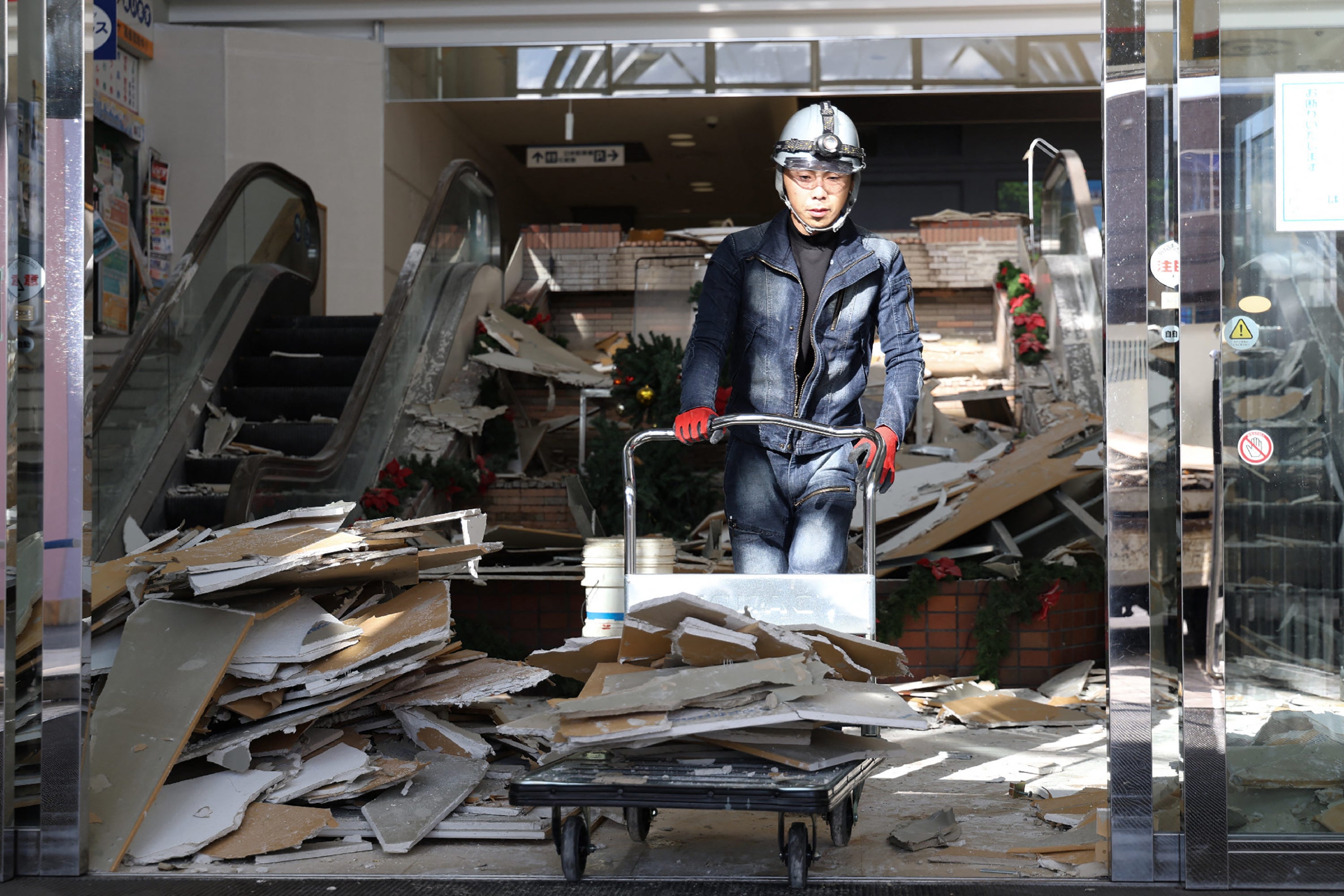
A worker clears debris at a shopping centre damaged by the earthquake in Hachinohe City, Aomori Prefecture, on 9 December 2025 (JIJI Press/AFP via Getty Images)
In Aomori, Hachinohe could experience tsunamis over 25 metres, while the Pacific coasts of Iwate, Miyagi, and Fukushima might see 10–30 metres.
The strongest shaking is expected in Hokkaido, with Akkeshi Town possibly reaching intensity 7 (on the Japan earthquake intensity scale that runs from 0 to 7), and areas east of Erimo reaching 6+.
Northern Honshu, including the Pacific coasts of Aomori and southern Iwate, could also feel 6+ intensity shaking.
Maroosha Muzaffar12 December 2025 08:15
A powerful magnitude-7.5 earthquake struck off the northeastern coast of Aomori Prefecture in northern Japan.
Tsunami warnings were issued for coastal Hokkaido, Aomori, and Iwate.
Observed tsunami waves reached 20–70 cm along the northern Pacific coast.
Tens of thousands of residents were ordered to higher ground – around 90,000 people in affected regions.
More than 50 people were injured, according to the fire and disaster agency.
Rail services and some infrastructure were temporarily disrupted.
Tsunami warnings were downgraded to advisories and then lifted by early Tuesday.
The Japan Meteorological Agency (JMA) issued its first-ever “Off the Coast of Hokkaido and Sanriku Subsequent Earthquake Advisory”, warning of a higher chance of a major follow-up quake – a megaquake – along the Japan and Chishima Trenches.
The advisory covered 182 municipalities across seven prefectures.
Municipal authorities set up temporary evacuation shelters across Aomori and Hokkaido, offering blankets, food, and heating.
Dozens of aftershocks continue to rock Japan’s Pacific coast since Monday night’s powerful tremor.
Officials continue urging residents to stay vigilant, even though they say that the chance of a megaquake is 1 in 100.
Schools in several regions remain closed, and some reported damage.
Officials continue urging residents in affected areas to review evacuation routes, secure furniture, and maintain emergency supplies.
A 6.9-magnitude earthquake struck off the east coast of Aomori Prefecture at a depth of nearly 17km, prompting a new tsunami advisory for parts of northern Honshu and Hokkaido.
The tsunami advisory was lifted even though local reports said evacuation orders were issued in some places in Miyagi Prefecture.
Maroosha Muzaffar12 December 2025 07:53
Across Aomori and Hokkaido, residents are reportedly stocking up on emergency gear as stores report surging sales of water, stabilisers, portable toilets, and adjustable poles to secure household furniture.
Families are preparing for the worst as the megaquake advisory remains in place.
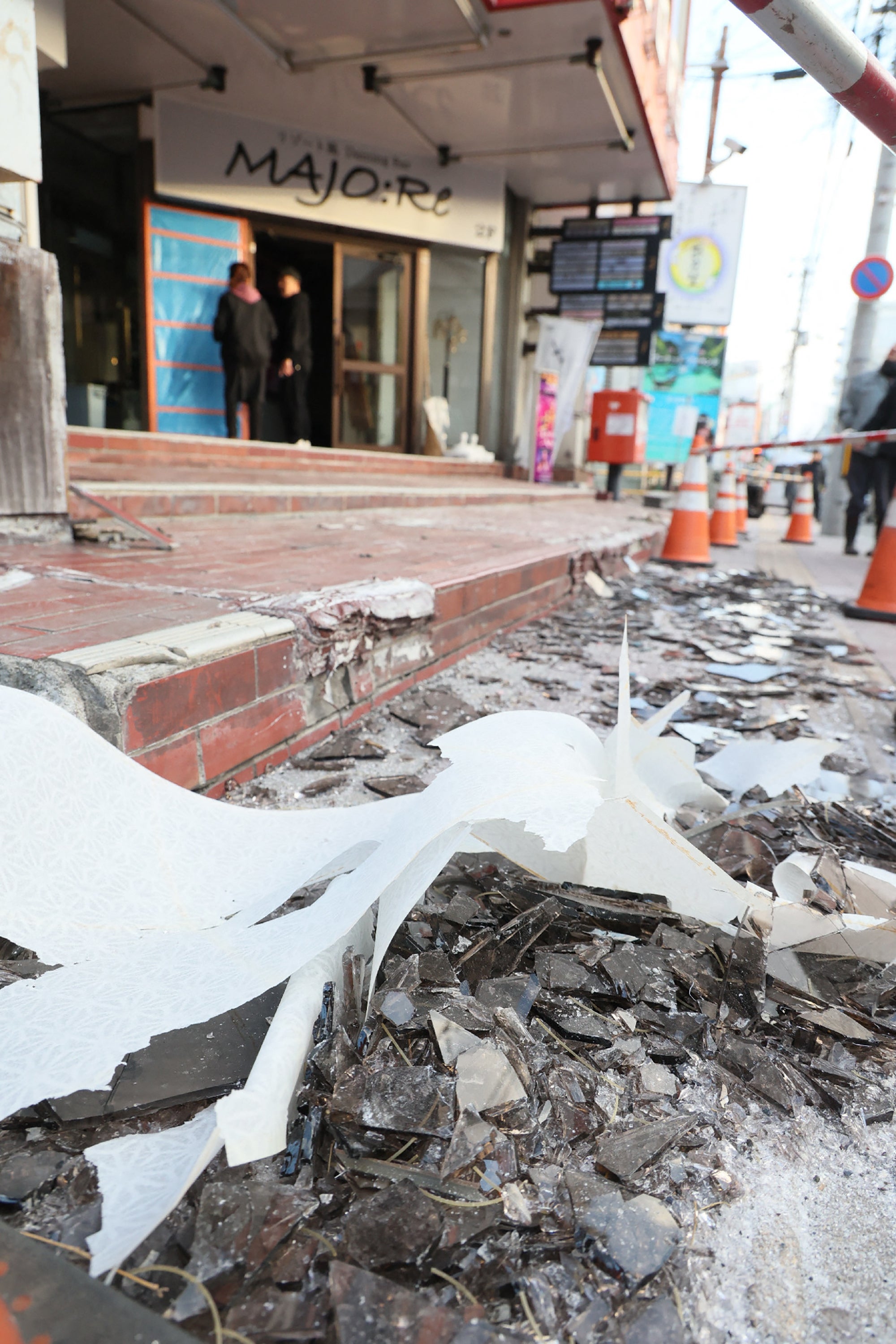
Broken window glass scattered on the street in front of a building is seen in Hachinohe City in Aomori Prefecture on 9 December 2025, following a 7.5 magnitude earthquake off northern Japan (JIJI Press/AFP via Getty Images)
A man in his 40s who was buying stabilisers for his fridge said: “It almost fell over in the quake. I hope we don’t experience another big one. I have young children, so I bought this as a precaution.”
Many stores are now also displaying disaster-related goods on shelves.
Childcare centres and community shelters are now prioritising heating options, thermal mats, and ways to keep evacuees dry in case of an emergency.
Maroosha Muzaffar12 December 2025 07:13