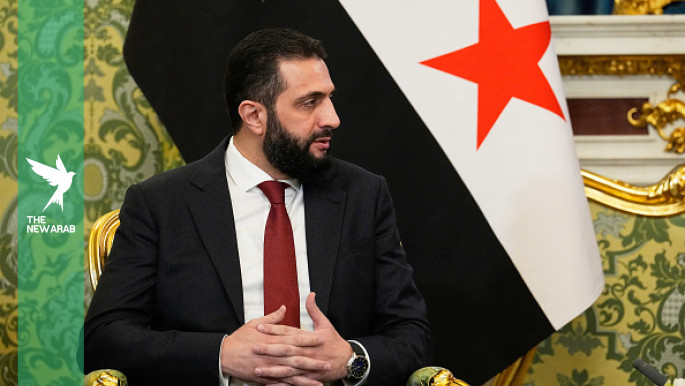
Syrian President Ahmed al-Sharaa is preparing to hold meetings with community representatives in the coastal region after a series of recent tensions in Latakia, Jableh and nearby areas.
Security sources in Latakia told The New Arab’s Arabic edition Al-Araby Al-Jadeed that Sharaa will meet around 100 figures from across the province on Saturday for what they described as a “transparent dialogue” to identify problems, hear residents’ demands and discuss solutions.
Interior Minister Anas al-Khattab is expected to accompany him. Activists circulated a photograph on Thursday showing al-Sharaa and the interior minister in the coastal region, although the visit has not been officially announced.
The meetings come as the Supreme Alawite Islamic Council in Syria and the Diaspora, led by Ghazal Ghazal, issued a statement rejecting what it described as the government’s attempt to form a delegation of selected individuals to claim representation of the Alawite community in a meeting with the president.
The council said it “rejects this path entirely” and condemned any attempt “to strip the legitimacy of representing Alawites” through groups that negotiate over “service-related demands that do not rise to the level of their political and rights-based cause”.
The council insisted that releasing all detained and disappeared Alawites – civilians and military personnel – whose number it says exceeds fourteen thousand, is a non-negotiable condition. It stated that “any negotiation not based on these fundamental demands is a negotiation without legitimacy”, and that any group engaging outside this framework “does not represent the Alawites nor express the will of their community”.
Ghazal has called for a general strike from 8 to 12 December across all sectors. In a recorded statement, he accused the Syrian government of seeking to celebrate the anniversary of replacing “Assad’s oppressive regime with a new regime, even more oppressive”.
He had previously called for sit-ins that were joined by some residents of the coastal region, leading to tensions particularly in Latakia and Jableh.
The Syrian government has not issued any public response to the recent protests or to Ghazal’s statements. Analysts note that the unrest reflects a mixture of socio-economic frustration, longstanding anger over detention cases and broader grievances about governance and corruption in areas traditionally viewed as government strongholds.
The identities of those selected for the upcoming meeting with Sharaa have not been disclosed, and the Supreme Alawite Islamic Council’s rejection highlights divisions within the community over who can legitimately speak on its behalf. As of Friday evening, Damascus had not commented on the council’s position.
If confirmed, al-Sharaa’s visit would mark one of his most direct engagements with coastal constituencies since the latest protests began. Local sources suggest the president hopes to ease tensions and signal attentiveness to residents’ concerns, particularly demands for the release of detainees.
The meetings also coincide with preparations for the upcoming session of the High Joint Committee, which al-Sharaa is expected to oversee.
It remains unclear whether these steps will reduce tensions or deepen internal rifts, as rival Alawite bodies – one aligned with the government, the other openly critical of it – assert competing claims to representation and legitimacy.
The Syrian coast saw large-scale massacres in early March 2025, when sectarian killings and retaliatory attacks swept through Latakia, Tartus and nearby areas.
Over several days, more than 800 people were killed – including many civilians and entire families – in executions, armed clashes and village raids that left neighbourhoods burned, residents displaced, and deep trauma across the Alawite community.