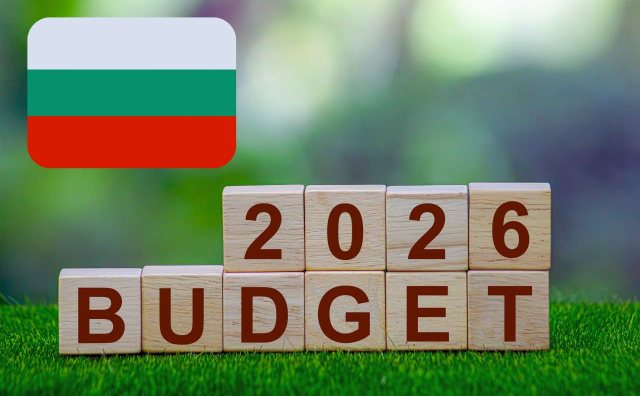
At the turn of the year, Bulgaria is preparing to enter 2026 without an approved state budget. The government is expected to pull back the second draft of Budget 2026 from parliament, allowing the Council of Ministers to move toward adopting an extension law either in the final days of December or early January. Because the bill has not passed a first reading, cabinet can withdraw it unilaterally. In parallel, the Fiscal Council released its formal assessment, urging revisions to the current version of the draft.
This will be the second consecutive January in which the country begins work without a voted budget, a situation that will coincide with the planned introduction of the euro. According to Fiscal Council member Lyubomir Datsov, the absence of a budget should not hinder the technical aspects of joining the Eurozone. He noted that similar crises have occurred in the past – between 1991 and 1997, six annual budgets were delayed. More recently, budgets for 2022, 2023, and 2025 also failed to pass on time. He stressed that the currency transition poses no additional complication for public finances.
If neither an extension law nor a specialized interim solution is approved, the state would continue operating under the rules used this year. That would limit spending each month either to the corresponding month of the previous year or to incoming revenues when they fall short. Datsov argued that structural issues inside the draft budget go beyond procedural delays. He highlighted that updated third-quarter data from the National Statistical Institute undermined the macroeconomic assumptions used by the Ministry of Finance, affecting projections for GDP and revenue. According to him, roughly one-tenth of projected income is based on incorrect estimates.
The Fiscal Council’s latest analysis reiterates concerns about feasibility. It warns that revenue targets may not be met, notes that the public sector has grown larger than the private sector, contrary to legal requirements, and points to rising national debt. The report also cautions that taking larger dividends from state-owned companies risks draining their capital. Datsov added that budgets drafted since 2021, when a shift toward expansionary planning began, have moved away from their intended purpose.
Meanwhile, the minimum wage in the private sector will still rise despite the budget deadlock. Under a Council of Ministers decree, it increases to 620 euros and 20 euro cents (approximately 1,213 BGN). For public-sector employees, the higher minimum will take effect only once a new budget is adopted. Trade unions expressed frustration, walking out in protest. Representatives argued that agreed improvements to benefits and compensations for workers are now stalled inside an unapproved budget.
Union leaders questioned whether the extension law inherited from GERB and the outgoing parliamentary majority is preferable to the draft that has been submitted. A decision on when the extension law will be voted on is expected next week.