The Guide VinsLux 2026 was published two weeks ago. This new edition of the definitive Luxembourg wine guide is trilingual for the first time and comes in A4 format. It showcases all of the country’s wineries, along with a selection of their wines and crémants.
As the author and editor of Guide VinsLux, I can assure you that it is always a pleasure to explore Luxembourg’s wine production in depth, discover new vintages, and re-evaluate older wines.
People often ask me what it is like to taste so many wines and how I manage it. Well, I am happy to share some insights.
Absolute silence is essential!
For the Guide VinsLux, I taste some of the wines and crémants directly at the wineries. Many of these wineries are well equipped and allow me to familiarise myself with and describe the products under virtually ideal conditions. I gradually enter my tasting notes into my laptop and select the most interesting products for the new edition.
Alternatively, I taste a larger selection of interesting products at home, make my choice, and enter my descriptions directly into the layout field on the computer.
The Guide VinsLux 2026 is available in various bookshops and via the prima.lu website, priced at €25
Absolute silence is essential. Much as I enjoy talking to the winemakers after the tasting about the wines and crémants, their creation and production, I need silence during the tasting. It’s simply impossible to concentrate properly when you’re constantly involved in conversation while working. Yes, tasting is work!
I allow the wine I’m currently tasting to unfold in peace, giving it time to release its aromas and subtleties. I like to spend five minutes on a product that has taken nature and the winemaker a year to produce. You need to allow enough time.
The complexity of the wine really comes into its own at a higher temperature
An earlier article in this series discussed the ideal wine temperature. This aspect naturally plays a key role in professional tasting. White wines are usually served quite cool, often even too cool for tasting. I therefore always wait a while to allow the wine to warm up in the glass. Only then can they reveal their full potential. While it is true that wine flaws are less noticeable at cool temperatures, high-quality wines served too cool fail to reveal their complexity.
In my experience, profound white wines are particularly appealing and expressive when tasted at a temperature between 12 and 16 °C. Some benefit from an even higher temperature. While they may no longer be as refreshing, they are full-bodied, complex and sometimes almost infinitely long. Such great wines can really inspire.
Incidentally, crémants, especially the very dry cuvées Extra Brut and Brut Nature, as well as vintage crémants, taste much better when not drunk too cold. For my tastings, I first try the crémants in champagne flutes to assess their effervescence. However, for the actual tasting, I pour the crémant into a bulbous wine glass, just as is done for Appellation d’Origine Protégée (AOP) tastings at the Remich Wine Institute.
The first rule is to spit!
People often ask me whether there is a risk of becoming tipsy or even drunk after a tasting. The first rule of tasting is to spit. No matter how good a wine or crémant tastes, it is essential not to swallow it. Drinking instead of tasting is not an option. After a few samples, you would be unable to concentrate, let alone write coherent descriptions. Not to mention the alcohol content in your blood!
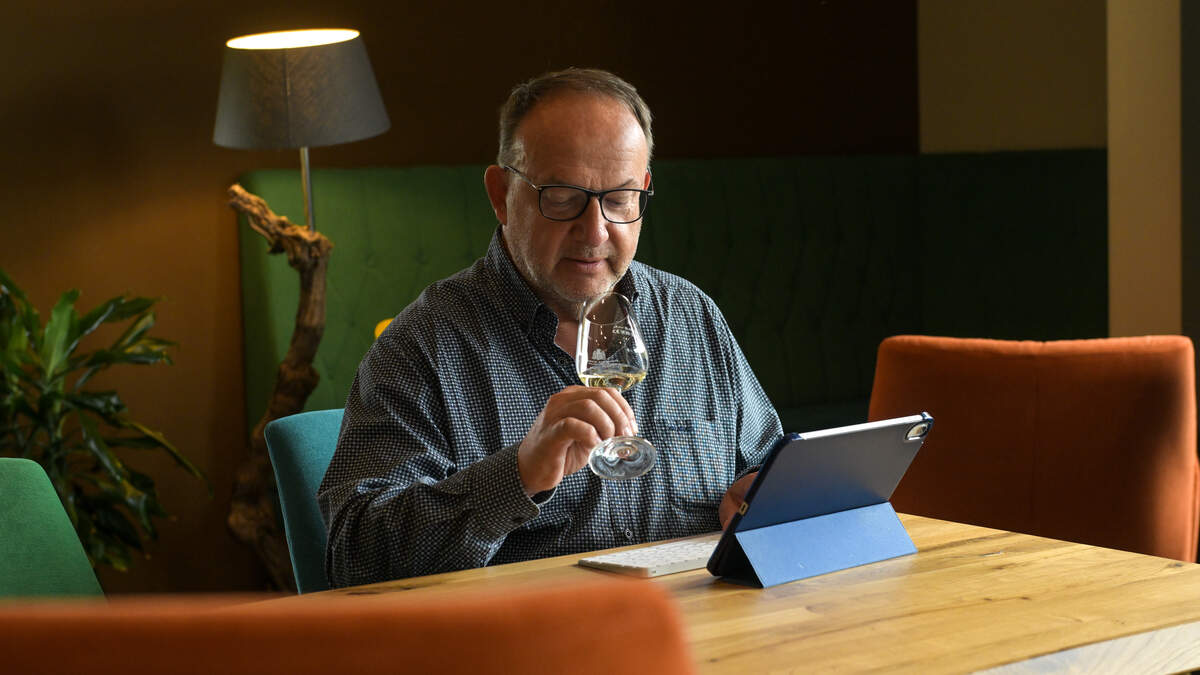
White wines are particularly appealing and expressive when tasted at a temperature between 12 and 16 °C © Photo credit: Claude François
However, even if you spit the wine out systematically, alcohol still enters your bloodstream. That’s why it’s important to take only one or two sips of wine and not hold it in your mouth for too long. As mentioned earlier, I usually allow myself plenty of time during a tasting and also take a few short breaks.
It’s also important not to taste on an empty stomach, as this will definitely end badly.
Anyone with experience of tastings will know the constant need to go to the restroom after a while. This is a completely natural process, as alcohol dehydrates the body even if you don’t swallow it.
Abi Duhr, an oenologist, winemaker and experienced taster of Bordeaux Primeur wines, recommended that I always have pretzel sticks to hand, as salt helps the body to retain water. Does it help? I’ll give it a try!