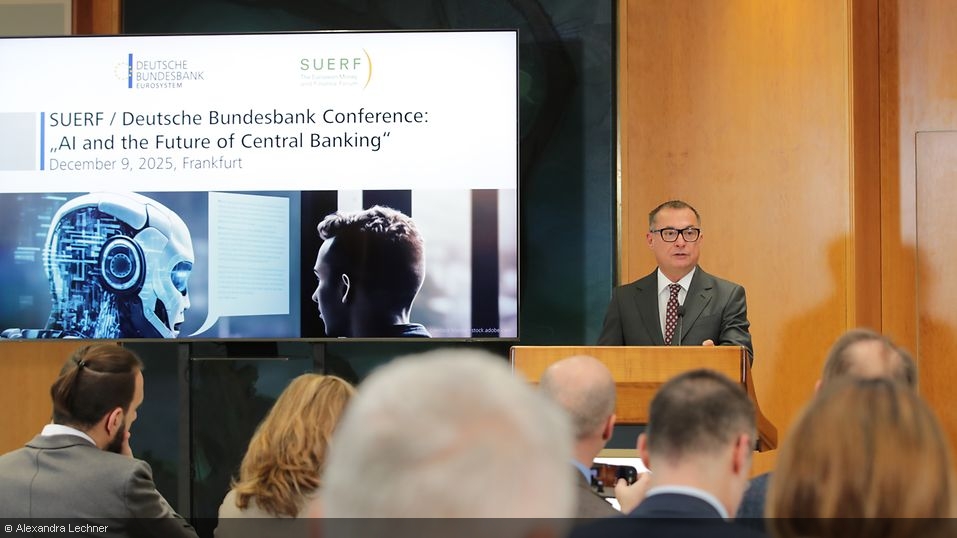
Künstliche Intelligenz entwickelt sich mit rasanter Geschwindigkeit. Und mit ihr verändert sich die Art und Weise, wie Wirtschaft, Unternehmen und Finanzmärkte funktionieren. Wie diese technologischen Umbrüche die Aufgaben von Zentralbanken beeinflussen, stand im Mittelpunkt der von der Deutschen Bundesbank und SUERF, einem unabhängigen europäischen Forum für den Dialog über Geld- und Finanzfragen, gemeinsam ausgerichteten Konferenz „Artificial Intelligence and the Future of Central Banking“.
Expertinnen und Experten aus Wissenschaft, Notenbanken und internationalen Organisationen kamen in Frankfurt zusammen, um Chancen, Risiken und die langfristigen Implikationen von KI für geldpolitische Analysen und Entscheidungsprozesse zu diskutieren.
Nagel: „Technologie sollte letztlich den Menschen zugutekommen“
In seiner Eröffnungsansprache stellte Bundesbankpräsident Joachim Nagel die Bedeutung künstlicher Intelligenz für die Arbeit von Zentralbanken in den Mittelpunkt. Nagel betonte, dass sich Wirtschaft und Finanzsystem in einer Phase tiefgreifenden technologischen Wandels befinden und dieser Chancen und Herausforderungen zugleich mit sich bringe.
Die Bundesbank nutze bereits heute vielfältige KI-Anwendungen, um Analysen zu verbessern und Arbeitsprozesse zu unterstützen, erklärte Nagel. Dazu gehören textbasierte Assistenzsysteme (TIAs),KI-gestützte Dokumentenanalyseverfahren sowie das Modell MILA, mit dem die Kommunikation der Notenbanken im Euroraum ausgewertet wird. Diese Technologien erweitern unseren Werkzeugkasten. Sie ersetzen jedoch nicht die Expertise unserer Mitarbeiterinnen und Mitarbeiter, so Nagel. Er machte deutlich, dass Offenheit für Innovation und ein verantwortungsbewusster Umgang mit neuer Technologie zusammengehörten. Der Einsatz von KI diene einem übergeordneten Ziel: Technologie sollte letztlich den Menschen zugutekommen. Auch für uns als Zentralbank gilt: Wir nutzen KI, um unser Mandat bestmöglich zu erfüllen.
Die sich anschließende Keynote von Álvaro Ortiz (BBVA Research) zeigte eindrucksvoll, wie moderne Datenquellen, Textanalysen und KI-Methoden bereits heute ein tieferes Verständnis makroökonomischer Entwicklungen ermöglichen.
Neuer Werkzeugkasten für die Analyse: Von maschinellem Lernen bis zu nicht-traditionellen Daten
Die erste Session widmete sich Prognosemodellen, Strukturanalysen und neuen Möglichkeiten der Szenarienbildung mithilfe maschinellen Lernens. Forschende aus verschiedenen europäischen Notenbanken und Universitäten präsentierten Ansätze, wie KI-Modelle wirtschaftspolitische Entscheidungen unterstützen können, ohne die Transparenz klassischer ökonomischer Verfahren zu verlieren.
In der zweiten Session wurden Anwendungen jenseits traditioneller Daten diskutiert. Darunter die Auswertung von Social-Media-Informationen, Kommunikationsdaten und Reaktionsmustern und sogar die Möglichkeit der Stimmauswertung. Die Beiträge zeigten, wie stark sich die Informationslandschaft geldpolitischer Institutionen erweitert und wie wichtig es ist, diese neuen Datenquellen verantwortungsbewusst zu nutzen.
Eine weitere Session widmete sich den makroökonomischen Auswirkungen von KI selbst. Die Forschenden beleuchteten, wie sich Künstliche Intelligenz auf zentrale makroökonomische Größen wie Produktivität und den Arbeitsmarkt auswirken kann und welche statistischen Herausforderungen damit verbunden sind.
Köhler-Geib: „Zentralbanking ist Technologie. Wir setzen KI produktiv ein und verstärken unsere Forschung zu den potenziellen Auswirkungen von KI auf die Zukunft des Zentralbankwesens“
Bundesbank-Vorständin Fritzi Köhler-Geib, verantwortlich für IT, Daten und Statistik, Risikocontrolling und das Forschungszentrum, betonte auf einem abschließenden Policy-Panel die Notwendigkeit, KI in Produktion zu bringen. Es gelte, damit messbaren Mehrwert für die Organisation zu schaffen, sowie ausreichend in die Technologie zu investieren. Sie stellte auch Forschungsergebnisse mit Bundesbank-Beteiligung vor, die zeigen, dass die Ausgestaltung von KI-Agenten Einfluss auf die Finanzstabilität haben können.
Sie unterstrich, dass es für die zukünftige Handlungsfähigkeit von Zentralbanken relevant sei, technologische Entwicklungen proaktiv begleiten: Eine robuste Datenbasis und moderne IT-Architekturen sind Grundvoraussetzung für belastbare Analysen, verlässliche Risikobewertungen und eine zukunftsfähige Geldpolitik.
Neben Köhler-Geib diskutierten Expertinnen und Experten aus der EZB, der BIS, der OECD und weiteren Institutionen über strategische Anforderungen an Zentralbanken. Hierbei ging es um die Rolle menschlicher Expertise über Governance-Fragen bis hin zur internationalen Koordination in einem zunehmend datengetriebenen Umfeld.
Jens Ulbrich, Leiter des Zentralbereiches Volkswirtschaft der Deutschen Bundesbank, dankte in seinen Abschlussworten den Teilnehmenden für den intensiven und konstruktiven Austausch. Der Dialog zwischen Forschung und Praxis sei ein entscheidender Baustein, um die geldpolitischen Institutionen auf die technologischen Herausforderungen der kommenden Jahre vorzubereiten.
Agenda Welcome address
9:00 to 09:15 am
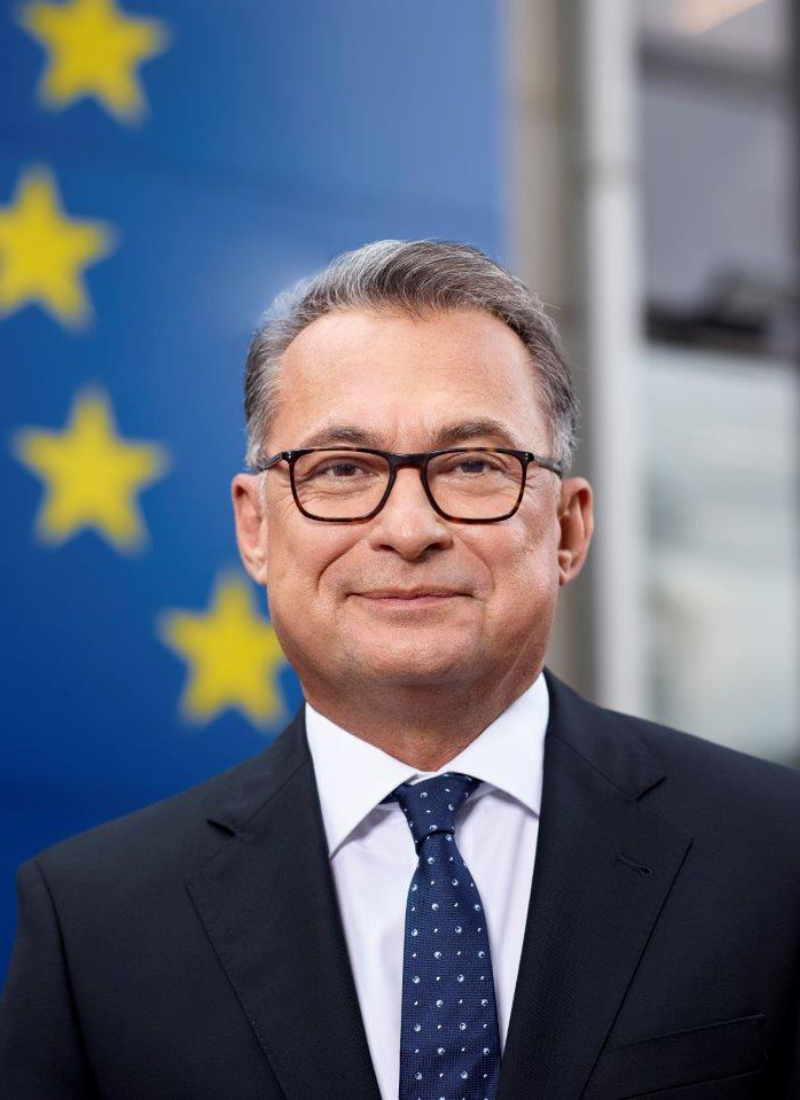
Joachim Nagel
© Gaby Gerster
Joachim Nagel has been President of the Deutsche Bundesbank since January 2022. Prior to this, he had already served in management positions at the Bundesbank between 1999 and 2016, including as an Executive Board member from 2010 with responsibility for the Directorates General Markets, Controlling and IT.From 2016 to 2020, he worked for the KfW Group, including as an Executive Board member. In 2020, he moved to the Bank for International Settlements (BIS) where he became Deputy Head of the Banking Department. Dr Nagel studied economics at the University of Karlsruhe and received a doctoral degree in 1997. He also serves as a member of the Governing Council of the ECB, a Governor at the IMF and a member of the BIS Board of Directors.
Keynote lecture
A Brief History of the Future: Data, Text and AI for Smarter Policies
9:15 to 10:00 am
Alvaro Ortiz

© privat
Head of Big Data & AI Economic Analysis · BBVA Research
Member of the Conference on Research in Income and Wealth (CRIW) at the NBER, and co-founder of the Financial Transactions “Big Data” Global Research Network.
His research focuses on empirical macroeconomics, monetary and fiscal policy, and applied geopolitics, leveraging Big Data and AI methodologies. His work has been presented at leading internation-al forums, including the NBER Summer Institute, CEPRESSIM, Paris School of Economics Macro Days, SED meetings, and central bank conferences hosted by the Federal Reserve Board, Europe-an Central Bank, Bank of England, Bank of Spain, and the Central Bank of Swe-den.
He holds a Ph.D. in Economics from Universidad Autónoma de Madrid and an Advanced Diploma in International Economics and Policy Research from the Kiel Insti-tute for the World Economy (Kiel IfW).
Session 1: Forecasting and structural analysis with ML
Moderator Natascha Hinterlang · Deutsche Bundesbank
10:00 to 11:15 am
Forecasting Public Debt in the Euro Area Using Machine Learning: Decision Tools for Financial Markets
Amélie Barbier-Gauchard

© privat
Amélie Barbier-Gauchard is Full Professor of Macroeconomics at the Faculty of Economics and Management, University of Strasbourg (France). Her field of interest are macroeconomics, fiscal policy, government performance, fiscal rules, public finance and European integration. She held various advisory positions for the French Prime Minister Services in Paris, the European Commission, the European Parliament, and the EU Committee of the Regions.
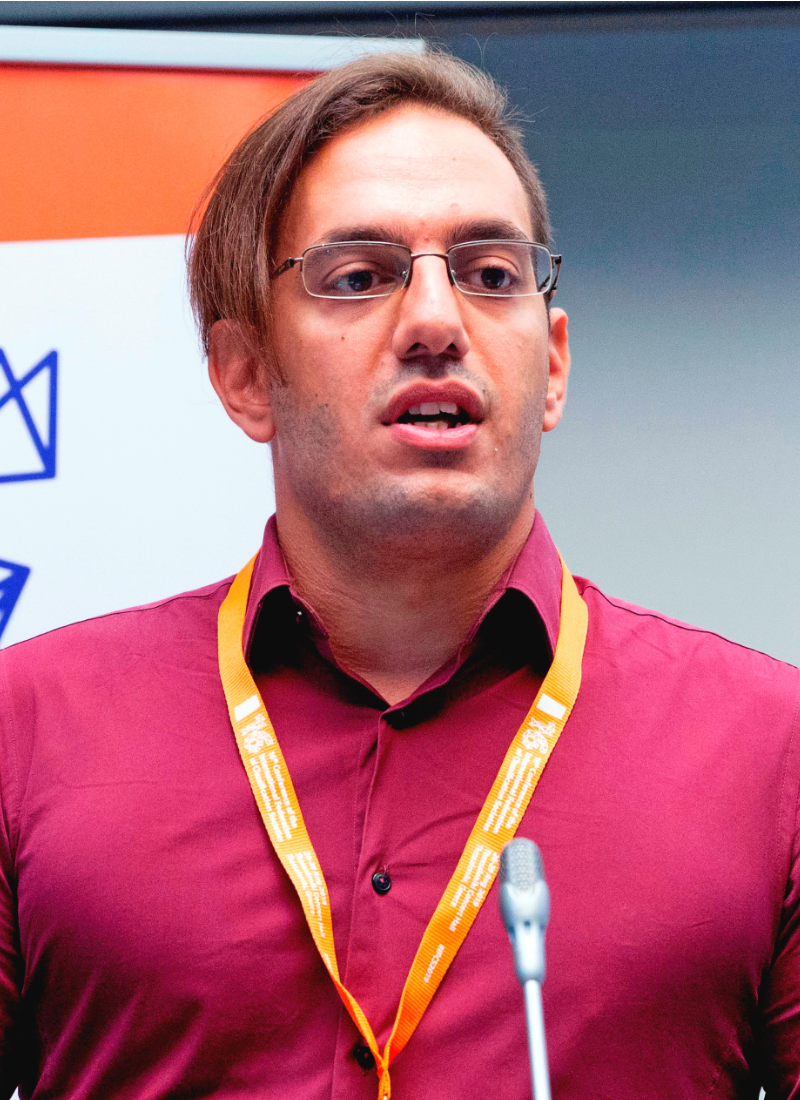
Emmanouil Sofianos
© privat
Emmanouil Sofianos is a postdoctoral researcher at BETA, University of Strasbourg. His work bridges macroeconomics, forecasting, and machine learning, with a focus on euro area dynamics and the integration of political and institutional factors into predictive models. He applies interpretable AI techniques to support economic policy and improve forecasting. His research has been published in leading journals and presented at international conferences, and he collaborates on projects linking data science with policy design, under the ITI MAKErS initiative.
Dual Interpretation of Machine Learning Forecasts
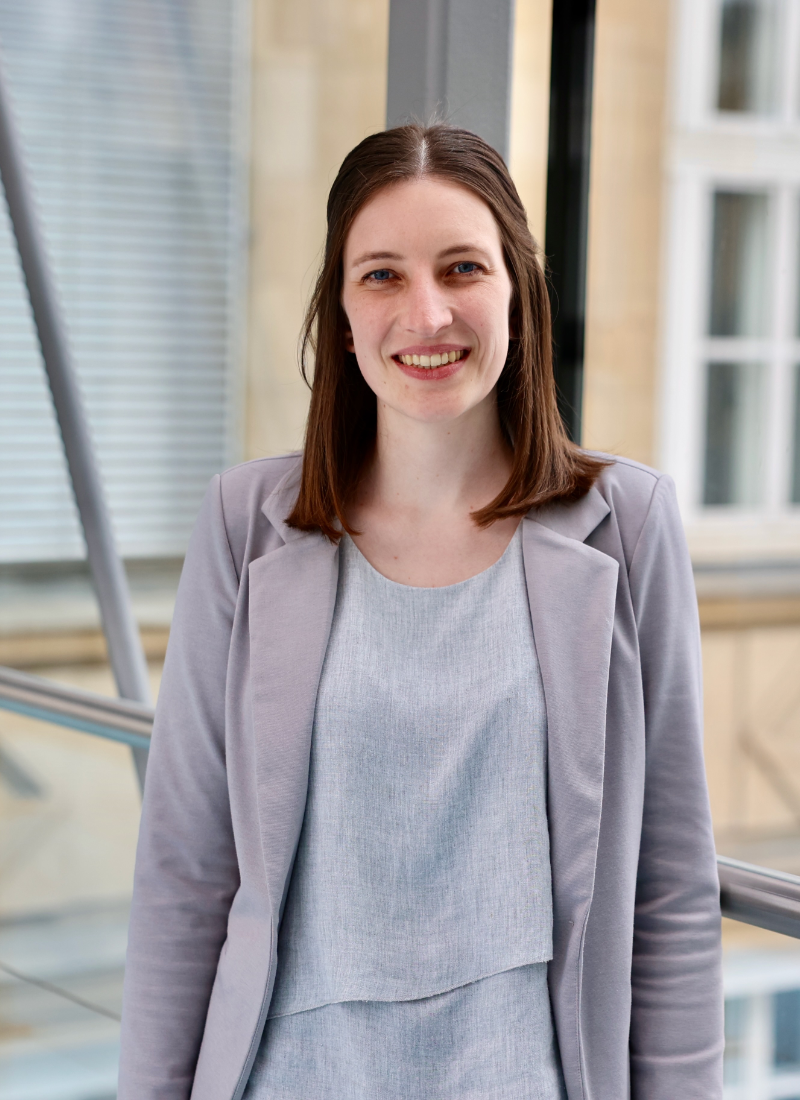
Karin Klieber
Co-author(s): Philippe Goulet Coulombe, Maximilian Goebel
© privat
Karin Klieber is Economist in the Prices & Costs Division at the European Central Bank, on leave from the Austrian National Bank (Oesterreichische Nationalbank, OeNB). She is specializing in the intersection of applied econometrics and central banking, bridging the gap between academic research and policy needs. Her research focuses on inflation developments, monetary policy, and machine learning in applied econometrics. She holds a PhD from the University of Salzburg.
Scenario analysis with multivariate Bayesian machine learning models
Anna Stelzer
Co-author(s): Michael Pfarrhofer

© privat
Anna Stelzer is an economist specializing in monetary economics, central bank policies, Bayesian econometrics, and multivariate time series. She holds a PhD in Economics from the University of Salzburg. Her research interests include heterogeneous effects of monetary policy, econometric methods for policy purposes and nonlinear time-series models. She currently works as an economist at the Monetary Policy Section of the Oesterreichische Nationalbank (OeNB) and has previously held positions at the European Central Bank as well as the University of Salzburg and WU Wien.Session 2: Going beyond numbers – exploiting nontraditional data
Moderator: Dimitrios Kanelis · Deutsche Bundesbank
11:45 am to 1:00 pm
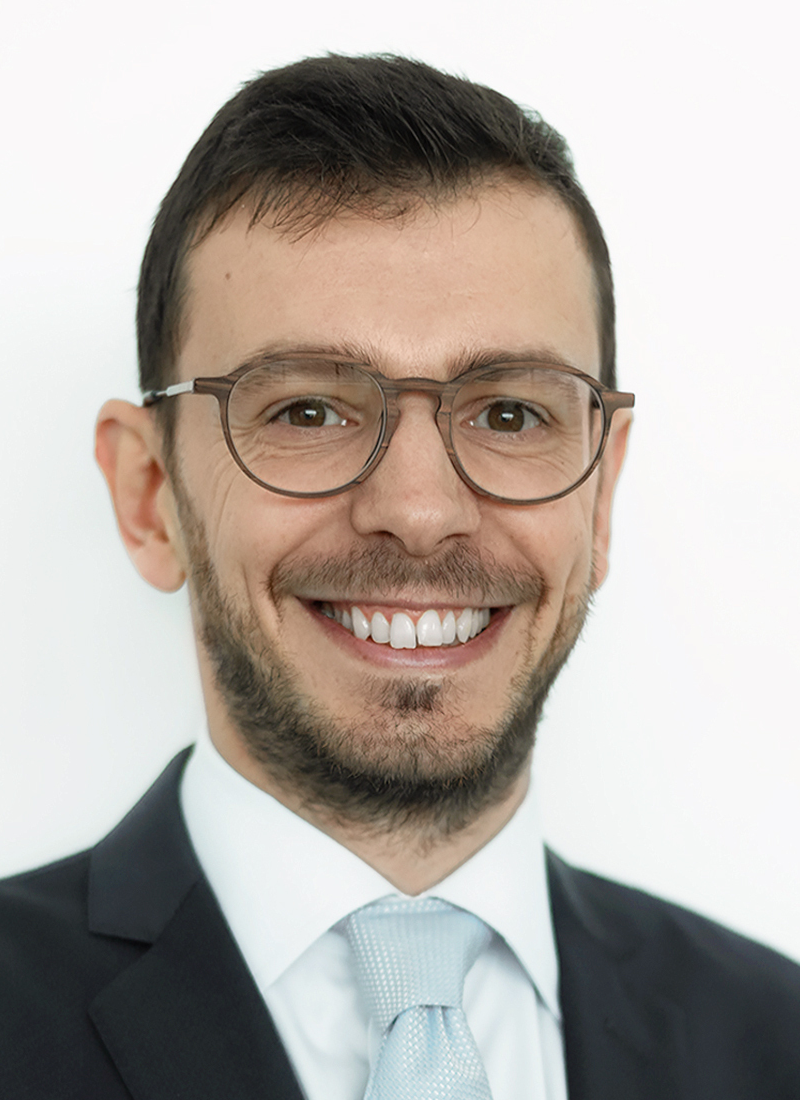
Uncovering Disagreement in Central Bank Communication: Social Media and Monetary Policy Surprises
Davide Romelli
Co-author(s): Donato Masciandaro, Conor Parle, and Matteo Pograxha
© privat
Davide Romelli is an Associate Professor in the Department of Economics at Trinity College Dublin. He is a Research Affiliate at International Macro-TCD (IM-TCD) and SUERF – The European Money and Finance Forum, a Research Fellow at the BAFFI-CAREFIN Centre at Bocconi University, a Research Associate at the Centre for Economics, Policy and History, and a Chercheur affilié at OFCE–Sciences Po. He also serves as an Associate Editor for the European Journal of Political Economy, the International Journal of Finance & Economics and International Economics and Economic Policy.
Disagreement about Fiscal Policy
Peter Tillmann
Co-author(s): Peter Winker, Albina Latifi, Viktoriia Naboka-Krell

© privat
Peter Tillmann is Professor of Monetary Economics at the University of Giessen, Germany. His research interests are monetary policy and empirical macroeconomics. He is also Research Professor at the IWH Halle Institute for Economic Research and a frequent visitor to the Hong Kong Institute for Monetary and Financial Research. Previously, he worked at the Swiss National Bank and the University of Bonn. He holds a PhD from the University of Cologne.
Slow Tone: Detecting White Lie Disclosures Using Response Latency
Doron Reichmann
Co-author(s): John C. Heater

© privat
Doron Reichmann is a postdoctoral researcher in the Accounting & Sustainability Department at Goethe University, where he previously served as a W2 Interim Professor of Management and Control. He completed his dissertation at Ruhr University Bochum and was a visiting scholar at Duke University, where he continued his work on nonverbal cues in financial communication. His research has been discussed by leading international and national press, including the Financial Times, FAZ, Harvard Business Manager, and WirtschaftsWoche.
Session 3: AI as a driver of macroeconomic dynamics
Moderator: Elisabeth Falck · Deutsche Bundesbank
2:00 to 3:15 pm
The Labor Market Effects of Generative Artificial Intelligence
Jonathan Hartley
Co-author(s): Filip Jolevski, Vitor Melo, Brendan Moore

© privat
Jonathan Hartley is an Economics PhD candidate at Stanford University and a Policy Fellow at the Hoover Institution. He holds degrees from the University of Chicago (BA), Wharton (MBA) and Harvard Kennedy School (MPP).
His research spans finance, labour and macroeconomics, with recent work on the labour-market effects of generative A. Previously he worked at Goldman Sachs Asset Management and held policy roles at the World Bank, IMF, the U.S. Joint Economic Committee and Federal Reserve Banks.
The macroeconomic effects of AI innovation
Andrea Giovanni Gazzani
Co-author(s): Filippo Natoli

© privat
Senior Economist, Bank of Italy, DG Economics & Research, International Directorate
Ph.D. in Economics, European University Institute
Concepts and Challenges of Measuring Production of Artificial Intelligence in the U.S. Economy
Tina Highfill
Co-author(s): David Wasshausen, Gregory Prunchak

© privat
Tina Highfill is a senior research economist at the Bureau of Economic Analysis, part of the US Department of Commerce. Tina leads research and development of prominent, multifaceted economic analyses, including several that originated from the US Congress. Tina’s recent work includes developing new and improved macroeconomic statistics, including GDP for the US digital economy, environmental goods and services, and artificial intelligence. Dr. Highfill holds a bachelor’s degree from Virginia Tech, a master’s degree from The Johns Hopkins University, and a PhD from Virginia Commonwealth University.Policy panel: Implications of AI for Central Banking
Moderator: Jens Ulbrich · Deutsche Bundesbank & SUERF Council
3:45 to 4:55 pm
Philipp Hartmann

© privat
Dr. Philipp Hartmann is Deputy Director General of the research department at the European Central Bank and a Fellow of CEPR. Previously, he held positions at the London School of Economics, Erasmus University Rotterdam and acted as Vice-President of SUERF. Mr Hartmann published scholarly research on financial, monetary and international issues in numerous journal articles and several books. His policy work has been discussed in the ECOFIN Council, the ECB Governing Council and the Basel Committee on Banking Supervision. He is one of the main organisers of the ECB’s flagship Sintra Forum.
Leonardo Gambacorta

© privat
Leonardo Gambacorta is the Head of the Emerging Markets unit at the BIS. Prior to his current role, he served as Head of Innovation and Digital Economy, Research Adviser and Head of Monetary Policy in the Monetary and Economic Department. His primary research interests include monetary transmission mechanisms, the effectiveness of macroprudential policies in curbing systemic risk, and the effects of technological innovation on financial intermediation. He is a research fellow of the Centre for Economic Policy Research.
Fritzi Köhler-Geib

© Gaby Gerster
Fritzi Köhler-Geib is a Member of the Executive Board of the Deutsche Bundesbank and is responsible for IT,Data and Statistics, Risk Control and the Research Centre. Before this, she was the Chief Economist and First Vice President of KfW Group. Previously she worked for over twenty years at the IMF and the World Bank in various positions and re-gions as well as at private sector financial institutions, last as the World Banks Lead Econ-omist and Programme Leader for Central America. She received her PhD in Economics from Ludwig Maximilian University Munich and Pompeu Fabra University, Spain.
Katja Langenbucher
(participates online)

© privat
Katja is a law professor at Goethe-University, affiliated professor at SciencesPo, Paris, and visiting faculty at Fordham Law School, NYC. She has held visiting positions at Sorbonne; WU Vienna; LSE; Columbia, Fordham and PennLaw School and will join NYU Law Global Faculty in 2026. She holds supervisory position as BaFin and SciencesPo.
Katja publishes on corporate and financial markets law with a focus on crypto and artificial intelligence.
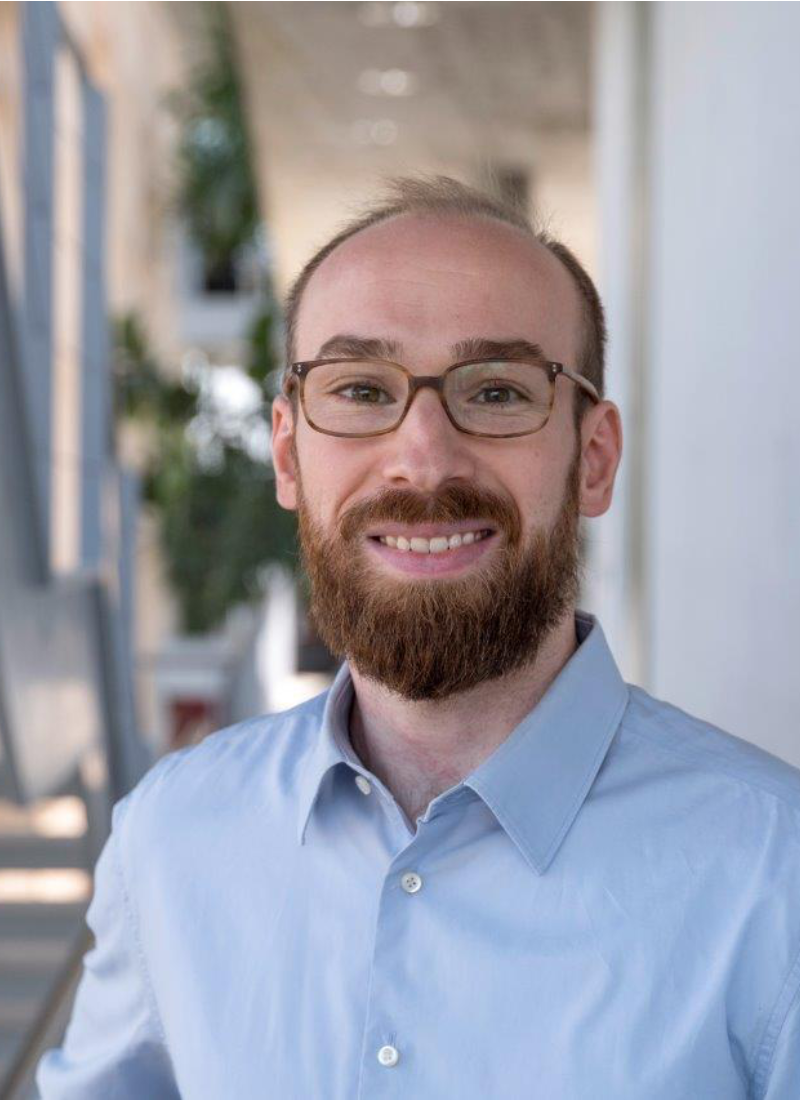
Maximilien Kintz
© privat
Maximilien Kintz studied engineering and computer science in Nantes (France) and Stuttgart. Since 2009, he has been working at Fraunhofer IAO in Stuttgart, where he has led the “Applied AI” team since 2020. His research focuses on the optimization and automation of business processes, including the analysis of complex text documents.
Filiz Unsal

© privat
Filiz Unsal is Deputy Director of the Policy and Research Branch in the Economics Depart-ment of the OECD, which produces analysis on a wide range of macroeconomic and structural policy issues and coordinates major flagship publications such as the Economic Outlook and Going for Growth. Earlier in her OECD career, she was the Head of the Structural Policy and Research Division, overseeing work on productivity, investment, artificial intelligence, de-mographics, and climate adaptation and modelling.
Prior to joining the OECD, she worked at the International Monetary Fund, where she led vari-ous key policy and research initiatives as well as country missions. She holds a Ph.D. in Eco-nomics and an MSc in Economics and Finance from the University of York (UK). Her research, focusing on macroeconomics and international trade and finance, has been widely published and has informed policymaking across advanced and emerging economies.
Closing remarks
4:55 to 5:00 pm
Jens Ulbrich

© Sophie Glombik
Jens Ulbrich is the Head of the Economics Department at the Deutsche Bundesbank in Frankfurt. Mr Ulbrich is a member of the Monetary Policy Committee of the European System of Central Banks. Before joining the Bundesbank he worked for Dresdner Bank, the German Chancellery and the German Council of Economic Experts.