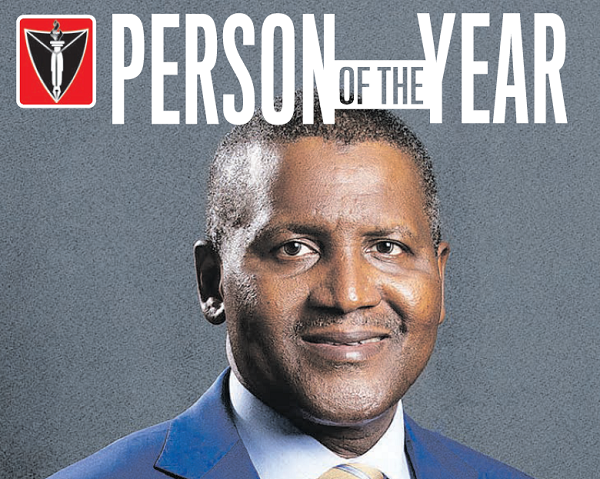
Little about Alhaji Aliko Dangote fits his profile as a man of money. His voice is mellow, almost sleepy. He does not wear the part. Not a flowing babanriga, not a skyey cap, nor perfume that heralds his class. His pair of shoes does not shoos off the commoner. Rather, a familiar picture of a workman, helmet on, almost sweaty. Even his smile is economical, too grave for flamboyance. He is, therefore, a wealthy man as camouflage. But in the past year, his name has generated no ambiguity. There is no ambiguity about the rage of labour, fear of inflation, about hundreds of men that lost their jobs and got them back, about a rich man in battle with most tempestuous humans in the country: labour leaders. Above all, there is nothing foggy about the nation’s original sin: oil.
Dangote was enmeshed in all these and more in the course of the year. He was at war with the workers when he separated 800 hefty humans, most of them with mouths to feed. He dueled with DAPPMAN, otherwise known as Depot and Petroleum Products Marketers Association of Nigeria. He also stared down IPMAN, also known as the Independent Petroleum Marketers Association of Nigeria. Whether with DAPPMAN and IPMAN, Dangote always wanted to show that he was the man of oil in the country.
No showman, he was the show. If it was about pricing, he was accused of making the big buck at the expense of others. But when the story unveiled, we witnessed a paradox. The rich man was hailed by the people. How did that happen to the man who is accused often of monopoly everywhere? Wherever he turns, so goes the charge, he turns money his way, and all the money. Cement, transport, et al. Now in the nation’s jugular, they say he has come crude again, barreling his way through the market, lapping up all the juice of oil.
At one point, they said it was not fair that the price of gasoline was dropping. The people said it was fair. The marketers said it was not. It was not good for business. The man was turning himself it an ugly profiteer. Dangote gave us the billionaire’s paradox: a wealthy man on the people’s side.
The consortium was fighting against one man. The consortium was weeping against one man. One man was whipping them. The people saw it differently. It was the man fighting against a rabid oligopoly. The people did not use that word. They did not know that word. They did not care about that word. They cared about one thing: their pockets and their prices. Dangote seemed to abide by their creed: let the prices drop.
The people did not know the niceties of economics. They knew their lives. Costs were not soft, bread, yam, tomato and garri were not so cheap even though, in the course of the year, prices have consistently dropped. The price of fuel was always a sticking point. The Tinubu administration’s decision to remove fuel subsidies put the industry in special position. Dangote became a poster figure of that industry, especially since NNPC has been wrapped up in one form of opaque scandal after another. Dangote has become cause celebre and a sort of implementer of the fuel policy. The price of fuel became the excuse and cause of any inflationary iniquity, from house rent to house help.
Another script in the drama. Dangote turned into a guarantor of national security when PENGASSAN decided to call for strike. The man had fired 800 workers for alleged sabotage, and a strike, the perennial sledgehammer of labour, was invoked to teach the man a lesson. Suddenly, it was not about bread and butter alone. Not about families without breadwinners. It was whether the labour leaders wanted to jeopardise our collective safety. Bringing down the refinery was to lock the country down, although it was a threat to fuel flow with long queues looming in petrol stations. The billionaire stood against the labour leaders on the side of national security. the mass stood beside the Dangote. A billionaire as nationalist, as patriot?
Such images are rare in history. Billionaires treasure their nests so much that they often have no loyalties except to their treasures. Yet we have seen over the ages where they stood with the people. It is considered by historians as a great paradox. It is the coincidence of a nexus of money and public good. June 12 was about democracy as it was about Nigeria’s money giant fighting and dying for a popular cause. We saw that in the French young man of wealth Marquis de Lafeyette who defied his king and yielded to the romance of a revolution. He became a soldier in the American Revolution. Even among the Americans, one of the founding fathers Robert Morris was known as the financier of the revolution. George Soros, the defiant Hungarian, gained notoriety in the American right for sponsoring candidates for the people.
Such men take up such roles without intention. They are accidental populists because of the sovereignty of impulse. They pursue their businesses, and find themselves and their money on the side of the popular cause. Whether or not that is the intention of Dangote, he was the centre of the drama. For orchestrating the furies and hopes in the majority of Nigerians for the majority of the year, oil magnate Alhaji Aliko Dangote is The Nation’s PERSON OF THE YEAR.
In this edition, we also look at other highfliers for good or ill. For instance, former Central Bank governor hauls the scandal of the year for the forfeited Abuja Estate of 753 high-level homes that tells the acquisitive greed of one man in public office who almost ran to lead the country. The Mokwa flood showed the precedence of nature over humans as the disaster of the year. We saw an unthinking might of water lap up lifeblood after lifeblood. Nor can we forget the issue of the year, as governor after governor, lawmaker after lawmaker defected to the ruling party, stirring debate over whether we are running a pluralist politics. It was a beauty-and-the-beast story in the senate between Natasha Akpoti-Uduaghan and senate president Godswill Akpabio bringing up the controversy of the year. Akpoti-Uduaghan did not release a smoking gun as she promised and that made the story less about substance and more about a woman of smoky beauty stoking imaginations of forbidden passions that some saw as a political equivalent of a gang rape or a lying accuser.
Of course, Wike versus Fubara, godfather versus godson, politics as oedipal clash. It raked up dusts of state of emergency, presidential power, law and ethnic foreboding. It is our conflict of the year. The tax reform is policy of the year for all its political, regional and rich-versus-poor reverberations. It is a matter that will kick off in the new year, and its far-reaching consequences will visit every citizen. Gaza clutches the international conflict of the year, dwarfing Ukraine for its fatal mix of faith and murder.
Ola Olukoyede, EFCC boss, has been without any form of public vanity but he has pursued with singular zeal an integrity culminating in profit. He has let the thieves pay for our public good, including NELFUND.
We cannot play down our sports person of the year, Victor Osimhen, whose lopes and goals conjoined with a magisterial head to bring his country fame and joy. So were the Super Falcons who snag the team of the year for their exploits on the continent and world. Rema was no less an ambassador with his act as a throaty impresario from Benin to India with his song of the year in his Baby.