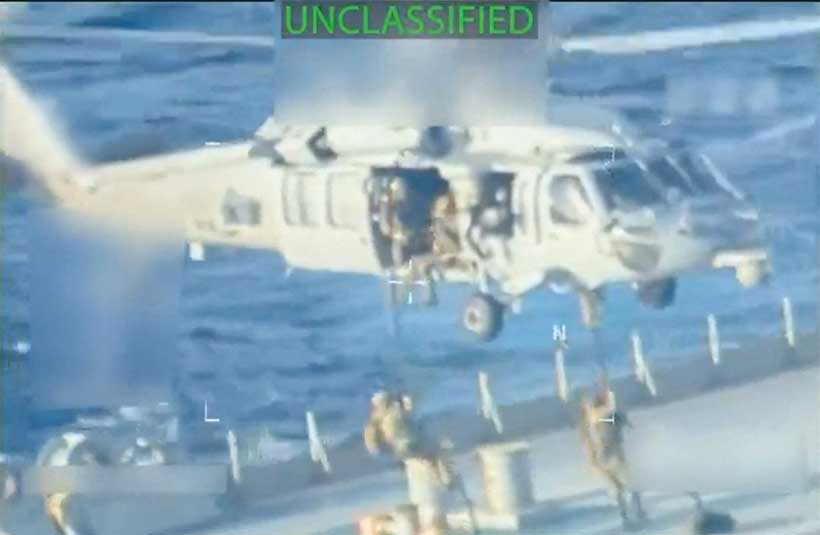
On December 11, 2025 (local time), the U.S. Navy seized a Venezuelan oil tanker, a development that underscores the growing risk of a full-scale confrontation.
President Donald Trump confirmed the incident: “We just seized an oil tanker off the coast of Venezuela—a very large tanker, in fact the largest ever—and more things are happening,” he said, adding that the vessel would be confiscated.
According to Reuters, the U.S. plans to continue detaining Venezuelan ships and may escalate further. Earlier, on November 30, 2025, President Trump and his Venezuelan counterpart held a rare phone call—their first since maritime tensions erupted. Washington is exerting maximum pressure to isolate Venezuela and force President Nicolás Maduro to resign. María Corina Machado, the Venezuelan political figure and Nobel Peace Prize laureate, has received U.S. backing as a potential replacement for Maduro.
The Return of American Isolationism
The recent developments in Venezuela not only increase pressure on President Nicolás Maduro’s government but also signal the re-emergence of isolationism in U.S. foreign policy.
Isolationism first appeared in President George Washington’s founding address and was later formalized in the Monroe Doctrine of 1823. President James Monroe outlined four key principles, including the warning that “any attempt by European powers to oppress or control any nation in the Western Hemisphere (Central and South America) would be viewed as a hostile act against the United States.”
At the time, several European nations were seeking to expand their influence and restore colonial systems in South America as a way to revive their economies after devastating wars on the continent. Such efforts threatened America’s role, position, and security in the region. As a result, the United States positioned itself as the protector of the “New World,” laying the foundation for the rise of American isolationism.
During the Cold War, the crisis in the Bay of Pigs and the Soviet deployment of missiles in Cuba pushed Washington to intensify efforts to topple Fidel Castro’s government in order to safeguard U.S. national security. American policymakers intervened in numerous Central and South American countries, building pro-U.S. governments to secure Washington’s distant defense perimeter.
Over time, isolationism was no longer confined to protecting the Western Hemisphere. It became a tool for the U.S. to isolate governments across the globe—such as North Korea, Syria, Iran, and Libya—inflicting severe economic damage and limiting their ability to integrate into the global system.
Venezuela is a clear example of American isolationism at work. U.S. strategists see Caracas as a target for intervention. The country holds some of the world’s largest oil and energy reserves. As of 2023, Venezuela was estimated to have 303 billion barrels of crude oil—around 17% of global reserves—five times more than the United States, which holds 55 billion barrels.
Venezuela is a clear example of American isolationism at work. U.S. strategists see Caracas as a target for intervention. The country holds some of the world’s largest oil and energy reserves. As of 2023, Venezuela was estimated to have 303 billion barrels of crude oil—around 17% of global reserves—five times more than the United States, which holds 55 billion barrels.
For these reasons, the Trump administration’s recent actions are not merely hostile gestures—they reflect a deeper return to American isolationism. Venezuela is likely to face escalating pressure from President Donald Trump’s government.
U.S. policymakers aim to pull Venezuela—and the broader region—away from the influence of Russia and China. The presence of these powers in America’s “backyard” is seen as a long-term threat to Washington’s security and strategic interests.