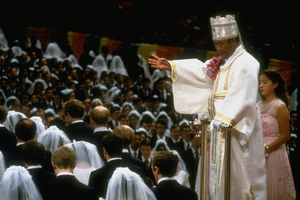
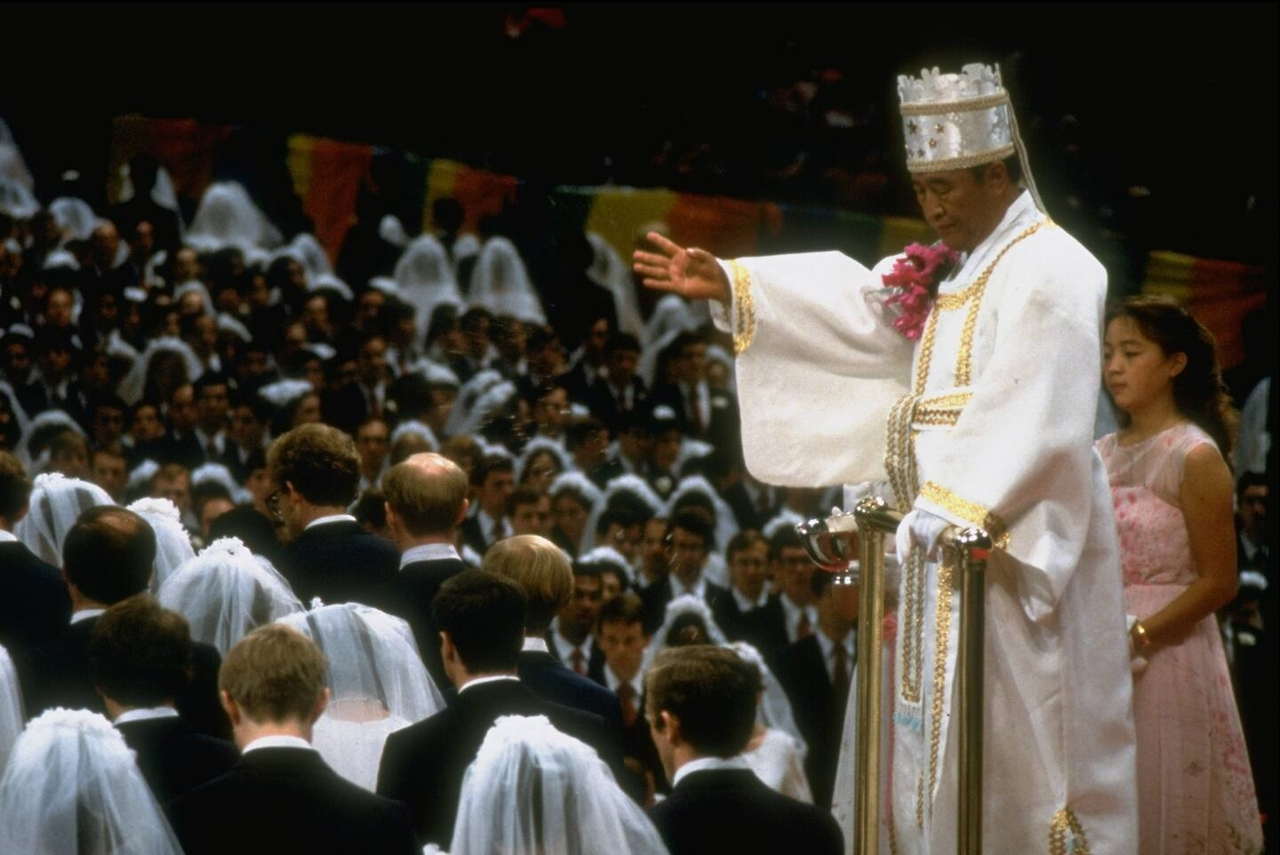
 Unification Church former leader and current head Han Hak-ja’s late husband, Sun Myung Moon, presides over a mass wedding ceremony in this undated photo. (Getty Images)
 Long known for its stadium-scale mass weddings that drew global attention — and for its followers’ widely used nickname, “Moonies” — the Unification Church has once again landed at the center of a widening political storm in South Korea, amid allegations of illicit lobbying and gift-giving involving political figures.
The allegations, which span contacts with both major parties around the 2022 presidential election, have reignited an old but unresolved question: Why does a religious movement repeatedly find itself entangled in political power?
Observers say the answer lies not only in recent accusations but in the church’s historical DNA, shaped by decades of political engagement, international ambition and internal crisis.
“For the Unification Church, it’s difficult to separate politics and religion,” said Tak Ji-il, a religion history professor at Busan Presbyterian University and editor-in-chief of a monthly religion magazine, told The Korea Herald on Sunday.
“Politics is religion, and religion is politics — that framing is crucial to understanding the current scandal,” Tak added.
Unlike mainstream religious groups that formally distance themselves from political influence, the Unification Church has long viewed political access as a means of fulfilling religious purpose, not a deviation from it.
Founded in 1954 by the late Sun Myung Moon, the church expanded rapidly during the Cold War era, driven by fierce anti-communism and a highly centralized organizational structure. It was never confined to worship alone. Schools, media outlets, businesses and foundations formed a global network that blurred the line between faith, enterprise and diplomacy.
Moon himself operated openly on the world stage. In 1990, he met Soviet leader Mikhail Gorbachev in Moscow; in 1991, he met North Korean leader Kim Il Sung in Pyongyang — extraordinary feats for a religious figure in the twilight of the Cold War.
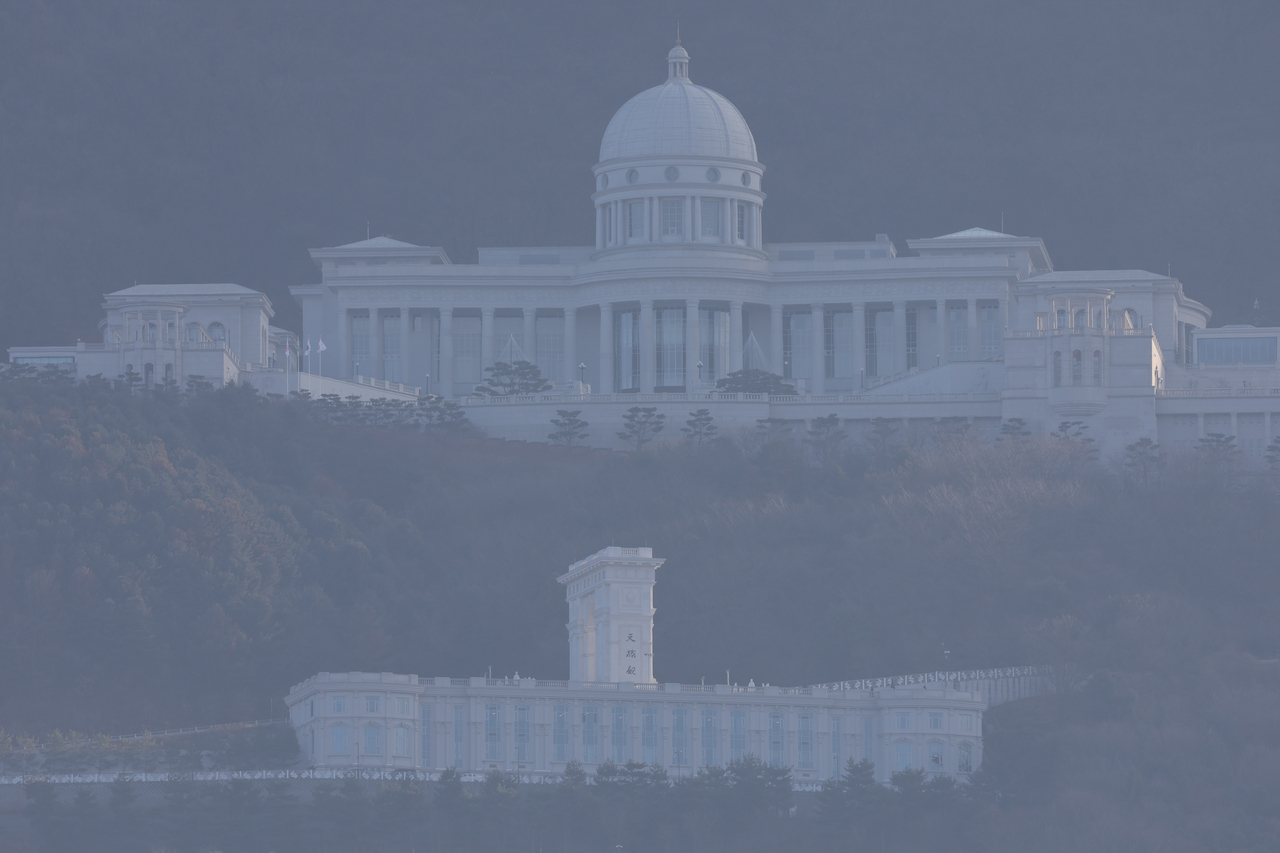 Unification Church headquarters in Gapyeong, Gyeonggi Province (Yonhap)
 The church framed these encounters as “peace diplomacy.” Critics, then and now, saw them as evidence of a religious organization operating as a geopolitical actor.
“In the Sun Myung Moon era, political access relied heavily on the founder’s personal charisma and international connections,” Tak explained. “It wasn’t systematic lobbying in today’s sense — it was Moon himself.”
That personal authority vanished with Moon’s death in 2012 — and the consequences have shaped the church’s recent behavior.
After his death, leadership passed to his widow Han Hak-ja, but succession disputes quickly erupted between her and Moon’s sons. Prolonged internal conflict fractured the movement, triggering lawsuits, factional splits and declining cohesion.
Religious scholars describe the post-2012 period as one of strategic vulnerability. Without Moon’s singular authority, the church increasingly relied on organizational strategies — including political access — to sustain influence and legitimacy.
“Projects the church had long promoted — peace initiatives, overseas development, the Korea-Japan undersea tunnel — cannot be realized through religious influence alone,” Tak said. “They require political power.”
It is in this context that prosecutors believe alleged lobbying efforts intensified.
Elections as opportunity and leverage
Findings by the special counsel team led by Min Joong-ki indicate that recorded statements by Yun Young-ho, former head of the Unification Church’s world headquarters, suggest the organization viewed electoral politics not as a civic process but as a potential source of leverage.
In recordings disclosed during the recent investigation, Yun is heard saying the church had become a “casting vote” ahead of the 2022 presidential election and stressing the need to avoid appearing aligned with only one camp.
“If you look at its past — lobbying US Republicans, Japan’s ruling party, military regimes in Korea — this wasn’t something that suddenly appeared,” he said. “What changed was the scale of risk they were willing to take.”
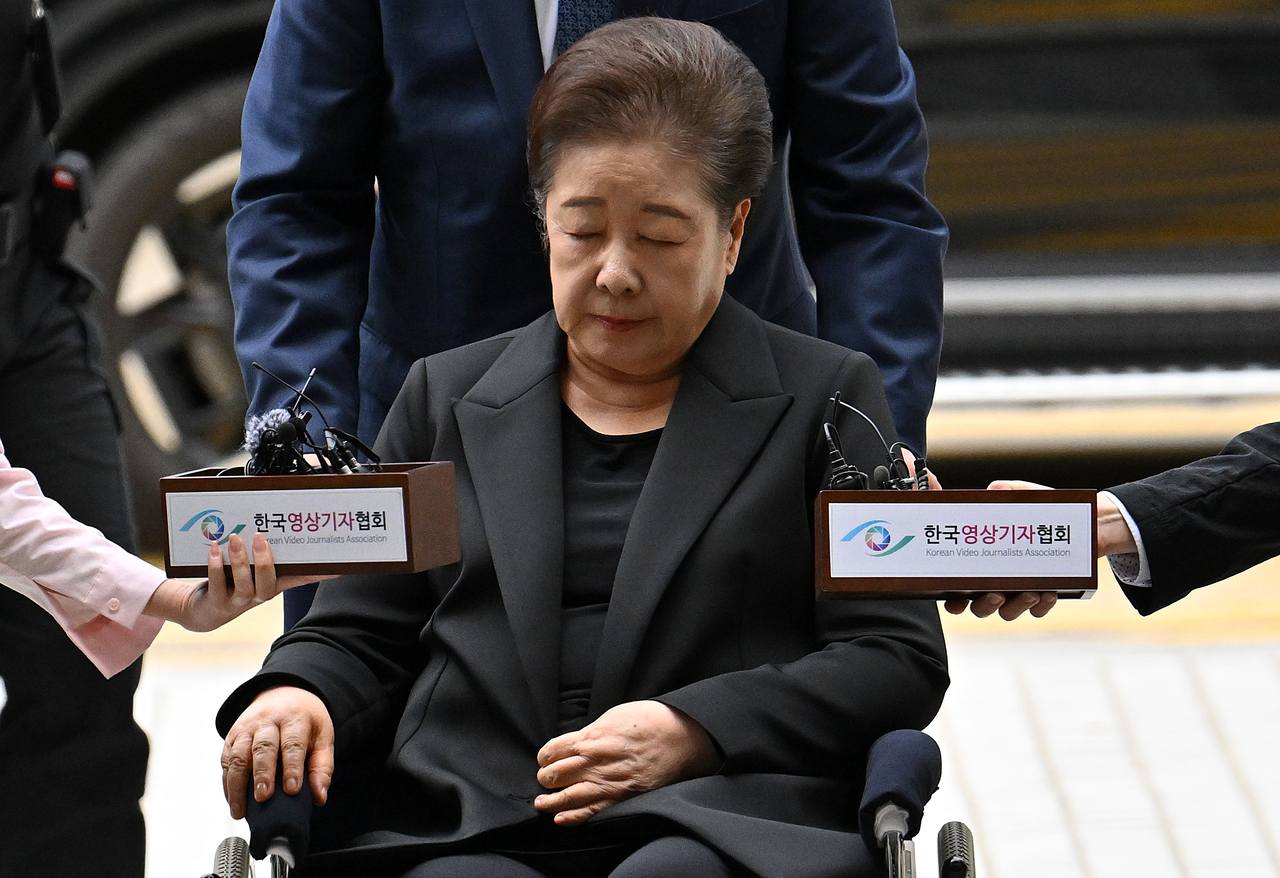 Han Hak-ja, head of the Unification Church, accused of providing illegal political funds, arrives at the Seoul Central District Court in Seocho District, Seoul, on Sept. 22 to attend a hearing to review the validity of her arrest warrant. Han is accused of delivering money and valuables along with various requests to Kim Keon-hee, wife of former President Yoon Suk Yeol, and People Power Party lawmaker Kweon Seong-dong. (Im Se-jun/The Korea Herald)
 The 2022 election period also coincided with a major Unification Church-linked international event, the “Korean Peninsula Peace Summit,” attended by global political figures. Prosecutors view the event as part of a broader effort to display political relevance and restore internal authority amid succession turmoil.
In addition, the church was facing pressure from outside the country.
Following the 2022 assassination of former Japanese Prime Minister Shinzo Abe, scrutiny intensified over the Unification Church’s fundraising practices and political ties in Japan — one of its largest financial bases.
Court rulings and administrative actions since then have severely weakened the church’s Japanese operations, cutting off a major source of revenue.
“Japanese donations accounted for a huge share of the church’s finances,” Tak noted. “Losing that inevitably shakes the entire organization.”
With strained finances and contested leadership, analysts say the incentive to seek political backing likely intensified.
The Unification Church on Friday released a statement insisting the alleged lobbying and gift-giving were carried out by individuals acting alone.
The church’s official stance, however, appears unlikely to shield it from further scrutiny.
The controversy has drawn a direct response from the presidential office, underscoring the sensitivity of the issue in a country where the constitutional separation between religion and the state is explicitly guaranteed.
President Lee Jae Myung on Wednesday ordered a thorough investigation into allegations of illegal ties between religious groups and politicians, his office said, amid mounting scrutiny over the Unification Church’s purported links to the political establishment.
Lee issued the directive a day after a special counsel referred a case involving alleged ties between the Unification Church and lawmakers from the ruling Democratic Party to police, following criticism that the probe had previously focused only on members of the opposition People Power Party.
“President Lee instructed authorities to conduct a thorough investigation into allegations of illegal involvement between a specific religious group and political figures, regardless of party affiliation or position,” the presidential office said in a press notice.
And as investigations continue, South Korea is being forced to confront an uncomfortable question that has lingered for decades: How far should religious movements be allowed to go when faith and politics become indistinguishable?
mkjung@heraldcorp.com