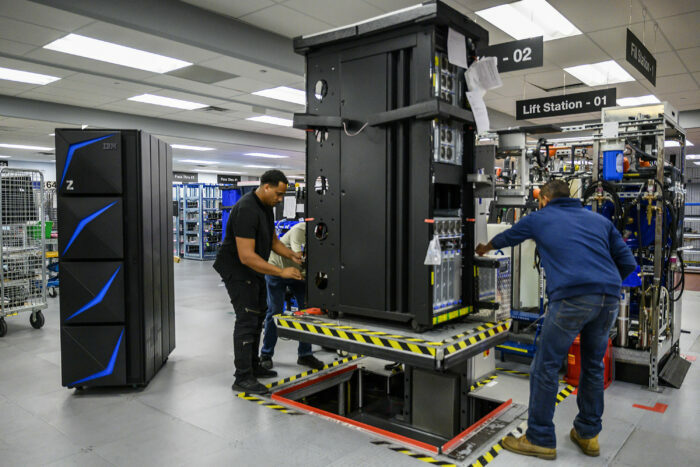
POUGHKEEPSIE, NY – By 2033, IBM plans to build the world’s first-ever large-scale and fault-tolerant quantum computers at its Poughkeepsie facility. This long-term commitment to the Hudson Valley represents IBM’s most significant investment at the Poughkeepsie facility in recent memory. The Starling and Bluejay projects, announced earlier this year, outline the roadmap IBM will follow, aiming to lead to quantum computing systems far more powerful than current technology.
Firstly, what makes quantum computing powerful? Quantum computing is extremely powerful as it has the ability to explore and process many different calculations, which is impossible for classical computers, exponentially increasing the speed and efficiency at which the computer can perform calculations, which is ideal for problems that classical computers simply are not equipped to solve. Starling, which is expected by 2029, is designed to perform 20,000 times more operations that today’s quantum computers, approximately 100 million quantum operations. Its successor, Bluejay, is expected by 2033 and is designed to execute 1 billion quantum operations.
 Photo by IBM
Jamie Garcia, director of strategic growth and quantum partnerships at IBM Quantum, provided insight on the forces that drove IBM’s $1 billion investment in quantum services. “IBM has built the world’s largest ecosystem of quantum explorers, adopters, and users, with over 300 IBM Quantum Network members, including enterprises such as Vanguard, HSBC, and E.ON, as well as government agencies and universities,” said Garcia. “Some of the early applications we see driving demand include drug development, materials discovery, chemistry, and optimization.”
The Poughkeepsie facility operates on what IBM describes as the highest number of available utility-scale quantum computers at a single location globally, while also housing the world’s first quantum data center. IBM’s quantum work spans throughout the Hudson Valley from its research headquarters in Yorktown Heights to a fabrication facility in Albany, where quantum processor components are manufactured.
Stakeholders from Westchester to Rensselaer County have branded the region “Quantum Valley” to emphasize IBM’s quantum computing presence, which includes research facilities in Yorktown Heights and a quantum computer installed at Rensselaer Polytechnic Institute in Troy in 2024, making it the first university in the world to house an IBM Quantum System One on their campus.
“All of this work is happening at the IBM facility in Poughkeepsie, NY, home to an IBM Quantum Data Center which currently operates the highest number of available utility-scale quantum computers at a single location in the world,” said Garcia, outlining the importance of the Poughkeepsie facility. “IBM Quantum Starling and Blue Jay will be built in a new IBM Quantum Data Center at the facility and made available to IBM Quantum Network members through the cloud,” Garcia finished.
There are many resources that quantum computing demands, including ultra-low temperatures, vast energy for cooling operations, and specialized materials. Something unique about the Poughkeepsie facility can be explained by Ron Hicks, Dutchess County assistant executive for strategic planning and economic development, who said that the Poughkeepsie facility has an infrastructure advantage from IBM’s mid-century expansion, from when it first established itself in Poughkeepsie in 1941. “They built out, overbuilt if you will, infrastructure,” he said. “So they have more than enough water, sewer, electrical capacity, gas capacity,” implying the county doesn’t foresee needing to make major infrastructure investments to support IBM’s quantum expansion, unlike projects in other regions that require extensive new development to meet the needs of their facilities.
It seems as though the county sees workforce availability as a key factor in IBM’s site selection decisions. Since 2014, Dutchess County has invested in technical training programs, including an $8.5 million aviation maintenance program and a mechatronics lab that opened in 2023. “Its curriculum and the selection of equipment IBM was directly involved in. So, when we said to our manufacturers that we wanna support you, we asked them what do you need?” said Hicks. “It’s a very indirect way of supporting the workforce development infrastructure, essential to IBM,” he continued, emphasizing Dutchess County’s role in providing the foundational skills that would be applicable across the region.
While there is economic impact expected, it is not expected to be transformational. “I don’t want anyone to think that tomorrow or the next five, 10 years that businesses are going to boom and everything’s going to change our world,” Hicks said. “What we see here is IBM seeing Poughkeepsie as incredibly strategic to IBM corporate. We see stability.”
IBM currently employs just under 4,000 people at the Poughkeepsie facility, down from a peak of 32,000 in the region during the 1980s as the company went under substantial downsizing in the early 1990s, prompting county officials to look into economic diversification. Hicks said quantum-related job growth is likely but difficult to quantify at this stage. More immediately, the facility attracts business visitors from around the world for demonstrations of quantum systems. “They stay here overnight. That means we have our hotels that get business, our restaurants get business.” said Hicks.
An important milestone for IBM’s quantum computing projects was achieved in 2023 is quantum utility, which is when a quantum computer can run quantum circuits more accurately than a classical computer can simulate them. Many quantum computing simulations were performed on classical computers, making this a huge turning point as it moves quantum computing beyond simulation and into true experimentation.
Jamie Garcia, providing a forecast on the timeline of these projects, said this. “We believe we will see the first examples of advantage as soon as next year. To support this, IBM recently announced a new open, community-led quantum advantage tracker to systematically monitor and verify emerging demonstrations of advantage, along with a number of new hardware and software innovations we believe will help our community get there. As we look beyond advantage, there are several other hardware and software milestones we need to achieve on the path to fault tolerance,” Garcia continued, making a point of both the importance of quantum advantage but also of not looking too far down the road.
Garcia highlighted how IBM has consistently delivered on published milestones along their quantum roadmap. “That should give confidence in our ability to deliver a large-scale, fault-tolerant quantum computer by 2029,” she said.
Quantum computing technology has also attracted significant attention from both government and industry. IBM announced plans in 2024 to invest $150 billion over five years in U.S. technology leadership, including more than $30 billion for research and development, seeking to separate themselves from other tech companies. IBM is the leading east coast player when it comes to quantum computing but faces fierce opposition on the west coast from tech giants such as Microsoft, Amazon, and Google.
Hicks said that the attention directed towards quantum projects provide a marketing tool for the region. “When we tell people about what’s going on in Poughkeepsie, it makes people impressed with the area and they want to know more,” he said. For residents, “Something that is going to change the world is happening in their backyard.” said Hicks.
The quantum projects at the Poughkeepsie facility will unfold over the next decade. Until then, the county will continue monitoring IBM’s progress and stay ready to provide support as needed, both learning from history and maintaining their focus on economic diversification to avoid over-reliance on IBM. All in all, investment and operations at the Poughkeepsie facility signal continued investment from IBM, but the next decade will reveal whether quantum computing brings transformation or simply reinforces IBM’s continued presence in Dutchess County and the Hudson Valley.