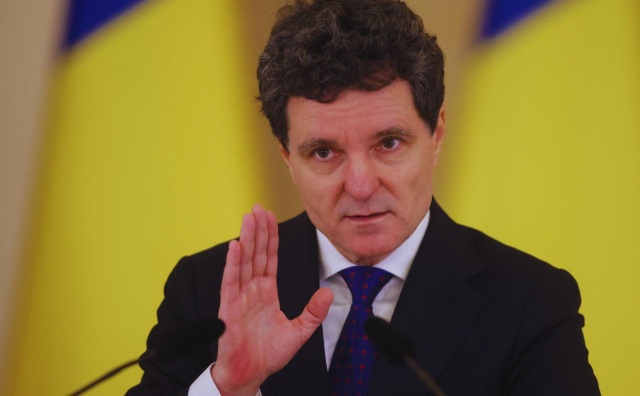
Romanian President Nicușor Dan said Europe must send an unmistakable signal to Moscow that it is prepared to defend itself, even as it seeks to avoid war. Speaking to France 24, he stressed that Romania and its partners do not want armed conflict on European soil, but Russia must be clearly told that any attack would be met with readiness and resolve. According to Dan, clarity and firmness are essential for deterrence.
Dan was elected president in May with 53.6% of the vote, defeating far-right, pro-Trump and Eurosceptic candidate Gheorghe Simion. He ran on a pro-European, anti-corruption platform after a turbulent electoral process. The initial presidential vote in November 2024 was annulled by Romania’s Constitutional Court over violations linked to the use of TikTok as a campaign tool, which benefited pro-Russian candidate Călin Georgescu in the first round. Dan said the court’s decision was justified, arguing that Russian interference and breaches of campaign finance rules distorted the vote. In his view, Moscow’s disinformation efforts in Romania date back a decade, but authorities underestimated their impact until new technologies amplified their effect in the final weeks of the campaign.
Fighting corruption has been placed at the center of Dan’s presidency. He acknowledged that corruption exists across all levels of Romanian society and said addressing it requires both administrative reforms and decisive action within the justice system. While there is political will to tackle the problem, he warned that meaningful results will take time.
Economically, Dan highlighted that Romania’s average purchasing power has grown by 134% over the past two decades, the strongest increase in Europe. At the same time, the country faces a serious fiscal challenge, with a budget deficit of 9%, well above EU limits. To address this, the government has implemented austerity measures that will continue next year. Dan said no additional, unexpected steps are planned and projected the deficit to fall to between 6% and 6.5%. He described the measures as painful but unavoidable, stressing the need to reassure investors, banks and financial markets that Romania can bring its public finances under control.
Domestically, Dan pointed to recent political developments in Bucharest, where liberal candidate Ciprian Ciucu was elected mayor on December 7, defeating far-right contender Anca Alexandrescu, who had been leading in polls. He warned, however, that anti-European and even pro-Russian forces remain influential. Referring to the AUR party, he said alliances on the far right can secure 35–40% of the vote. Dan argued that many of their supporters are not inherently anti-European, but feel marginalized by mainstream pro-European parties. Rebuilding trust with these voters, he said, is a key task for the coming years.
On security, Dan noted that Romania, which shares a 650-kilometer border with Ukraine, has sharply increased defense spending. Military expenditure reached 2.2% of GDP in 2024 and is expected to rise to 2.5% in 2025. The country is also set to receive 16.7 billion euros through the EU’s SAFE program, which provides competitively priced loans for defense. Dan argued that, given the current geopolitical environment, Europe must be able to defend itself quickly. While Romania has signed long-term contracts with US defense companies valid until 2033, he said the priority now is to strengthen Europe’s own defense industry. He cited contracts already signed with France’s Mistral, potential deals for Airbus helicopters, and ongoing cooperation with Thales, adding that funds from the SAFE program will be spent primarily within Europe.
The Romanian president reaffirmed his strong support for Ukraine, describing the situation facing the Ukrainian people as tragic. He said Europe must continue backing Kyiv and demonstrate to Russia that support for Ukraine will be sustained over the long term, including through unconditional financial assistance.
Commenting on the United States and statements from the Trump administration portraying Europe as being in decline, Dan said such positions are not new. He recalled that even during Trump’s first term, Washington signaled a strategic shift toward the Pacific. On ideological differences, Dan said the EU needs its own internal debate, noting that while Europeans often argue these issues nationally, they fail to elevate them to the European level. Despite disagreements, he emphasized that Europe and the United States remain interdependent and broadly share the same core values.
Finally, Dan addressed the EU’s decision this week to tighten migration policy, including plans to send migrants to centers outside the Union. He said the bloc must strike a careful balance between respecting the rights of people fleeing hardship and the practical limits of what member states can absorb. Romania, he added, is ready to take part in this debate at the European level.