The only way to eat an elephant, according to the old and slightly distasteful advice, is one bite at a time.
The wisdom of reaching your goal through steady, incremental progress hardly requires such elephantine emphasis, and Irish rugby players in the era of Joe Schmidt used to express their devotion to short-term goals differently.
They talked about reducing a match to a series of 80, one-minute contests; their logic was that if they won more of those minutes than the opposition, they would win more than they lost.
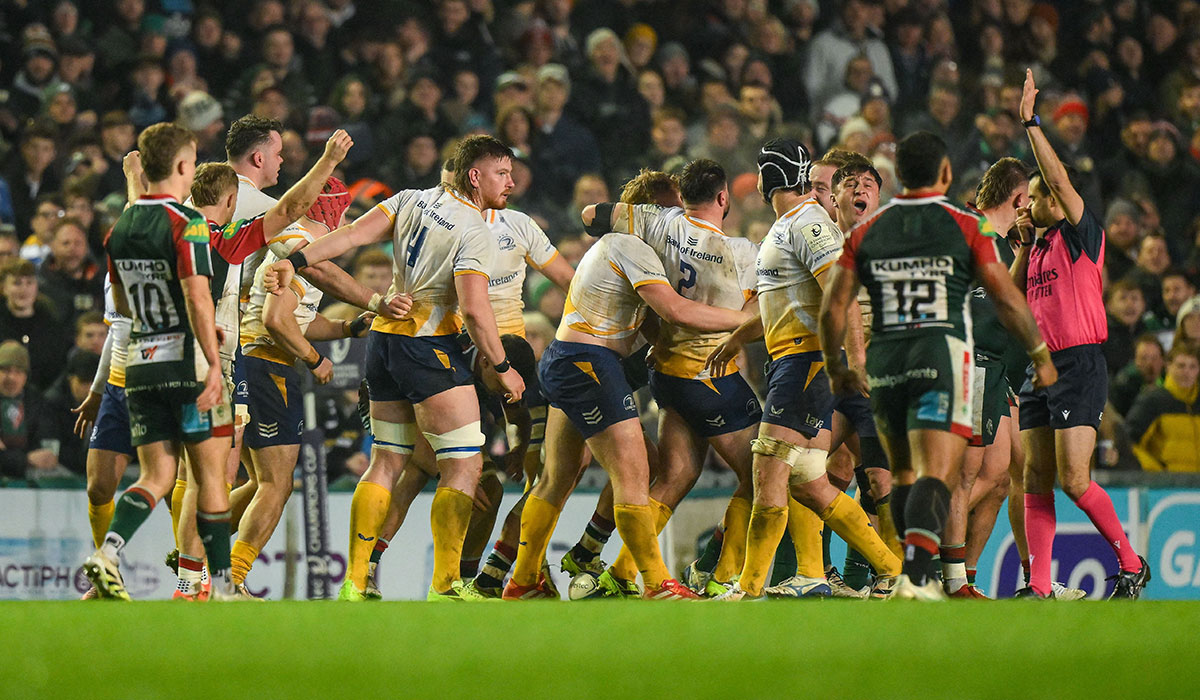 Referee Pierre Brousset awards a scrum penalty against Leinster during the Investec Champions Cup match between Leicester Tigers and Leinster. Pic: Brendan Moran/Sportsfile
Perhaps there is a willingness in the Leinster camp to embrace that thinking this morning. In a season of fractured form, with injuries mounting up and against a backdrop of speculation around the future of one of their leading coaches, two wins out of two in the Champions Cup might give them reassurance that they are doing more right than wrong.
Such a line of thinking is delusional. Leinster have collected nine points from two matches against a pair of English sides who are miles off the standards at the top of the European game.
Both Harlequins and Leicester are also well off the standards set by Bath in their own domestic game.
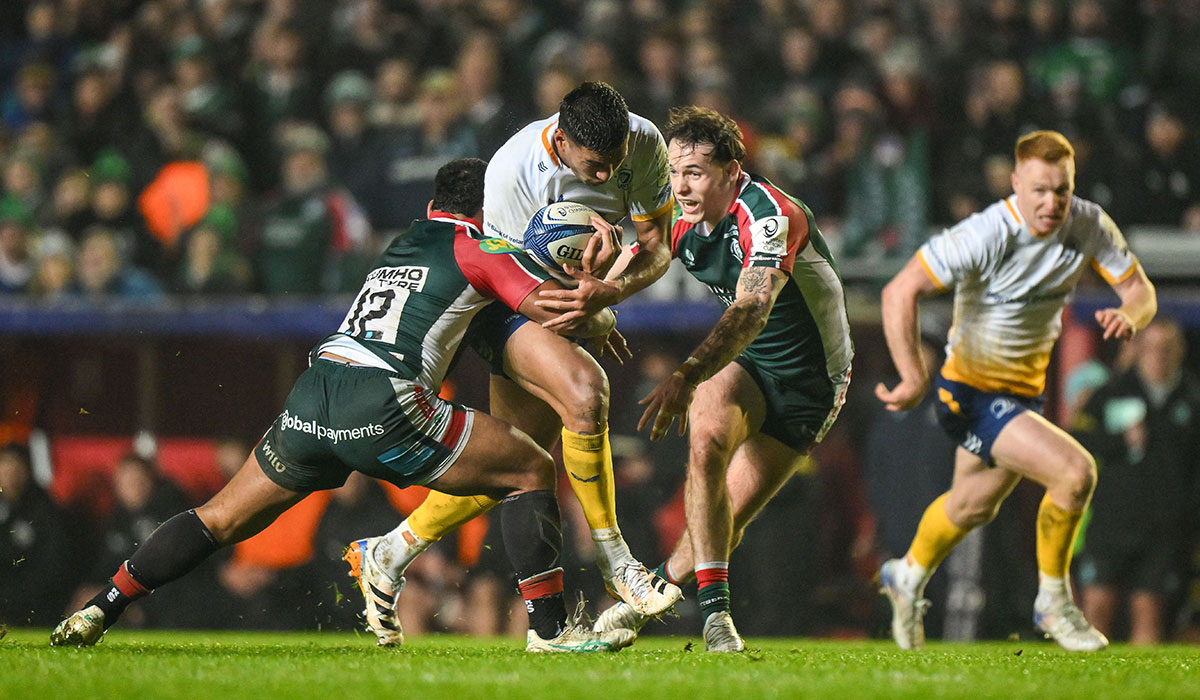 Rieko Ioane of Leinster is tackled by Solomone Kata, left, and Will Wand of Leicester Tigers. Pic: Brendan Moran/Sportsfile
Leicester on Friday night were much better than Harlequins a week earlier, but even the latter were within three points of Leinster with an hour gone.
At Welford Road two nights ago, Leinster squeezed into the lead at the same point in the match through a Harry Byrne penalty.
It would be another ten minutes before they finally put distance between themselves and the opposition through Dan Sheehan’s try.
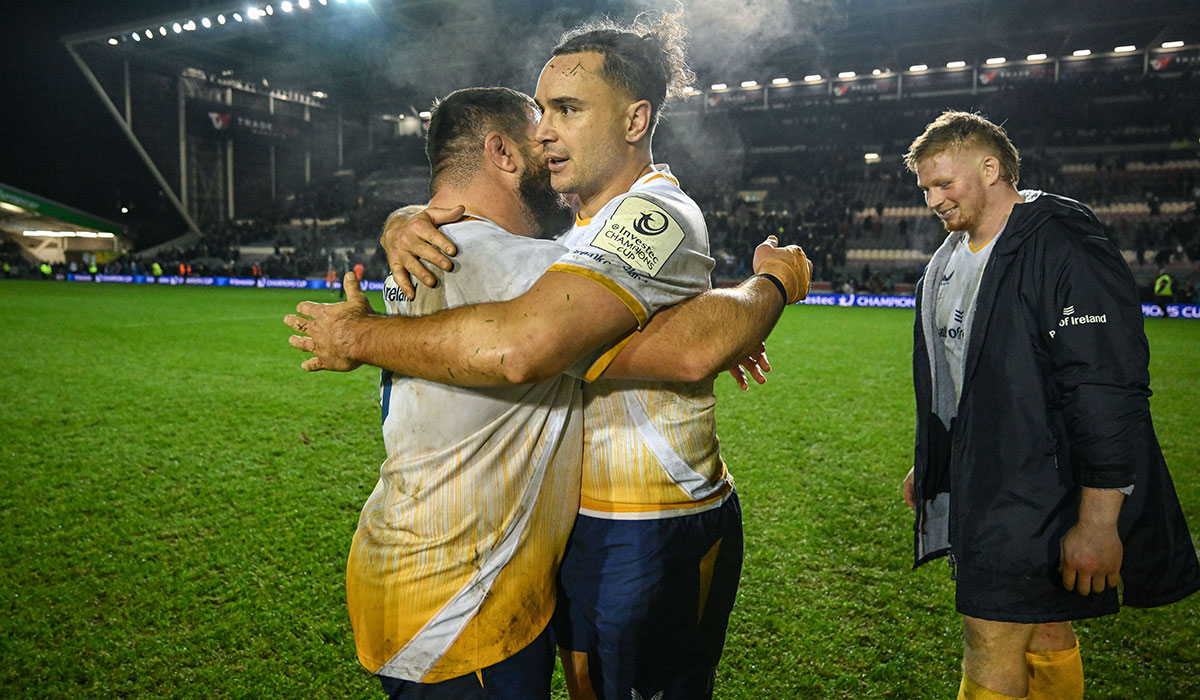 Rabah Slimani, left, and James Lowe of Leinster after the Investec Champions Cup match between Leicester Tigers and Leinster. Pic: Brendan Moran/Sportsfile
Spirited as Leicester were, this was a middling English team still getting used to a head coach who only arrived in late summer, and with almost half of their firstchoice team unavailable.
And Leinster were sweating to beat them for more than 70 minutes. A bench that included Sheehan and Rabah Slimani finally put them on their way, but it would be a mistake to chalk this down as one more incremental win placed like a building block on top of last week’s triumph.
This was not in the spirit of 80 one-minute victories. Instead, it stood apart as a match won thanks to bench impact and the role played by a veteran Test and Lions star like Jamison Gibson-Park.
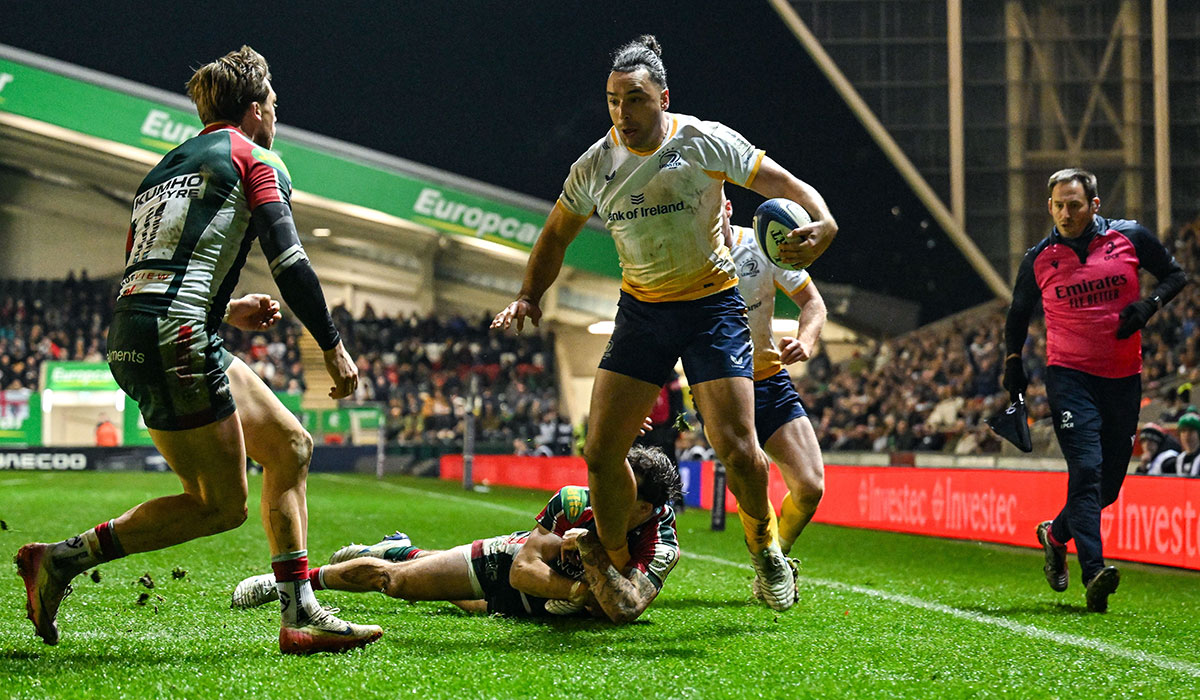 James Lowe of Leinster is tackled by Will Wand of Leicester Tigers. Pic: Brendan Moran/Sportsfile
It was a victory that in its own narrow terms might offer satisfaction – the outstanding Joe McCarthy talked about ‘pounding the rock’, confident it would crumble eventually – but this didn’t look part of a wider plan to reconquer Europe. Rather, it appeared to be a win salvaged by a team that belatedly wielded its enormous advantages over opponents that wouldn’t go away.
Leinster continue to lack coherence, however, and fluency, too. The line-out wasn’t a problem on Friday night, and it almost led to a smashing early try for Tommy O’Brien that, had it not been correctly ruled out for an offside earlier in the move, could have changed the nature of the game.
The scrum was unstable, conceding penalties but winning one, too. Paddy McCarthy had his hands full with England tight-head Joe Heyes, but the young loose-head was brilliant in the loose.
The two McCarthys carried the fight to Leicester on the most primal terms, with Rieko Ioane not far behind them. He wasn’t signed at presumably great expense to engage in arm-wrestles in the English midlands a fortnight before Christmas, but that was the job on Friday night, and he didn’t take a step back.
The mentality of the entire Leinster squad in that regard will have heartened Leo Cullen, but the ongoing search for form, elusive since their humbling on the first day of the season away to the Stormers, should concern him.
He said that Monday of last week was like welcoming back strangers as the Test players returned from over a month away, and most of them had barely figured prior to that as they enjoyed late summer holidays following the Lions tour.
That isn’t helping to build cohesion, but what was notable about Friday’s jerky win was the inability to shake basic errors out of their game.
Misplaced passes abounded, leading to handling errors and therefore more scrum Sam challenges. Then there’s the longer-standing problem of attacking shape, or the lack of it since Stuart Lancaster left.
The demands of learning and implementing Jacques Nienaber’s defensive system have been pointed to as reasons for the diminished offensive game. Cullen was in lighthearted form after the eventual easy canter to victory against Harlequins, but by some accounts there was more of an edge to his postmatch media duties in Welford Road.
After telling the journalists present, tongue presumably near cheek, he loved them ‘to bits’, he then told them he didn’t care what they thought, and he was more interested in judging Leinster against what the squad and backroom staff demanded of themselves.
It had the flavour of us against the world about it, a sentiment Sheehan used to season his take on their opening match.
Teams source motivation wherever they can, but it’s very early in the season for Leinster to be reaching for that hoary old inspirational technique.
They are four-time European champions with an 88-cap All Black added to their ranks, a squad full of Lions, plus one of the most dominant lock forwards in the world, who also happens to be a two-time World Cup winner.
Expectations are inevitable, and dealing with them was never an issue when they were winning. The same goes for the national team, some of whose number were said to be left bemused by analysis of their November window.
That was the one that began with a flat defeat to an unremarkable New Zealand and concluded with a schooling against a riotous Springbok side intent on humiliation.
Andy Farrell talked after the recent World Cup pool draw about wanting to win it outright, an ambition that befits one of the leading teams in the world.
So, by that measure, November raised more questions and concerns than reasons for optimism.
And the fact that where Leinster ends and Ireland begins can be tricky to determine means that the fortunes of one have a profound effect on the other.
Leinster’s middling European form could then be as a result of Ireland’s rough autumn. Or Ireland’s difficulties might be a consequence of Leinster’s downturn.
One wonders, for instance, what Farrell made of Cullen picking Harry Byrne over Sam Prendergast at out-half against Leicester. Farrell’s preference for Prendergast as his starting No10 is apparent, but Cullen went for Byrne in this match.
He did as best he could behind a forward pack that were finding ball hard to come by given Leicester’s appetite for destruction at every ruck.
Leinster fans will remember the chopping and changing at out-half two seasons ago in the province’s first campaign without Johnny Sexton.
The failure to settle on a first choice in the position didn’t serve them well. Yet Prendergast, for all his precocity, has enough gaps still in his game to make the notion of him enjoying an unchallenged status like late-career Sexton implausible.
He did well when he came on against a tiring Tigers team, just as Byrne pushed his case with a high-tempo cameo in the final quarter against Harlequins.
Leinster won’t win this tournament by regularly rotating at out half, because fluidity in attack will only come with established half backs. The return to form of Gibson-Park is one plus at least in that regard. He was good for the Lions, at times very good for Ireland and he was the difference-maker in Welford Road.
Along with the McCarthys, Caelan Doris was prominent in the pack, and a partnership of Ioane and Garry Ringrose would bring real quality.
Leinster should have the means of meeting their goals within the group, but it will require much more convincing performances than this one.
As in the case of Ireland, however, the wait for a performance that addresses the doubts goes on.
And until that comes, and the days of eked-out, stand-alone wins like this one become a memory, then the jitters about their quest for another European Cup must remain.