“We have accepted Lebanon’s new ambassador, and I hope the process of accepting our new ambassador in Lebanon will follow its natural course,” foreign ministry spokesperson Esmail Baghaei said during his weekly briefing on Sunday when asked about the reported suspension.
Baghaei rejected suggestions that diplomatic ties had been disrupted, saying relations between Iran and Lebanon were long-standing and ongoing.
Iran already has an ambassador in Beirut and that Lebanon’s new ambassador has recently taken up his post in Tehran, he added.
“The relevant process regarding Iran’s new ambassador in Lebanon has been underway for some time,” Baghaei said. “We hope this process will proceed in a normal manner in Lebanon as well, and that our new ambassador will be stationed there.”
 Beirut delays processing credentials of new Iran envoy – Lebanese daily
Lebanon’s foreign minister, Youssef Raji, has declined to advance the administrative steps required to approve Iran’s proposed ambassador, including submitting the credentials to the cabinet and presidency, the Lebanese pro-Hezbollah daily Al-Akhbar reported on Saturday.
Iran’s role in Lebanon and the wider region had fueled instability, Raji told Al Jazeera on Friday, saying Beirut remained open to dialogue if Tehran stopped supporting Hezbollah and ended what he described as interference in Lebanon’s internal affairs.
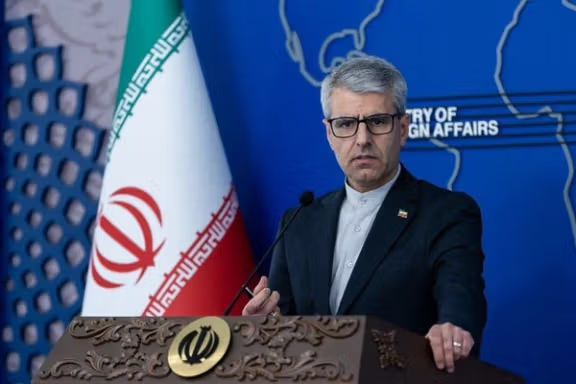 Iran’s Foreign Ministry Spokesman Esmail Baghaei
“Iran’s role in Lebanon and the region has been very negative,” Raji said. “We have a problem with Iran, but we are open to dialogue, provided it stops interfering in our internal affairs and halts funding an illegal organization in Lebanon.”
Iran has long backed Hezbollah and has rejected international and domestic calls for the group to disarm, arguing that continued Israeli actions justify its armed presence.
The diplomatic dispute followed an exchange earlier this month in which Iranian Foreign Minister Abbas Araghchi invited Raji to visit Tehran. Raji declined, citing unfavorable conditions, and suggested meeting in a third country.
Baghaei dismisses Venezuela meddling
In the same briefing, Baghaei brushed off comments attributed to Venezuelan opposition figure María Corina Machado accusing Iran of interference in Venezuela’s internal affairs. He said the claims were politically motivated and unrelated to facts on the ground.
“It is not appropriate to respond to the remarks of someone who has shown no value or attachment to her own country,” Baghaei said.
On reports of Iranian interference in Caracas, he said: “These remarks are irrelevant. Venezuela, as a sovereign country, sets its foreign relations according to its national interests, engages with partners on the basis of mutual respect, and shapes its foreign policy accordingly.”
 Iranian dissident meets Venezuelan Nobel laureate, cites shared struggle
US Secretary of State Marco Rubio this month cast Venezuela as a regional launchpad for Iranian influence, describing Maduro’s government as a narcotics transit hub that hosts Iran’s Revolutionary Guards and its Lebanese ally Hezbollah
Little public evidence exists about the security relationship Venezuela has with Iran or its armed allies. Tehran and Caracas boosted ties under Maduro’s predecessor Hugo Chavez, who cast himself as a bulwark against what he called American imperialism.
Machado said on Wednesday that their influence in Venezuela amounted to an invasion while not directly addressing whether she supported stepped up US military attacks on the country to bring about Maduro’s downfall.
“Venezuela has already been invaded,” she said at a news conference alongside the Norwegian Prime Minister Jonas Gahr Store on Thursday.
“We have the Russian agents, we have the Iranian agents, we have terrorist groups such as Hezbollah, Hamas, operating freely in accordance with the regime. We have the Colombian guerrillas, the drug cartels.”