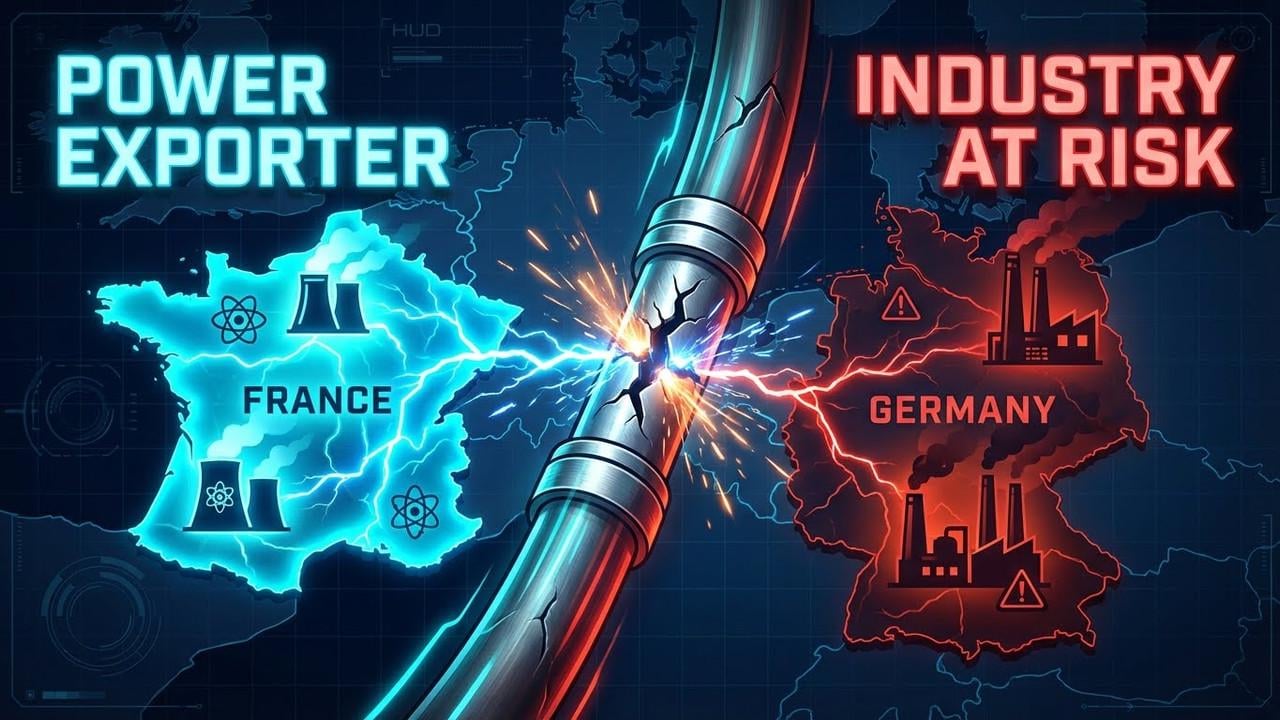
After the 1973 oil shock, France and Germany diverged on energy strategy.
France launched the Messmer Plan — an aggressive nuclear buildout designed to eliminate energy dependency. Expensive, centralized, state-driven. Germany optimized for cheap imported fuel, primarily Russian gas, betting on trade interdependence and flexibility.
For decades, Germany's bet looked smarter. Cheap energy fueled an industrial export machine that became the backbone of the EU economy. France dealt with high capital costs and maintenance headaches.
Then 2022 happened.
The current scoreboard:
- Gas imports from Russia to Germany: 52% in 2021 → 22% in 2022. Nord Stream deliveries hit zero by September 2022.
- German electricity prices: ~38 euro cents per kWh (Reuters, Q1 2025) — among the highest in the world.
- French net electricity exports in 2024: 89 TWh — the highest in their history (RTE).
- Germany shut down its last three nuclear plants in April 2023, locking deeper into gas as gas became a liability.
The industrial consequences are already visible:
- BASF announced closures at Ludwigshafen while expanding its Zhanjiang "Verbund" project in China
- Volkswagen floated German factory closures for the first time in the company's history
- Reuters surveys show over a third of German industrial firms cutting core investment due to energy costs
France is now an electricity exporter. Germany is an importer paying premium prices. Within Europe, this is a slow-motion power shift — the country that can offer abundant, stable, affordable electricity becomes an industrial magnet. The country that can't watches its manufacturing base ask: why produce here?
The strategic implications:
Energy independence isn't just about security. It's about retaining industrial capacity — and industrial capacity is leverage. Countries that deindustrialize don't just lose factories. They lose bargaining power, supply chain control, and the ability to produce strategic goods domestically.
This video breaks down the 5-stage pattern that industrial economies follow when energy costs diverge — and where Germany currently sits in that sequence: https://www.youtube.com/watch?v=FomhunPUWYw
The question I'm watching: Europe may be splitting into two categories — countries that can produce abundant, stable electricity, and countries that have to buy it at the margin. If that's the new dividing line, w
https://postimg.cc/646tFdr5
Posted by HMB94
12 comments
AI written piece to promote an AI-generated video. Reported & blocked.
I have always loved that France actually decided to take advantage of nuclear power. They did it better than anyone else and it’s awesome. They are actually scaling back nuclear power these days but at its peak 80% of electricity was generated by nuclear power and they are going to keep it 50% nuclear.
Every state that was not oil rich could have done this instead of creating Petro states all over the world.
This seems somewhat biased, or politically charged even.
In my view, DE has successfully made a significant shift toward renewables (up to ~2/3?) and is still in transition. FR’s nuclear industry is undoubtedly one of the most advanced, providing cheap reliable energy based on mature technology. But it is too often overlooked associated hidden costs/risks, such as decommissioning (not to mention Chernobyl or Fukushima).
To me, a fairer (and potentially more intriguing) assessment would be comparing DE’s short-term vulnerability with FR’s long-term hidden liabilities.
Who is the author of the video?
Sorry I know this is geopolitics and not economics… But you forgot something. France electricity cost to consumers is the highest ever. It completely exploded. So France didnt win that side at all. Yes its exporting but exporting at a super low price for political reasons.
Also it makes it sound like the german industry is struggling because of gas import problem. No. They are struggling because China became competitively on their sectors. Look at cars.
Nuclear energy is a prerequisite for building nuclear weapons. Germany cannot be allowed to have nuclear weapons. There’s your reason.
This was France 60 years ago : politicians at that time had vision. We can tell the same with the TGV.
Now the country is still living on the results of that period but it creates nothing new. Thanks to our predecessors, we are here now. But with the current politicians, selling our country, doing nothing for the future, we are doomed.
And also, don’t forget that Germany already knew that this situation could happen. What did Germany do with the help of the EU ? Set a regulated prices on electricity so that France could never be a electric power in Europe … and that’s what happened. Even if we produce and export electricity, we gain nothing. Typical German behaviour against their French « ally ».
Messmer, came to earth from the shadow lands? Damn hate to be france those fire golems gonna wreck some stuff
thanks chatgpt.
Did you forget that France’s nuclear reactors are all super old and failing? Weird to not include that in your analysis.
Where is all this recent nuclear love coming from? What I find stranger about it is it’s one of the few things I cannot invest in as a individual or even as a business.
I can buy a diesel or petrol generator I could buy a battery and hook it up for wind turbine or solar panels.
If I live beside the right sort of river I could even do hydro but but there’s nothing I can do in any way shape or form nuclear based. What think tanks are pushing this because ultimately it’s going to governments there’s nothing we can do in the comments.
Germany didn’t just bet on cheap energy it bet on interdependence itself as a security guarantee. France assumed problem were inevitable and paid early. What we’re seeing now isn’t policy failure so much as a worldview mismatch.
Comments are closed.