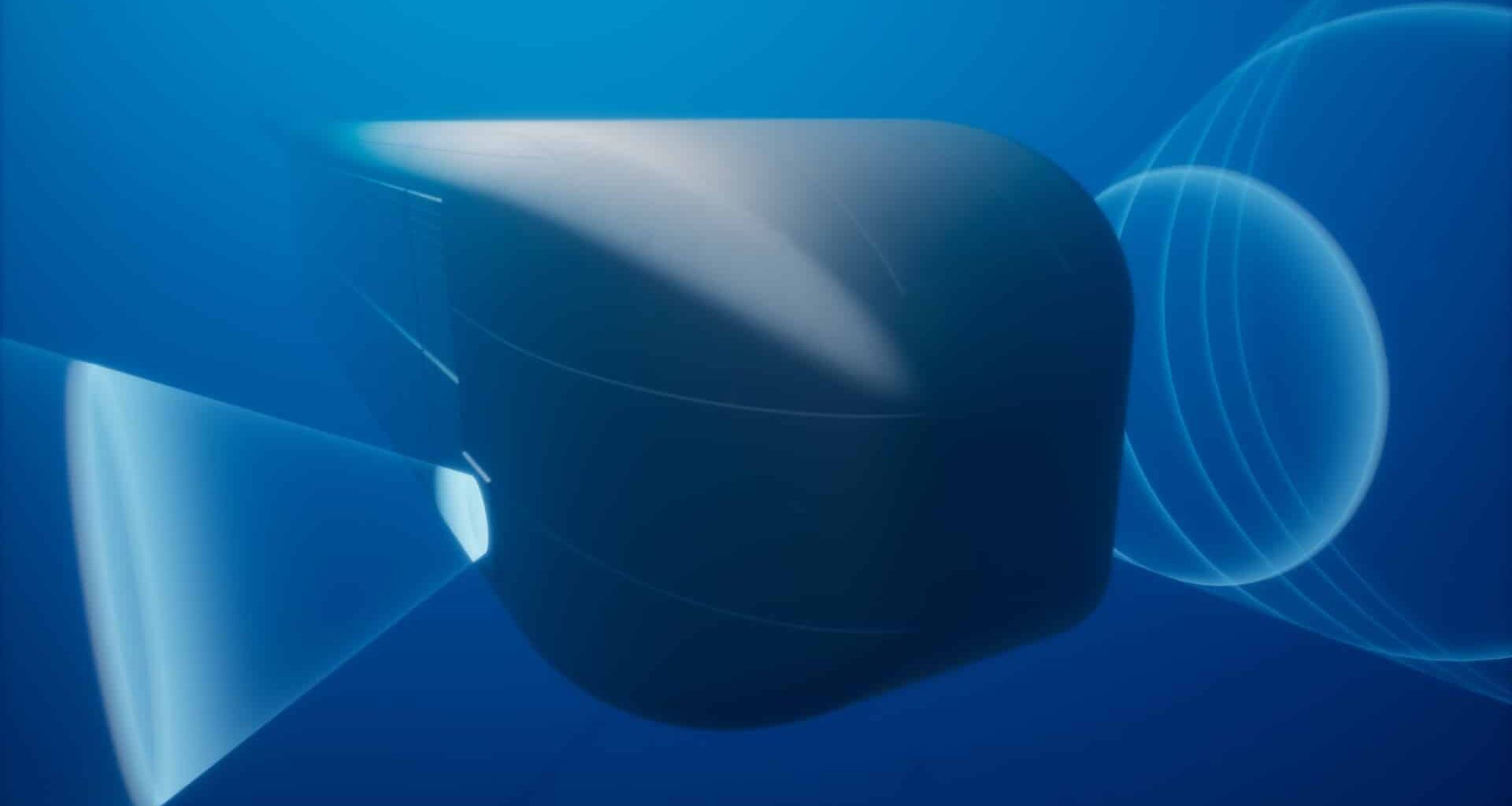
Thales is launching Sonar 76Nano, a compact, miniaturised acoustic detection system designed to meet maritime security underwater sensing requirements of NATO and the Royal Navy.
Thales has taken Sonar 76Nano from concept to prototype in 10 months, bringing new technology innovation but exploiting the proven capability of its in-service Sonar 2076 system.
The company is revealing this new capability as NATO navies continue building up North Atlantic sub-surface sensing presence. Such enhanced presence will augment deterrence and defence against growing anti-submarine warfare (ASW) threats. It will counter underwater-based threats to maritime security tasks including ensuring maritime access, freedom of navigation, sea lines of communication (SLOCs) security, and critical undersea infrastructure (CUI) protection.
NATO navies are acquiring maritime uncrewed systems as host platforms for much of this increased sensing capacity. Thales has designed Sonar 76Nano largely for such uncrewed systems. “Thanks to its modular and flexible design, this sonar system can be deployed onboard a wider range of uncrewed underwater vehicles (UUVs) and seabed monitoring systems rather than being limited to large, high-value platforms,” Thales said, in a statement on 15 December.
Thales said Sonar 76Nano is platform-agnostic, designed particularly for UUVs but applicable to fixed seabed sensing nodes and crewed platforms. The system being reconfigurable for required platforms fits illustrates its modular, versatile design architecture.
According to Thales, Sonar 76Nano supports several core underwater tasks: threat detection; seabed mapping; data collection, including acoustic information; and communications.
Acoustic detection capability is enhanced through artificial intelligence (AI), for example accelerating target identification and decision-making. The system’s AI capability, produced by Thales’ Cortex AI business unit, processes, sifts, and prioritizes data onboard in real-time, with critical information transmitted offboard immediately, leaving remaining data available for post-mission analysis.
Nano need
Thales’ decision to develop Sonar 76Nano was driven by the company detecting an increased tempo in ASW and other underwater sensing operations for the RN and NATO allies, and increasing use of sonar sensing, set against more limited crewed platform availability, Ian McFarlane, Thales UK’s underwater systems sales director, told Naval News.
“If we think back a year ago or so … we could see there was going to be a need for increased ASW capability in the North Atlantic,”
“So, we took a decision to invest our own money in developing a capability we felt could be used for platforms like medium, large, and extra-large UUVs [MUUVs, LUUVs, XLUUVs] to create an ASW tripwire using passive or active surveillance.”
Ian McFarlane, Thales UK’s underwater systems sales director
The capability is designed to meet three core tasks:
Passive and active ASW through receive and transmit arrays;
CUI security and wider seabed survey through using a synthetic aperture sonar (SAS);
Long-range underwater communications through active transmit array and acoustic receive panels.
For the ASW capability, Thales worked with small-to-medium enterprise Neptune Sonar to develop the transmit element.
This capability is for quiet, passive, persistent receive, McFarlane explained: it can be deployed for static sensing on a bottom node, or for mobile sensing on MUUVs, LUUVs, and XLUUVs.
“We’ve developed that [capability] through the prototype stage, we’re fielding in-water, and we’re getting good results from testing,” said McFarlane.
Covertly deploying such ASW capability on a UUV is easier than on a crewed platform, as the UUV is smaller. The UUV can operate independently, within a surveillance ‘net’ alongside other uncrewed systems, or integrated with a platform like a nuclear-powered submarine (SSN) in the underwater domain’s equivalent of the air domain’s ‘loyal wingman’ concept, McFarlane explained. Forward-deploying such capability on a UUV also enhances sensing reach, extending decision time too. “It’s trying to build that recognized underwater picture for warfighters … to give them better information earlier,” said McFarlane.
“This is going to give warfighters a capability they’ve not seen before, being able to put sensors in places they’re transiting through or where they just want to listen or record information, in either a covert or an active way, without putting people at risk,”
Ian McFarlane, Thales UK’s underwater systems sales director
Regarding meeting the CUI requirement with SAS, “What we’re providing is the ability to conduct change detection over a much wider area in a single sweep,” he added.
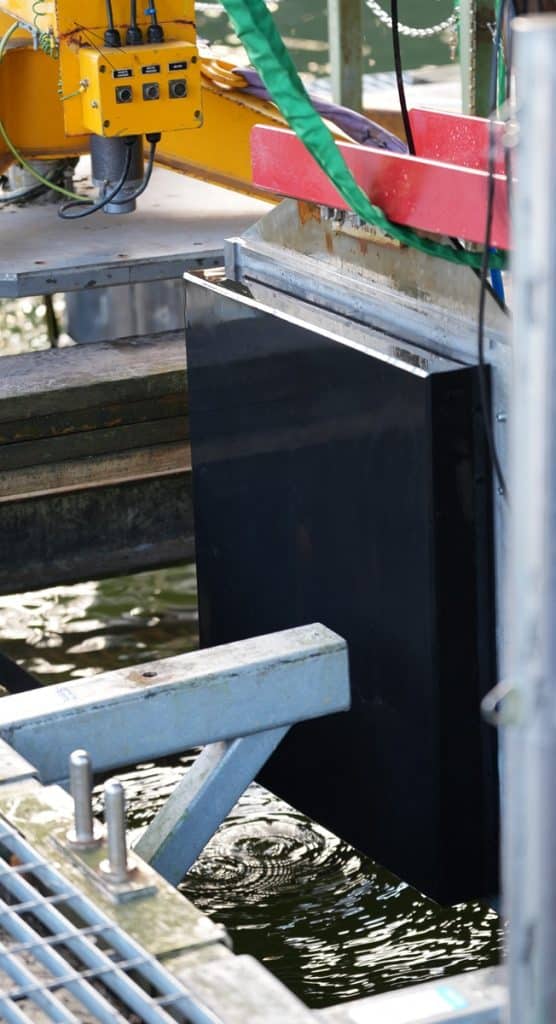
Sonar 76Nano consists of receive and transmit tiles. The receive tiles can be arranged in arrays of up to 48 tiles, on an XLUUV’s port and starboard flanks and on its bow. Thales UK photo.
Core capability
Sonar 76Nano’s core capability involves fitting a suite of acoustic sensing panels (tiles) around the vehicle. The tiles measure 75 cm by 75 cm, and can be fitted port, starboard, and on the bow of a vehicle like an XLUUV.
MUUVs, LUUVs, and XLUUVs are Thales’ target market for Sonar 76Nano, as the capacity in many existing UUV designs offers space to add significant sensing capability, McFarlane said. Arrays scaled up to 48 tiles can be fitted on the port and starboard flanks, and on the bow. “The more tiles you’ve got, the more receive capability you’ll have,” he added.
Each array is accompanied by a single transmit tile, measuring 40 cm by 40 cm, which provides the active ASW element and a medium-frequency SAS capability for CUI search imaging.
Tile numbers and arrays can also be tailored to optimise fidelity and range for a customer’s vehicle and operational requirements, McFarlane explained. This also maximises agility and output when using smaller sensors on different types of smaller vehicles, compared to (for example) Sonar 2076 on a large, crewed platform. This is why an XLUUV is an ideal platform for Sonar 76Nano, said McFarlane, as it provides the space to add sufficient capability. “That’s physics: that’s not going to change,” he added.
Thales said Sonar 76Nano is planned to participate in a UK Royal Navy (RN) technology demonstrator event on 17 December, where navy personnel will gain first-hand understanding of the capabilities and operation of the systems present.
The navy’s ‘Atlantic Bastion’ concept, set out in the UK’s June 2025 Strategic Defence Review, is the RN’s ‘hybrid’ (crewed/uncrewed) contribution to national and NATO North Atlantic underwater sensing needs. It has two phases: the first involves deploying large numbers of UUVs in key North Atlantic waters to build sensing presence; the second involves integrating this initial ‘net’ with greater mass of uncrewed platforms (including XLUUVs) and crewed sub-surface, surface, and air platforms deployed more widely across the region.
Thales sees Sonar 76Nano as adding particular value when working across the wider integrated force, including with the RN’s future Type 26 ASW frigates, which will carry hull-mounted (Ultra Type 2150), towed array (Thales Sonar 2087), and organic airborne (Merlin helicopter Thales Flash dipping sonar) sensors, McFarlane explained. Here, it offers seamless integration including of its wider area picture, he added.
Regarding prototype readiness for production, McFarlane said “We’ve designed it, we’ve built it, we’ve tested it …. We know what it’ll do.” Thales is assessing production approaches, for the UK and elsewhere. “We see there will be a great need for it, and we’re getting ready to supply it,” McFarlane told Naval News.
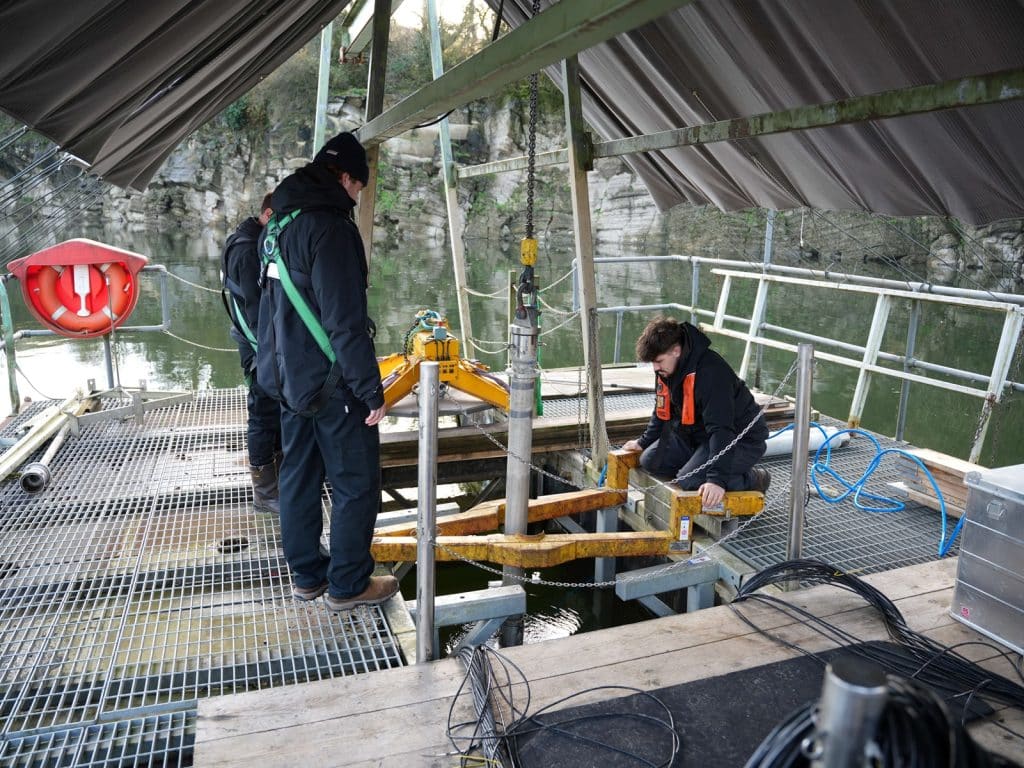
Thales has gone through design, build, and testing for Sonar 76Nano, and is looking at production approaches as part of preparations for system supply. Thales UK photo.
Naval News comment
On 8 December, the UK Ministry of Defence provided a progress update on Phase One of its ‘Atlantic Bastion’ acquisition process. It announced contract awards to 20 companies, under an initial work programme worth GBP4 million, to take concept development activities forward into capability testing with frontline operators in 2026. The RN is aiming for ‘Bastion’ to deliver operational sensing capability into the water in 2026, too.