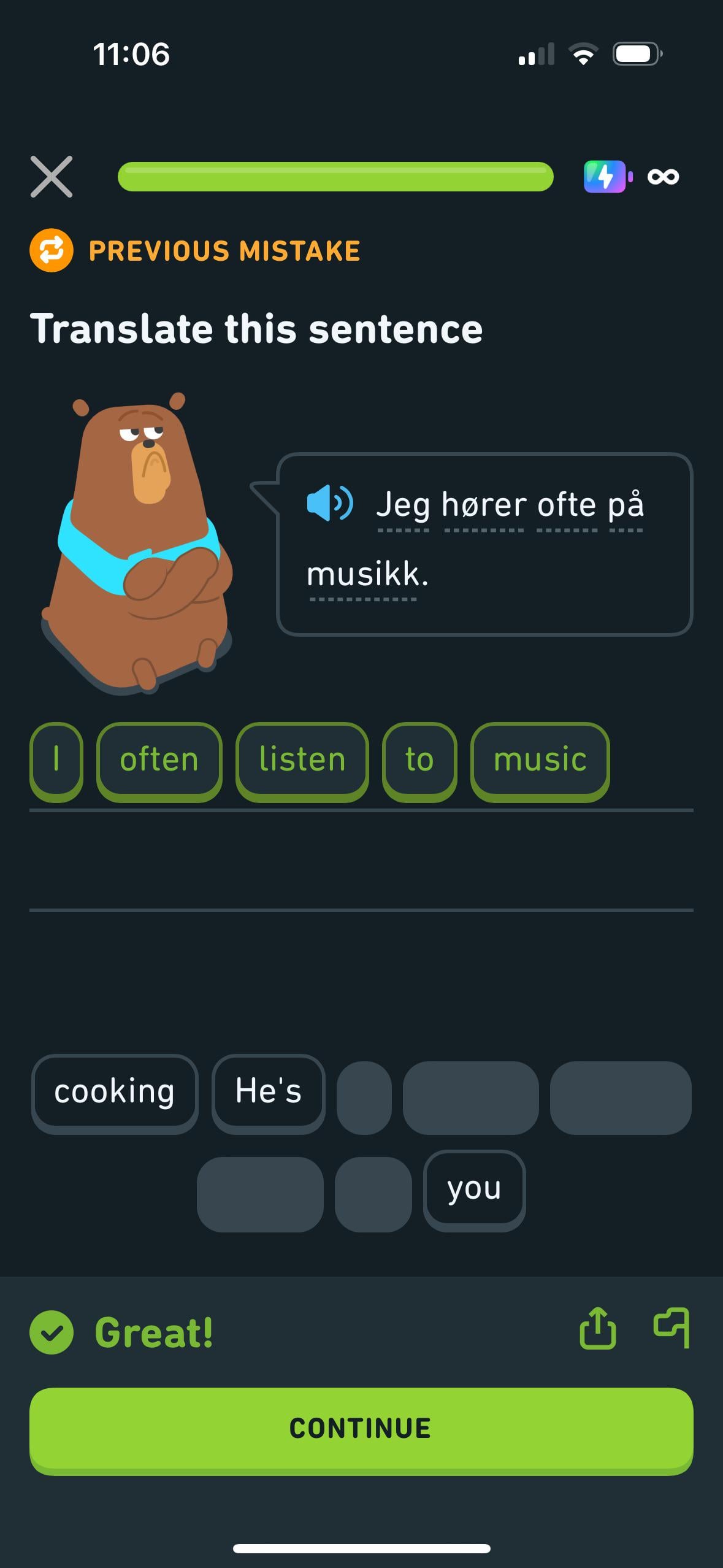
It is correct. Adverbs (*often* in this sentence) in English can move around quite a bit more freely than they can in Norwegian, but with *often*, it feels more natural to put it at the beginning, right after the subject, or at the end of the sentence (often, I listen … / I often listen … / I listen…music often).
Norwegian has a slightly more fixed adverb placement, but as a general rule, it usually comes after the subject and the verb.
Let’s use the example above: *I often listen to music.*
Best translation is the one you have: Jeg hører ofte på musikk.
Jeg = subject, hører = verb (which must come in the second position in a sentence), ofte = adverb, på musikk= object.
In the Norwegian example, ofte comes after jeg and hører because the subject is first followed by the verb (V2 rule).
If we put something other than the subject in the first position, let’s say **I Oslo** (adverbial/place), then the sentence structure changes to reflect something other than the subject in the first position while still following the V2 rule.
I Oslo hører jeg ofte på musikk.
Here you see that the adverbial (place/I Oslo) is in place #1 followed by the verb in place #2 followed by the subject because the subject and the verb need to be as close together as possible. Then the adverb then the rest of the sentence.
That said, unlike some other adverbs, you can move ofte around here, ofte hører jeg på musikk, but as you’ll notice ofte is taking on the responsibility of **time** (adverbial, same as I Oslo) in that sentence, and therefore can be placed in the first position, then the verb comes in the second place, followed then by the subject right after the verb.
You don’t have the same flexibility with other adverbs, like *ikke* for example. You can’t say Ikke hører jeg på musikk. But that is because Ikke isn’t functioning as an adverbial (time, place, or method). *Often, usually, never* etc… all function as elements of time so they can move a bit more freely, which is why I say as a general rule, adverbs always come after the verb and subject, but not always. This is, more or less true for English too. I can’t say “Don’t I listen to music” (okay, well I can, but then it becomes a strange, likely rhetorical question and therefore not the same as saying “I don’t listen to music”).
Hope that helps.
Why wouldn’t it be?
(It is)
Neither one is *wrong*, but neither one is something anyone would actually *say*.
You’d probably say *”I listen to music all the time”* or *”jeg hører på musikk hele tiden”*.
9 comments
Feels right to me 🙂
Try r/norsk
It is
He’s cooking you!
Why doesnt it feel right? 🙂
Yes, it’s correct.
It is correct. Adverbs (*often* in this sentence) in English can move around quite a bit more freely than they can in Norwegian, but with *often*, it feels more natural to put it at the beginning, right after the subject, or at the end of the sentence (often, I listen … / I often listen … / I listen…music often).
Norwegian has a slightly more fixed adverb placement, but as a general rule, it usually comes after the subject and the verb.
Let’s use the example above: *I often listen to music.*
Best translation is the one you have: Jeg hører ofte på musikk.
Jeg = subject, hører = verb (which must come in the second position in a sentence), ofte = adverb, på musikk= object.
In the Norwegian example, ofte comes after jeg and hører because the subject is first followed by the verb (V2 rule).
If we put something other than the subject in the first position, let’s say **I Oslo** (adverbial/place), then the sentence structure changes to reflect something other than the subject in the first position while still following the V2 rule.
I Oslo hører jeg ofte på musikk.
Here you see that the adverbial (place/I Oslo) is in place #1 followed by the verb in place #2 followed by the subject because the subject and the verb need to be as close together as possible. Then the adverb then the rest of the sentence.
That said, unlike some other adverbs, you can move ofte around here, ofte hører jeg på musikk, but as you’ll notice ofte is taking on the responsibility of **time** (adverbial, same as I Oslo) in that sentence, and therefore can be placed in the first position, then the verb comes in the second place, followed then by the subject right after the verb.
You don’t have the same flexibility with other adverbs, like *ikke* for example. You can’t say Ikke hører jeg på musikk. But that is because Ikke isn’t functioning as an adverbial (time, place, or method). *Often, usually, never* etc… all function as elements of time so they can move a bit more freely, which is why I say as a general rule, adverbs always come after the verb and subject, but not always. This is, more or less true for English too. I can’t say “Don’t I listen to music” (okay, well I can, but then it becomes a strange, likely rhetorical question and therefore not the same as saying “I don’t listen to music”).
Hope that helps.
Why wouldn’t it be?
(It is)
Neither one is *wrong*, but neither one is something anyone would actually *say*.
You’d probably say *”I listen to music all the time”* or *”jeg hører på musikk hele tiden”*.
Comments are closed.