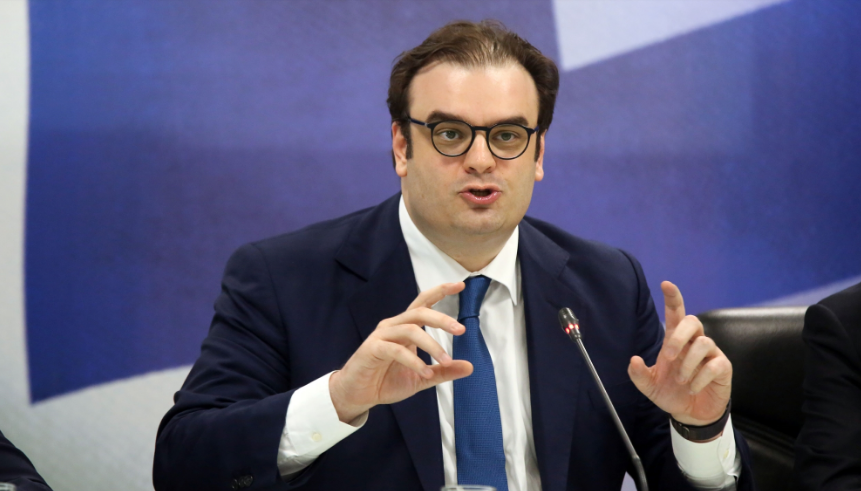
Kyriakos Pierrakakis’ election as president of the Eurogroup is a true achievement. Not only for him, for the government, for Greece, but for the European Union itself. It highlights the country’s success in staying in the eurozone when many inside and outside Greece presented its exit as a miraculous solution for all of Greece’s and the EU’s problems. It also confirms the Union’s wisdom in providing every member-state and every citizen with the opportunity to undertake an important role in the project.
This is evident in the sixth-month rotating presidency of the EU, countries’ veto power, the selection or election to the highest offices of people from small countries. In the case of Greece, this double achievement (for Greece and the Union), is even more impressive. Not only because Greece came closer than any other country to leaving the eurozone (although others, too, needed bailouts), but because the Union needs all its members to contribute actively, so that it can forge a political, economic and social entity that will make use of the virtues of all its people and offer support to offset their weaknesses. The Greek debt crisis forced the EU to adopt mechanisms to deal with such problems, thus strengthening the whole while helping Greece, Ireland, Portugal, Spain and Cyprus get past their difficulties. For Greece, this relationship was especially valuable, because, as we here know but our partners need constant reminding, our country is at the very edge of Europe, neighboring on a very volatile region.
Greece at the center of Europe and at its edge, not only in geographic terms but also from a cultural and political aspect.
Greece at the center of Europe and at its edge, not only in geographic terms but also from a cultural and political aspect. Greece’s borders are the EU’s closest point of contact with the Middle East-North Africa region, with all that this means in terms of instability and migration, but also in terms of opportunities to play a significant role here. This is the cultural edge. The political one is evident within Greece’s borders. Here there is no end to the conflict between those who want to contribute to the shaping of a country that will be an integral part of a strong and prosperous Europe, and those who insist on making the least effort, on “eating into our savings” wherever and whenever they find the opportunity (as in the farm subsidy scandal, in the murderous sloppiness that we saw at Tempe, Mati, and elsewhere).
Either through indifference or intentionally, many try to undermine the country’s European course. The reaction to Pierrakakis’ election by Greece’s world-famous celebrity rebel Yanis Varoufakis is indicative of a mentality that can be found across left- and right-wing narratives. Hitting the bull’s-eye in his tireless effort to be at the center of every story, the one-time bete noire of the Eurogroup posted this on X: “After Portugal’s Centeno & Ireland’s Donohoe, now a Greek completed the PIGS Submissive Trinity. This is what Empires do: They bestow honorary titles on the colonized as a reminder of their supremacy. My badge of honour, in contrast, is their hatred.” Varoufakis employs the insulting acronym which was once in fashion among British commentators (before their own country took a very wrong turn), to refer to nations which were forced to take bailouts, just so he can show off with his comment on “empires.” If he spent more time reading than making declarations, he might understand that the EU is the very opposite of an empire. But even it were an empire, those that stood more firmly were the ones that used people from the periphery, or peripheral groups, in crucial positions.