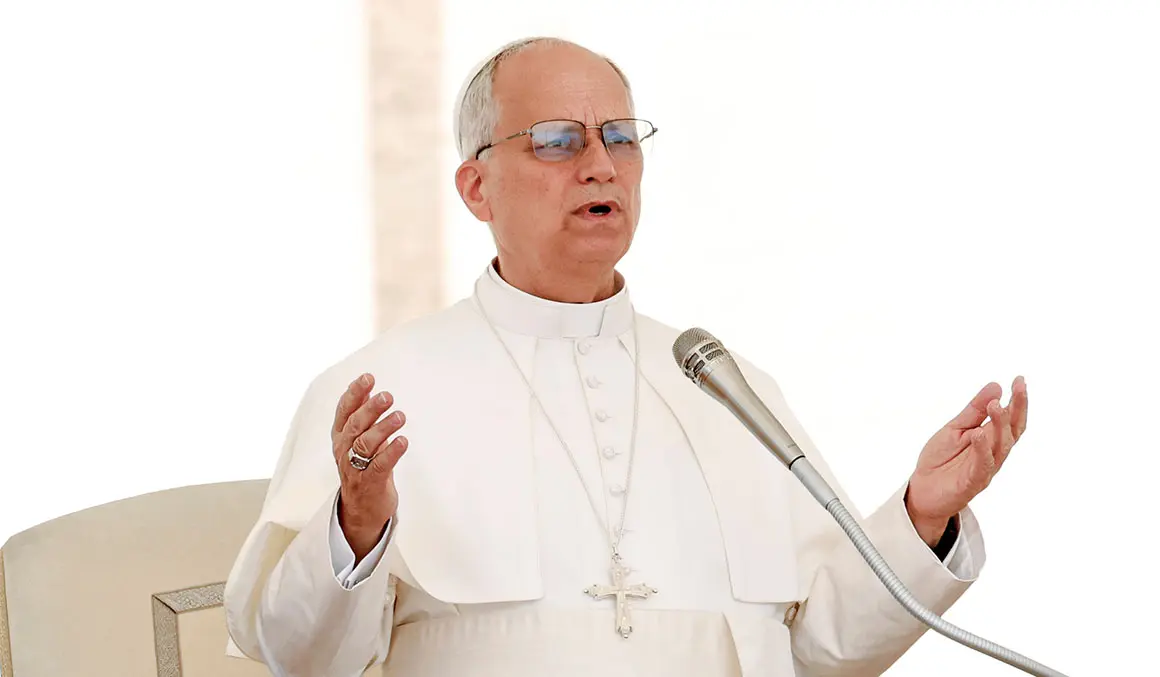
Pope Leo XIV has reaffirmed the “essential role of archaeology in understanding Christianity.”
In a Dec. 11 letter released on the centenary of the Pontifical Institute of Christian Archaeology, the Holy Father said that in this time of change, crisis, and cultural transitions mankind is in need of wisdom capable of preservation.
“In this light, I strongly wish to reaffirm the essential role of archaeology in understanding Christianity and, consequently, its application within catechetical and theological formation,” he wrote. “Archaeology is not just a specialized discipline reserved to a few experts, but a path accessible to anyone who wishes to understand how faith is embodied in time, place and culture.”
He explained that, for Christians, history is an essential part of faith because of their belief in the unique claim that God was made man and lived in history.
“Christianity was not born from an idea, but through flesh,” the Pontiff wrote. “It was not born from an abstract concept, but through a womb, a body and a tomb. At its most authentic core, the Christian faith is historical, grounded in specific events, faces, gestures and words spoken in a particular language, era and environment. This is what archaeology uncovers and makes tangible. It reminds us that God chose to speak in a human language, to walk the earth and to inhabit places, houses, synagogues and streets.”
He commended the institute for remaining true to its Christian mission even as it has grown and changed as archeological practices have progressed.
The Pope said that archeology forms Christians in a “theology of the senses,” helping them to see, touch, smell, and listen to physical manifestations of faith. He also described archeology as “a school of hope.”
The Holy Father said that studying archeology helps contemporary Christians understand the hearts and minds of the Christians who came before. However, it is not aimed at nostalgia but instead at better incarnating the Christian faith in one’s own time and serving as a witness.
“Christian archaeology does not simply look towards the past; it also speaks to the present day and points towards the future,” he wrote. “It speaks to believers, helping them rediscover the roots of their faith. It also speaks to those who are distant, to non-believers and to those who question the meaning of life, because they find an echo of eternity in the silence of the tombs and in the beauty of the early Christian basilicas.”
Pope Leo said that archeology encourages the cultivation of living memory, rather than mere conservation. He further explained that archeology, history, and identity are all interconnected.
“Those who know their own history know who they are,” he wrote. “They know where to go. They know whose children they are and the hope to which they are called. Christians are not orphans: we have a genealogy of faith, a living tradition and a communion of witnesses. Christian archaeology reveals this lineage and preserves its signs, interpreting them, recounting them and passing them on.”
Pope Leo asked bishops and educators to encourage young people, lay people, and priests to study archeology. He then told all those in the field of archeology to be dedicated to their important work.
“Do not be discouraged by difficulties. Christian archaeology is a service, a vocation and a form of love for the Church and for humanity. Please continue your excavations. Continue to study, teach and recount history. Be tireless in your search, rigorous in your analysis and passionate in communicating with others.”
The Holy Father closed by asking the Lord to bless archeologists’ work and the Blessed Virgin Mary to protect them.
>> Pope Leo encourages conservative politicians to defend Christian heritage
