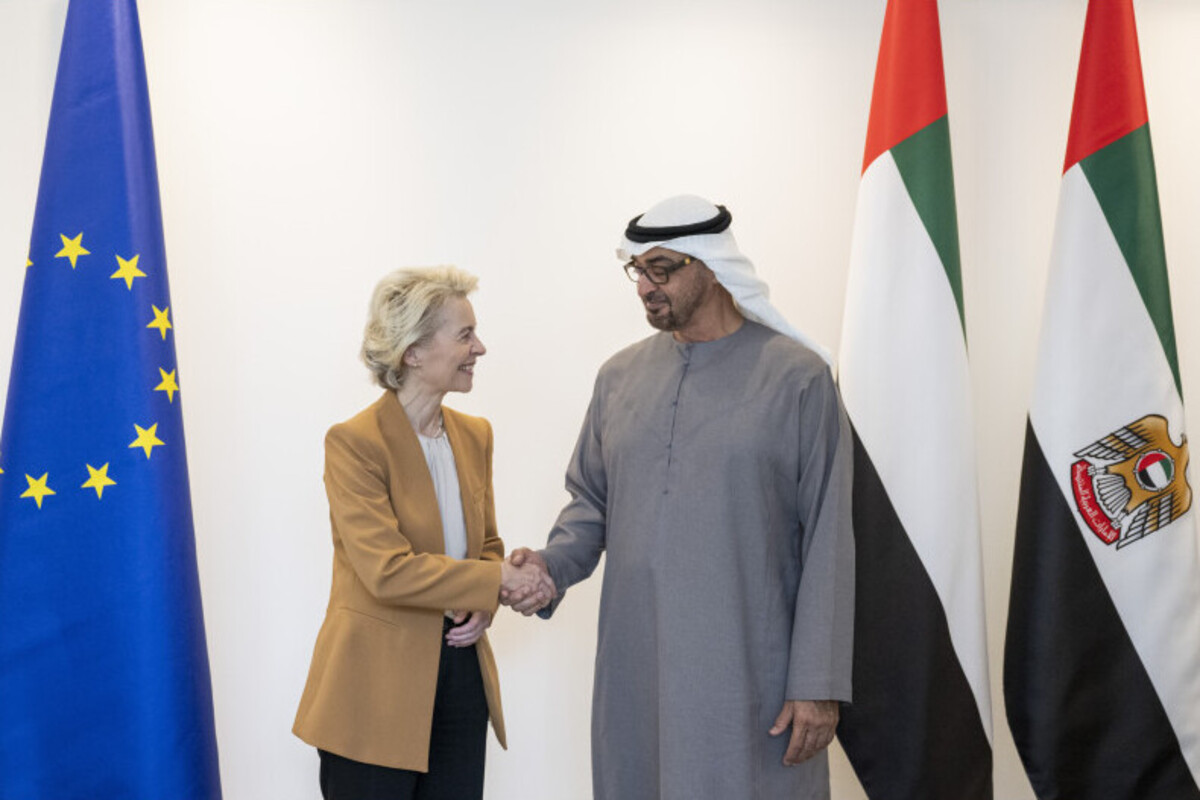
The call addressed the formal launch of negotiations between the UAE and the EU on a strategic partnership agreement, with both sides underlining its significance
UAE President His Highness Sheikh Mohamed bin Zayed Al Nahyan and Her Excellency Ursula von der Leyen, President of the European Commission, held a phone call on Monday to discuss cooperation between the UAE and the European Union (EU), as well as ways to advance ties in support of shared interests.
The call addressed the formal launch of negotiations between the UAE and the EU on a strategic partnership agreement, with both sides underlining its significance in strengthening bilateral ties in priority areas and providing a comprehensive framework to bolster cooperation.
His Highness and the European Commission President reaffirmed their shared commitment to deepening UAE-EU relations, particularly in development-related sectors. They noted that negotiations towards a free trade agreement between the UAE and the EU represent a key step that would open new horizons for collaboration.
Strategic partnership agreement to boost trade, investment
The discussions between the two presidents come after the UAE and EU announced last week the launch of negotiations on a Strategic Partnership Agreement. The announcement was made by Lana Zaki Nusseibeh, Minister of State, during a joint press conference in Abu Dhabi with Dubravka Šuica, EU Commissioner for the Mediterranean.
During the conference, Nusseibeh explained that the UAE and EU’s intensive discussions—particularly on the free trade agreement—are progressing rapidly, supported by a strong foundation of shared economic interests. She noted that the positive impacts of these negotiations will be felt by the people of both regions, as trade ties will be strengthened, investment opportunities expanded and business-to-business cooperation deepened.
Nusseibeh stated that the UAE-EU Strategic Partnership Agreement currently under negotiation will provide a structured framework for cooperation in vital and timely fields, including digitization, artificial intelligence, renewable energy and others.
“Our task now,” she said, “is to translate this growing alliance with the European Union into tangible outcomes, moving from strategic intent to practical implementation, and ensuring that our partnership delivers measurable benefits for our peoples, our private sectors and the broader international community.”
Nusseibeh also affirmed that the UAE stands ready to work closely with the EU, guided by principles of mutual respect, shared interests and long-term vision, to strengthen the future of multilateralism, diversity and constructive global engagement.
Work to progress on UAE-EU free trade agreement negotiations
For her part, Šuica said that work will progress on the free trade agreement negotiations launched in May of this year. She described the UAE as a strategic partner of the EU and a key player in trade and investment, as well as a central hub linking Europe with the Middle East and Asia.
She also explained that the free trade agreement aims to establish a comprehensive and ambitious framework to deepen essential cooperation in areas including scientific research and innovation, energy, artificial intelligence, digitization, humanitarian action and education. The agreement will also open new prospects for large-scale collaborative projects across the Middle East and North Africa, contributing to tackling shared challenges and seizing strategic opportunities.
Šuica stressed that Europe’s role in building this strategic cooperation is essential to reinforcing stability and prosperity, and that the UAE is regarded as a strategic partner in this effort. She said the UAE-EU Strategic Partnership Agreement constitutes a key instrument within the framework of their shared relations.