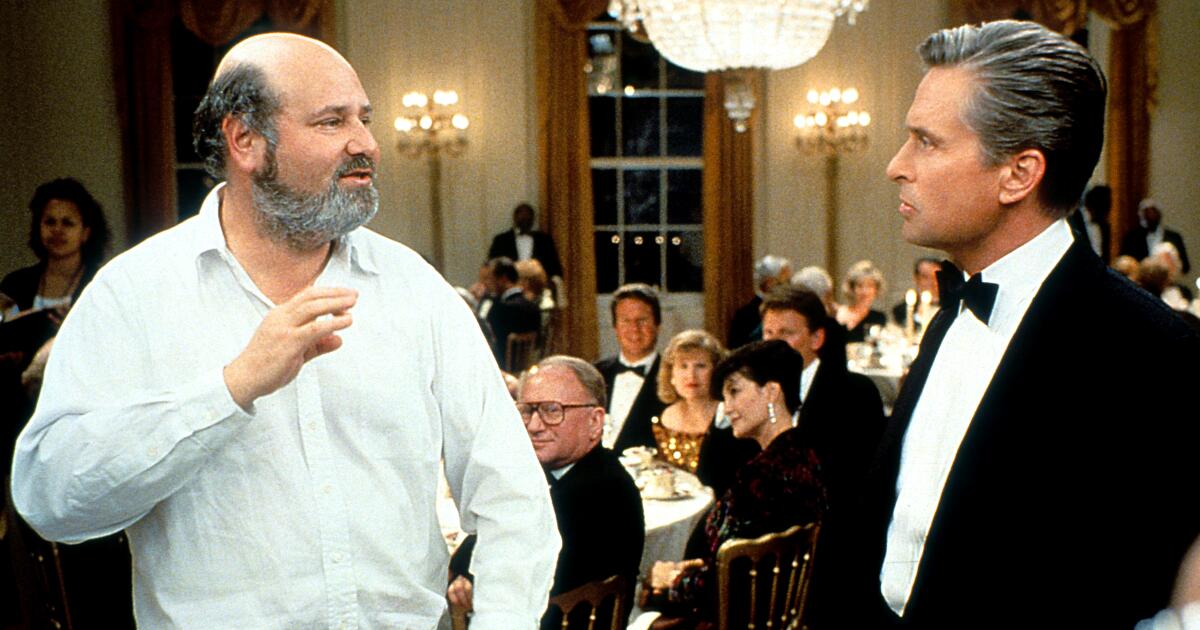
I think about Rob Reiner almost every time I put on my socks.
I am old enough to remember the famously hilarious (and largely improvised) bit from “All in the Family” in which Reiner’s Mike “Meathead” Stivic and Carroll O’Connor’s Archie Bunker argue about the correct order of donning footwear — both socks first (Archie’s method) or sock/shoe, sock/shoe (Mike’s).
The straight-faced back and forth was, and is, a pitch-perfect exhibition of how much time and energy we waste judging, and arguing about, personal differences that are none of anyone’s business and matter not at all.
I also think about Reiner whenever my now-adult children and I sit down for a movie night. When all other suggestions fail, at least one of his films — ”Stand by Me,” “The Princess Bride,” “A Few Good Men,” “When Harry Met Sally…,” “Misery” — will achieve consensus, in large part, because of that same understanding.
Reiner was, above all, a compassionate filmmaker, willing to excavate all manner of conflict and tension in search of the essential humanity that connects us all.
Reiner helped shape the culture of my youth and early adulthood with such brilliant empathy that his random appearances on television — as Jess’ (Zooey Deschanel) father in “New Girl” or, more recently, Ebra’s (Edwin Lee Gibson) business mentor on “The Bear” — sparked immediate reflexive delight, as if a beloved uncle had shown up unexpectedly at a family dinner.
It helped, no doubt, that I share his political leanings. Reiner’s advocacy for gay marriage and early education were well-known, as was, in recent years, his unvarnished criticism of President Trump, who Reiner, like many others, considered a danger to democracy.
That criticism should have prepared me for the chilling invective unleashed by some, including Trump, in the wake of the news that Reiner and his wife, Michele Singer Reiner, were found dead in their home on Sunday night, victims of a knife attack, and that their son Nick, who has a history of drug addiction, was in police custody.
Even as the millions who were touched by Reiner’s work struggled to process their shock, grief and horror, Trump responded with a post in which he claimed that the Reiners’ murders were “reportedly due to the anger he caused others through his massive, unyielding, and incurable affliction with a mind crippling disease known as TRUMP DERANGEMENT SYNDROME, sometimes referred to as TDS.”
Horror unfolds around the world on a daily basis. This weekend, a father and son opened fire on a Hanukkah celebration in Australia, killing 15 and wounding many others; a gunman killed two and wounded nine at Brown University; and two members of the Iowa National Guard were killed and three others injured by gunmen in Syria.
Even so, between the shocking news of the Reiners’ deaths, the possible involvement of their son and the unhinged and cold-hearted response of the president of the United States, it is difficult to know how to react, short of tearing out one’s hair and screaming up to an indifferent sky.
No person’s life means intrinsically more than any other — many people are killed by violence each and every weekend, often by family members; that we seem to have become inured to mass shootings is another sort of horror.
But Reiner’s work, in film, television and politics, affected millions around the world personally and culturally. In “All in the Family,” his young leftie was far from the hero of the piece — Mike’s values were more humane and progressive than the bigoted Archie’s, but he could be just as narrow-minded as his father-in-law and just as capable of change.
As a director, Reiner championed independent filmmaking, which is to say smartly written movies that told interesting stories about characters that were recognizable in their humor and humanity (which is one reason he was so successful in adapting Stephen King’s work, including the novella “Stand by Me” is based on and “Misery”).
His political activism too was grounded in the desire to make life better for those historically marginalized by policy and culture. He campaigned against tobacco use and for Proposition 10, which increased the tax on cigarettes, and funded early education. In 2009, he used his considerable influence to co-found the American Foundation for Equal Rights and successfully fought to legally challenge Proposition 8, which banned same-sex marriage in California.
As an artist and a public figure, he put his money where his mouth was and remained invariably sincere, a powerful and compelling trait that has become increasingly rare in a time of the sound-bite inanities, muddy thinking, obvious contradictions and outright falsehoods that threaten our public and political discourse.
Reiner mastered many mediums and wielded a broad palette but his signature artistic trait was empathy. No story was too small, or too brutal, to be examined with kindness and an understanding that the most grave injustice we can commit is to choose apathy or revenge when connection and transcendence are always possible.
The news cycle surrounding the Reiners’ deaths is likely to get worse, as details emerge and reactions of all kinds continue. For a long while, it will be difficult to think of Reiner and his wife as anything but victims of a brutal crime of truly tragic proportions and the regrettable heartlessness that our political divisions have created.
Ironically, and mercifully, solace for this loss, and so many others, can be found in Reiner’s work, films and performances that are impossible to watch without feeling at least a little bit better.
As Hollywood and the world mourns, I will try to think of Reiner as I always have. After all, no matter the order, we all put on our shoes and socks one at a time.
And then, as his artistic legacy teaches us, we stand and try to do the best we can with whatever happens next.