For centuries after the Romans destroyed the Second Temple in 70 CE and then razed Jerusalem in 135 CE, renaming it Aelia Capitolina, Jews were banned from living in the city that had represented the beating heart of their national and religious identity for a millennium.
And yet, a new archaeological discovery suggests that some Jews in the final centuries of the Byzantine period may have returned to the city and visited, or even lived, in the shadow of the Temple Mount.
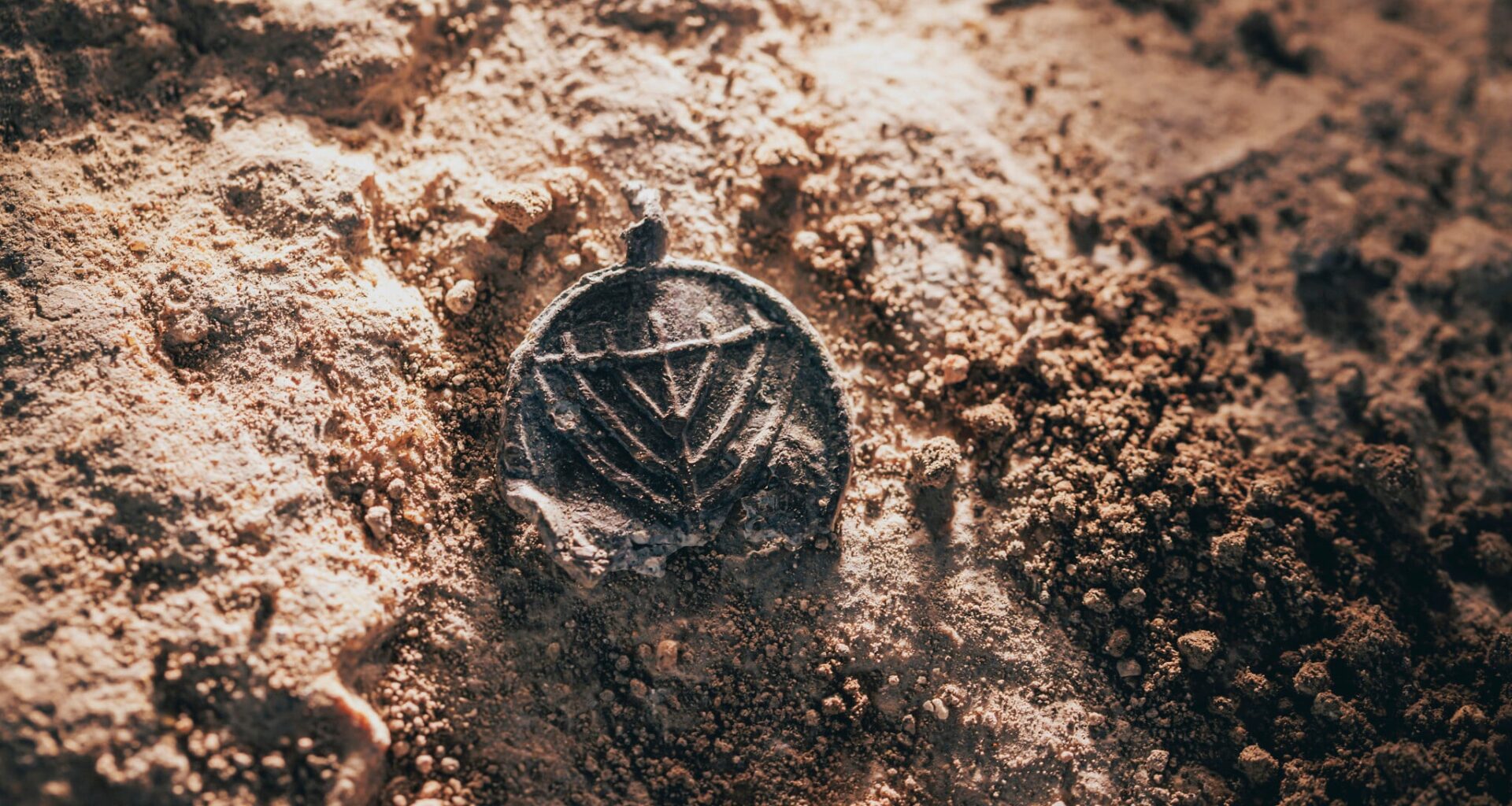
A cast-lead round pendant decorated with a seven-branched menorah on both sides, dating to approximately 1,300 years ago, was unearthed during an archaeological excavation at the Davidson Archaeological Park in Jerusalem, the Israel Antiquities Authority (IAA) announced Monday.
“We excavated between two walls from the Umayyad period [638-750 CE], and we went through the fills left in a Byzantine building,” Esther Rakow-Mellet, an IAA archaeologist, told The Times of Israel, while showing this reporter the excavation site. “In the foundations, we found [the artifact].”
“According to historical sources, since the Roman period, Jews had been forbidden to enter Jerusalem, but this is a clearly Jewish symbol,” she added.
Get The Times of Israel’s Daily Edition
by email and never miss our top stories
By signing up, you agree to the terms
The location where the artifact was discovered could not be more striking. The site is located at the foot of the Temple Mount, in the area of Robinson’s Arch, which once supported the staircase leading up to the Temple, at the southern end of the Western Wall. Visitors touring the Davidson Archaeological Park can still walk on part of the first-century CE street.
The current excavation is situated between this area and the beginning of the so-called Pilgrimage Road to the Temple Mount, a 600-meter-long pathway (approximately one-third of a mile) that originates at the Pool of Siloam — the remains of which today stand in the City of David National Park, located in the predominantly Palestinian neighborhood of Silwan. Researchers believed pilgrims purified themselves in the pool before ascending the street.
The excavation area includes the Umayyad remains, the Byzantine building, and a structure that, based on preliminary findings, appears to date to the Roman period (first century CE to fourth century CE), according to Rakow-Mellet.
The pendant was dated based on the abundance of pottery, coins, and other finds recovered from the same archaeological layer.
“Everything points to the late Byzantine period, or the sixth to seventh centuries,” Rakow-Mellet said. “This is true also for the style of the menorah, even though, unfortunately, we are missing the part of the pendant depicting its base, which would have given us more information.”
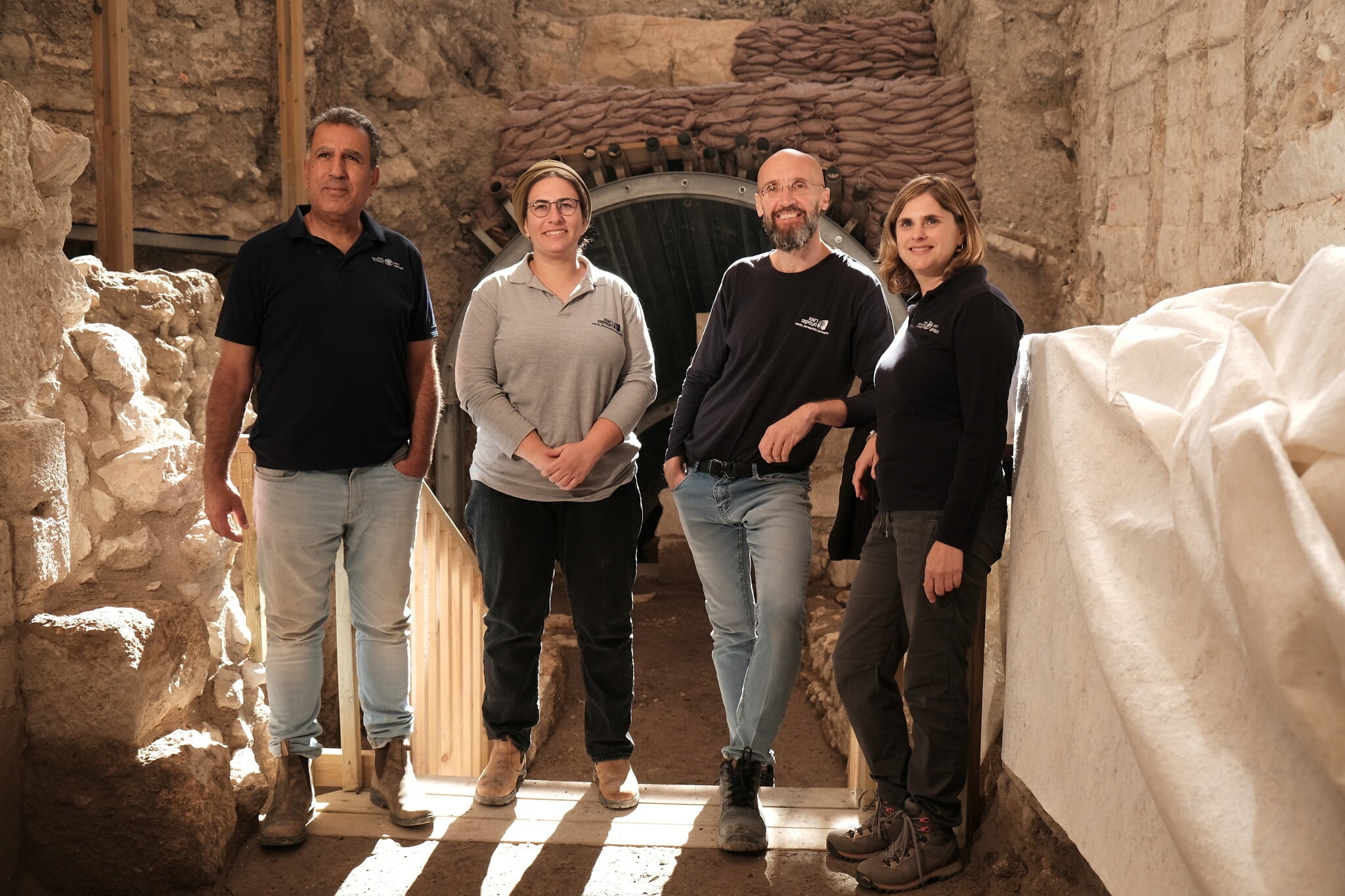
Left to right: Israel Antiquities Authority researchers Dr. Shulamit Tarem, Dr. Filip Vukosavović, Esther Rakow-Mellet, and Dr. Yuval Baruch at the Davidson Archaeological Park in Jerusalem. (Emil Aladjem/Israel Antiquities Authority)
According to Rakow-Mellet, the artifact is not the first finding suggesting a Jewish presence in the area at a time when Jews were not supposed to be here.
“Some 50 years ago, [late archaeologist] Eilat Mazar excavated a house that became known as the ‘menorah house’ because someone had covered a cross on the archway above a door with plaster and painted two menorahs,” Rakow-Mellet said.
The house, also from the late Byzantine period and very similar to the building that is currently being excavated, is located just steps away from where the pendant was found.
“This seems to suggest that Jews not only visited Jerusalem, but lived here, even though it is only a hypothesis,” she said.
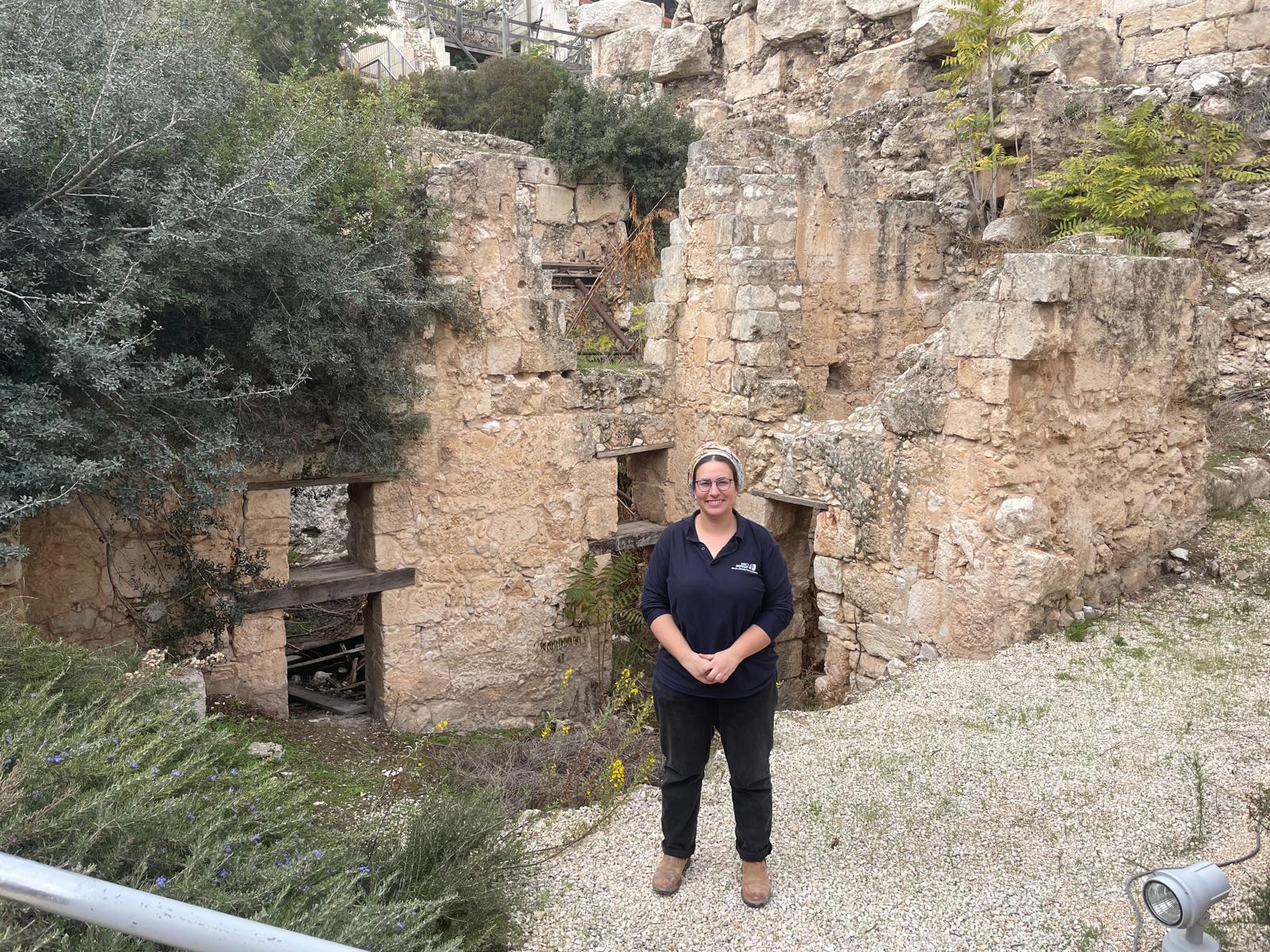
Israel Antiquities Authority archaeologist Esther Rakow-Mellet in front of the ‘Menorah House’ from the Byzantine period at the Davidson Archaeological Park in Jerusalem on December 15, 2025. (Rossella Tercatin/Times of Israel)
Meanwhile, the archway carrying the decoration has disappeared, according to the archaeologist, only deepening the mystery.
“Maybe one day it will reappear in some storage,” Rakow-Mellet said.
In addition, a larger menorah-engraved gold medallion was found in the nearby Ophel excavation, also led by Mazar, decades ago, which dates to approximately the same period as the lead pendant.
An alternative explanation for the presence of Jews in the heart of Jerusalem is that they returned during the few years the city was under Sasanian Persian rule between 614 and 628 CE.
“We know that the Persians allowed Jews to come back,” Rakow-Mellet explained. “Archaeologically, it is very difficult to identify remains from those years, as the period is too short and its findings are mostly similar to the late Byzantine period. However, we are still working on analyzing many coins and other finds, including glass remains, that we discovered in the building. We might have more answers in the future.”
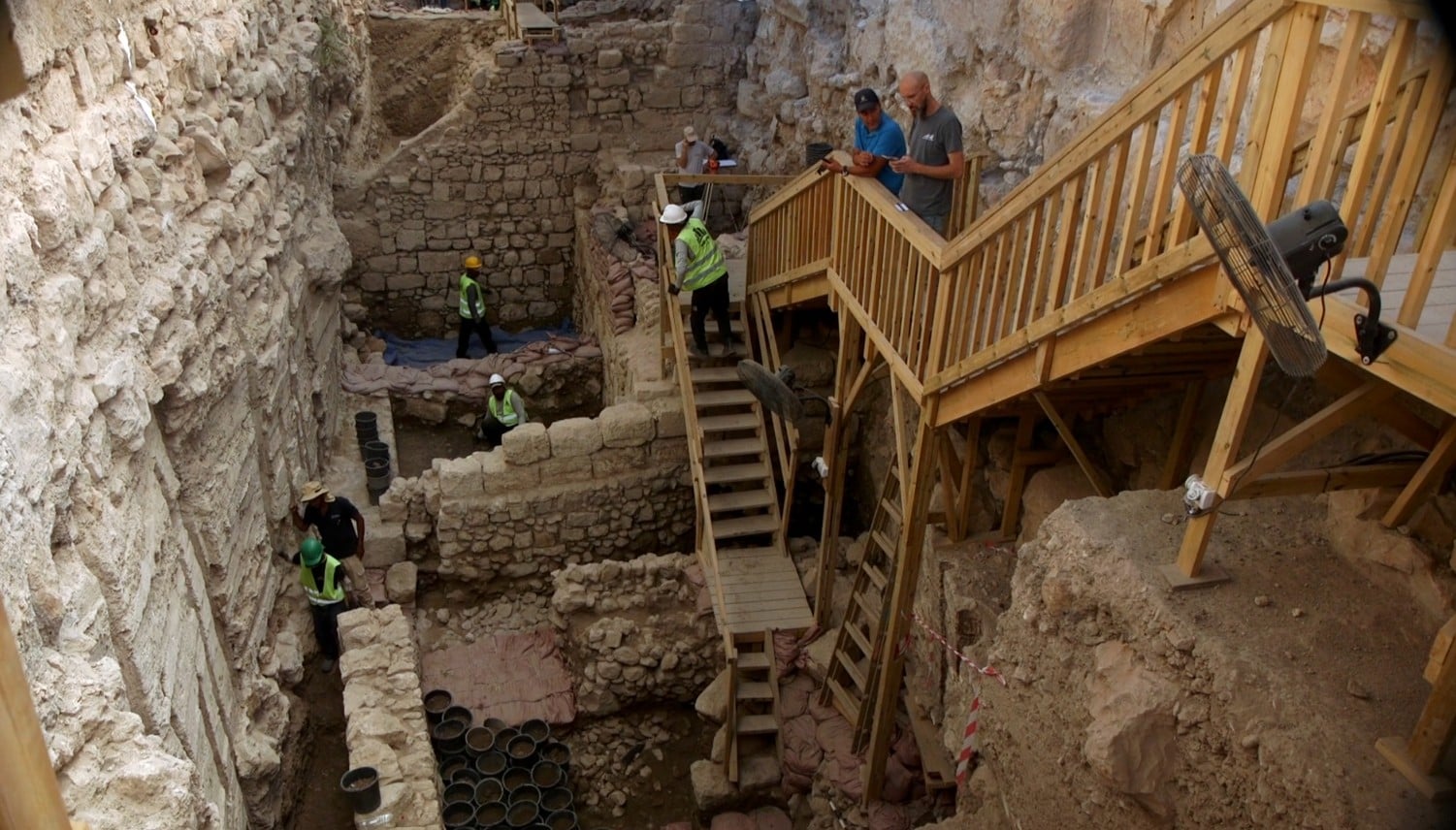
An excavation at the Davidson Archaeological Park in Jerusalem, where archaeologists found a menorah-decorated pendant from the Byzantine period in a discovery announced on December 15, 2025. (Emil Aladjem/ Israel Antiquities Authority)
While it is not possible to date the pendant independently, the archaeologist stated that they have collected organic samples from the building for radiocarbon dating.
“We need to wait for the results,” Rakow-Mellet noted.
The pendant also marks an unprecedented find because no such lead artifact had ever been discovered in an archaeological excavation.
“We have just one example of a similar pendant in an American museum, but we do not know its origin,” said Rakow-Mellet, referring to a medallion that is part of the collection of the Walters Art Museum in Baltimore. “On the other hand, similar objects in different materials from the same period have been found before.”

A 1,300-year-old menorah-decorated pendant was found at the Davidson Archaeological Park in Jerusalem, in a discovery announced on December 15, 2025. (Eliyahu Yanai/City of David)
The IAA researchers believe that the artifact might have been an amulet, or an object believed to possess special powers, rather than a simple piece of jewelry, as lead at the time was often used to craft amulets.
The excavation, carried out by the IAA in cooperation with the City of David Foundation and the Company for the Restoration and Development of the Jewish Quarter, is ongoing. The archaeologists still have vast amounts of earth to remove and analyze, as well as more structures to expose.
“Right now, we have a lot of questions and not many answers,” Rakow-Mellet said. “Hopefully, we will find out more.”
To celebrate Hanukkah, which runs from December 14 to 22, the menorah-decorated pendant will be on display at the Jay and Jeanie Schottenstein National Campus for the Archaeology of Israel in Jerusalem.