
Nazemi was detained during a memorial service in the northeastern city of Mashhad for Khosrow Alikordi, a former political prisoner and lawyer for dissidents whose sudden death left supporters suspicious of state involvement, which Tehran denies.
At the ceremony, security forces used force to dispersed mourners and arrested 39 people, including activists, lawyers and civil society figures.
Nazemi’s sister Mahshid told Iran International she was on a live video call with Pouran when security forces stormed the mosque where the commemoration was being held.
“The security officers opened the mosque’s doors and attacked the people with batons and knives,” Mahshid said. “They threw tear gas inside the mosque,” Mahshid said.
Mahshid was able to record portions of the incident by capturing the live video call with her sister, though she was unable to document the alleged knife and baton attacks she described.
She did, however, provide photos showing what appear to be knife wounds and a bloodied scene.
 Screenshot of Iranian protester describing being hit on the head and bloodied by baton from Iran’s security forces.
 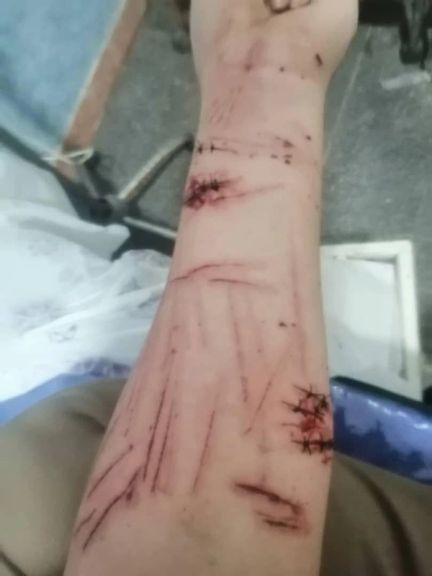 Photo of what appears to be a knife attack during the ceremony of rights lawyer Khosrow Alikordi.
Videos reviewed by Iran International show Pouran describing the crackdown in real time before the feed was abruptly cut. Screams and loud bangs were audible.
Mahshid said she watched plainclothes officers beat women inside the mosque and drag people away. “They attacked them very badly. We could only hear screaming and see the camera shaking,” she said.
Iran International was not immediately able to verify all aspects of her account of the raid.
Defiance, fear of death
“It was terrifying,” Mahshid said. “But I also felt proud because I saw a group of brave women, without the hijab, in a mosque, in a religious city, shouting ‘Death to the dictator’ and ‘Woman, Life, Freedom.”
The Woman, Life, Freedom movement marked one of the most serious challenges the Islamic Republic has faced, with protests erupting nationwide in 2022 after the death of Mahsa Amini in morality police custody and calling for an end to clerical rule.
Nazemi’s sister says they still do not know where she is being held or which security body is responsible for her detention, though they fear the case may be under the authority of the Islamic Revolutionary Guard Corps.
“We don’t know which prison she is in or which organization is holding her,” Mahshid said. “And when there is no official information, the risk of torture and fabricated charges increases,” she added.
The family is also concerned about Nazemi’s health. She has a history of stomach cancer, severe respiratory problems and life-threatening anaphylactic reactions caused by medical negligence during a previous detention, according to her sister.
During an earlier imprisonment, Nazemi suffered allergic shock after being given an antibiotic she was known to be sensitive to while undergoing surgery, Mahshid said.
“Since then, her condition has never been stable. Now I don’t know if she is receiving any medication at all,” she told Iran International.
There is also an open case against Nazemi in the southeastern city of Kerman, which her family fears could be used to impose harsher charges.
“They have already given her 14 years in prison in one case,” Mahshid said. “They don’t answer us, they don’t give court documents, and they argue with our lawyers,” she told Iran International.
From memorial to mass arrests
Iranian authorities say 39 people were arrested during the memorial ceremony. Those detained included Alikordi’s brother Javad Alikordi, Mohammadi and human rights activists Aliyeh Motallebzadeh, Sepideh Gholian, and Hasti Amiri.
Several detainees have since made brief phone calls to their families, but relatives say information about their condition and whereabouts remains limited.
In a message relayed by her family, Mohammadi said she was severely beaten during her arrest, suffering repeated blows to the head and neck with batons, and was later accused of “cooperation with the State of Israel.”
Human rights groups say the arrests followed a violent crackdown on mourners at the memorial, which had become a flashpoint amid growing controversy over Alikordi’s death.
Alikordi, a lawyer known for defending political prisoners and bereaved families, was found dead in his office in Mashhad on December 5. Authorities say he died of a heart attack, but his family and colleagues have questioned the official account, citing the removal of surveillance cameras and inconsistencies in the investigation.
Calling on the international community to act, Mahshid urged governments and rights groups to demand accountability.
“When names and locations are hidden, people are tortured and silenced,” she said. “Be a voice. Raise the cost for the Islamic Republic and demand transparency — for my sister and for the suspicious death of Khosrow Alikordi,” she told Iran International.