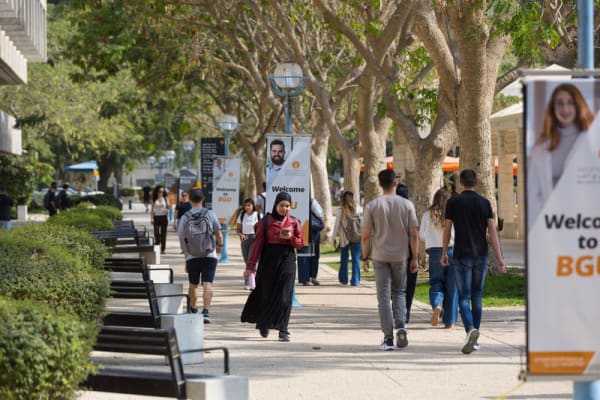
Students at Ben Gurion University, in Beer Sheba. November 04, 2025. Photo by Liron Moldovan/Flash90
A new OECD report reveals that high levels of skills and education in Israel do not translate into quality employment and wages, with a significant gap compared to other countries, as published this Tuesday morning.
The latest report, OECD Skills Outlook 2025, shows that gaps in skill levels are not accidental but stem from socio-economic background conditions and, in most cases, deepen over the course of a person’s life. However, the report emphasizes that this is not a foregone conclusion, and that the rapid transformation of the world of work actually opens opportunities for mobility and for narrowing gaps. The report also finds that gender gaps in the labor market hardly narrow at all – even in the face of improvements in skills.
The report clearly indicates that skill levels are also derived from education levels: the higher the level of education, the greater the likelihood, in most cases, of more effective integration into the labor market, with implications for job quality and wage levels. In contrast, in Israel the level of education has a relatively limited impact on skill levels compared to other countries and does not guarantee high-quality labor market integration or higher wages.
While in other OECD countries there is a strong and consistent link between higher levels of education and a significant jump in quantitative reasoning skills, in Israel the impact is more limited. At intermediate levels of education (upper-secondary studies and post-secondary vocational and academic tracks), the added contribution to skills is relatively low. In short-cycle higher education and at the bachelor’s degree level and above, the added contribution is much greater – meaning that in Israel higher education does strengthen skills, but at the intermediate stages formal education adds fewer quantitative skills than in many other OECD countries.