The world’s glaciers are vanishing at an unprecedented rate, and a new study published in Nature Climate Change highlights how this could dramatically accelerate over the next few decades. As global temperatures continue to rise, researchers predict that we could lose thousands of glaciers each year. The study underscores the critical need for swift and significant action to curb climate change if we are to preserve these vital ice structures.
The Study and Its Implications: A Race Against Time
In a groundbreaking study published in Nature Climate Change, glaciologists led by Lander Van Tricht from ETH Zurich and Vrije Universiteit Brussel, examined the future of global glaciers under various climate scenarios. This research shifts the focus from the traditional view of glacier ice loss to the individual glaciers themselves, offering a sobering prediction for the coming decades.
Currently, the world is losing around 1,000 glaciers annually, but by mid-century, this number could rise dramatically. According to Van Tricht, if global temperatures continue to rise unchecked, we may see 2,000 to 4,000 glaciers vanish each year by 2050. The study’s findings are particularly concerning in the context of global warming, with the possibility that the majority of glaciers may be gone by the century’s end.
“Our results underscore the urgency of ambitious climate policy,” said Van Tricht, reflecting on the severe consequences of inaction. The research highlights the stark difference in outcomes depending on the temperature rise. If temperatures are limited to a 1.5°C increase, around half of the world’s glaciers could survive by 2100. However, if the global temperature rise reaches 4°C, only about 9% of glaciers may remain by the end of the century. This sharp contrast emphasizes the critical role of international climate agreements in shaping the future of glaciers and global ecosystems.
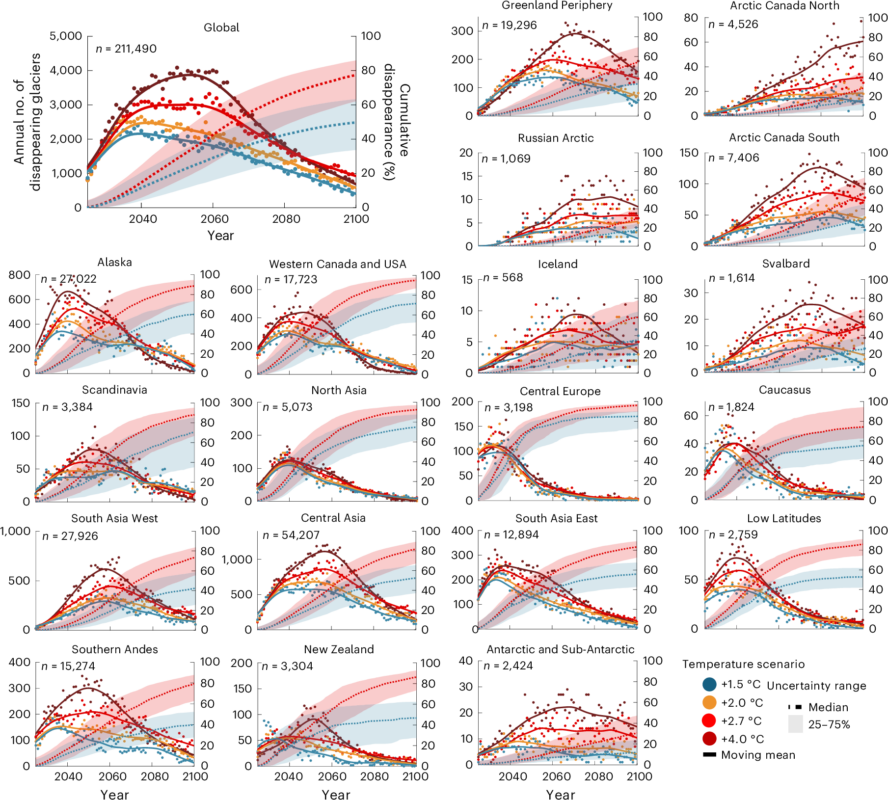 Projected annual glacier disappearance at global and regional scales under different warming scenarios. (Nature Climate Change)
The Heartbreaking Impact on Local Communities
The loss of glaciers is not just an environmental concern—it has profound cultural, economic, and social implications. In regions where glaciers are not only natural wonders but also integral to local heritage and livelihoods, their disappearance will have far-reaching consequences. Many communities depend on glacier-fed rivers for water, agriculture, and energy. Additionally, glaciers attract millions of tourists each year, making them key to local economies.
“The loss of glaciers that we are speaking about here is more than just a scientific concern. It really touches our hearts,” said Matthias Huss, a co-author of the study.
He underscored the emotional and cultural impact of losing these ancient ice formations. The symbolic funeral held for the Pizol Glacier in Switzerland in 2019 serves as a poignant reminder of the cultural ties that many have to these vanishing landscapes.
For communities dependent on glaciers for their water supply, the loss could mean major shifts in daily life. Glacial meltwater, which contributes to fresh water in some of the world’s most arid regions, is vital for drinking, irrigation, and hydropower. Without these ice giants, the balance of local ecosystems could be permanently disrupted.
Regional Variations and the Path Ahead
The disappearance of glaciers is not a uniform process—it varies significantly depending on the location and size of the glaciers. In places like the European Alps and the subtropical Andes, smaller glaciers are melting at an accelerated pace. In fact, researchers predict that in these areas, half of the glaciers could be gone within the next 20 years. The smaller size of these glaciers means they are more vulnerable to the rising global temperatures.
On the other hand, larger glaciers, particularly in Greenland and Antarctica, will take longer to disappear, but their eventual loss would have a devastating impact on global sea levels. While smaller glaciers may contribute less to sea level rise, their role in local ecosystems, cultures, and economies cannot be overlooked.
The timing of glacier disappearances also varies according to the level of warming. In a 2°C world, which is the current trajectory of global temperatures, the number of glaciers lost each year could peak at 2,000 by 2041. If global temperatures rise by 2.7°C, as predicted under current government policies, 3,000 glaciers could disappear annually. The worst-case scenario of a 4°C temperature rise would see the loss of up to 4,000 glaciers every year by the mid-2050s.