Real journalists wrote and edited this (not AI)—independent, community-driven journalism survives because you back it. Donate to sustain Prism’s mission and the humans behind it.
New Yorkers were shaken in October when “military-style” immigration raids that targeted street vendors were carried out by masked federal agents on Canal Street.
New York Gov. Kathy Hochul was quick to note on social media that the Canal Street raid was an abuse of power, one in which the agents used batons and pepper spray on street vendors and bystanders.
“You don’t make New York safer by attacking New Yorkers,” she wrote on X.
For the estimated 23,000 immigrants who are part of New York City’s vending community, the raid was an alarming escalation after months of brutal attacks—from both state and federal agencies.
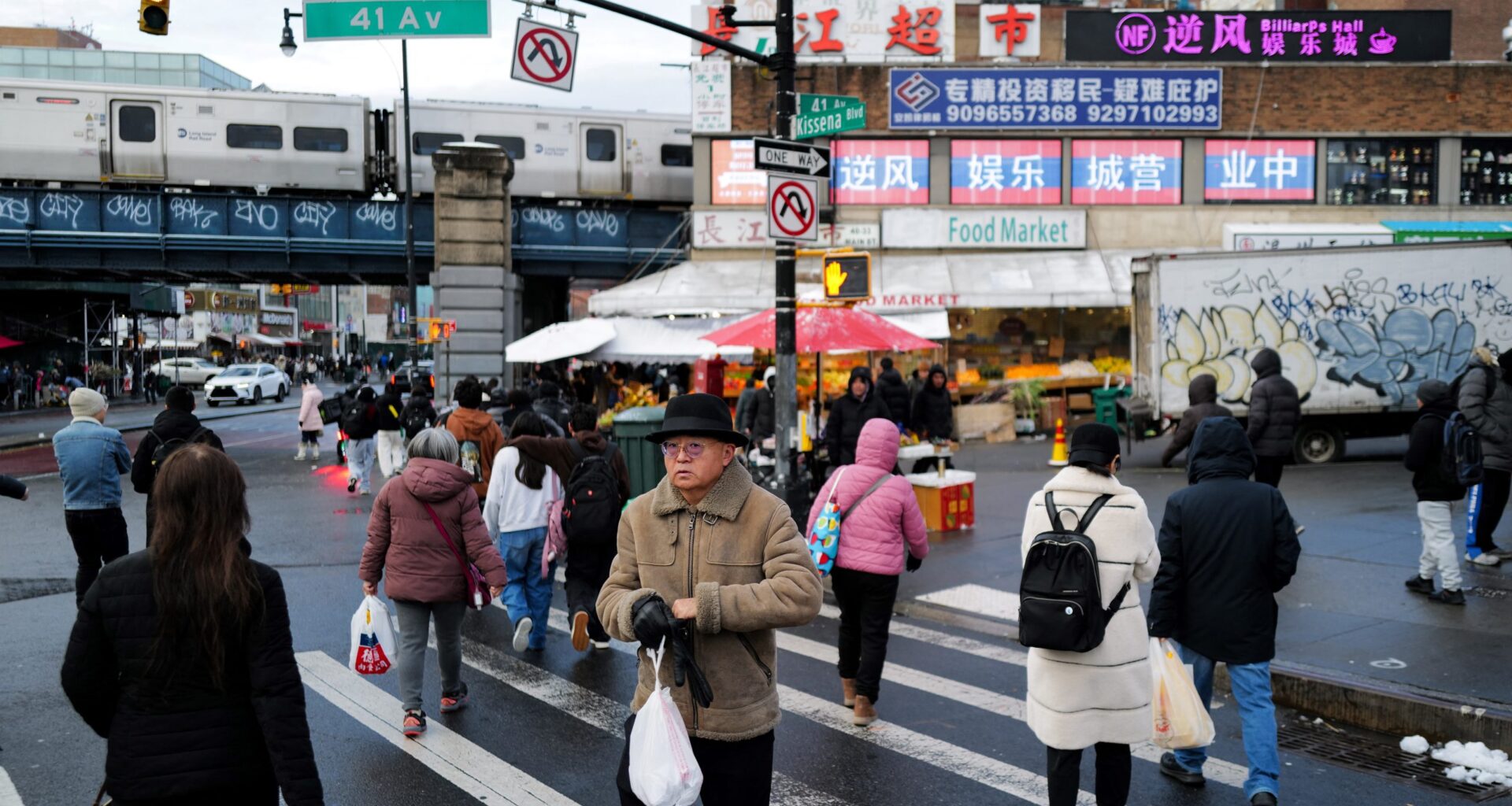
This was especially true for migrant workers in Flushing, a neighborhood in the outer borough of Queens that is home to 100,000 residents of Chinese descent. Since its origin, Flushing has served as a gateway for Chinese immigrants seeking work. Many are delivery workers and street vendors—two types of employment that exploded across New York City during the pandemic.
But as conditions worsen for migrant workers nationwide due to the Trump administration’s anti-immigrant agenda and broad dismantling of labor protections, the effect on Flushing’s Chinese immigrants has been immediate, according to workers who spoke to Prism.
“Recently, the number of street vendors in Flushing is noticeably lower than before,” said A-Long, a 42-year-old vendor in Flushing who is using a pseudonym for fear of immigration enforcement. “Many hotels and apartments are now empty.”
According to 30-year-old Xiao Lin, a street vendor-turned-delivery worker who is also using a pseudonym for safety, migrant workers are especially afraid to attend court proceedings at Federal Plaza Immigration Court because agents with Immigration and Customs Enforcement (ICE) are often waiting at the door. The chance of someone safely returning home from the court appears low, Lin told Prism.
Despite the broader political landscape, NYC street vendors have successfully pushed for better protections in recent months. However, many are left wondering if their incremental success is enough to help them survive the Trump administration and the final days of Mayor Eric Adams’ tenure.
In the crosshairs
As Prism reported in October, New York City’s Street Vendor Reform Package, first introduced in 2024, will implement important new protections for street vendors. This includes decriminalizing the work, a critical development to emerge in the final weeks of Adams administration. The long-embattled mayor, who leaves office Dec. 31, spent the months leading up to the city’s November mayoral election targeting some of the city’s most marginalized workers: undocumented street vendors.
As part of Adams’ “trash revolution” effort to clean up the streets of the city, the mayor announced in March that the city’s Department of Sanitation would take over enforcing street vendor regulations. Not long after the announcement, vendors across the city reported a massive uptick in ticketing and merchandise confiscations, pushing some vendors into debt due to steep fines and lost income.
While food delivery workers have also had some recent wins, including an expansion of their minimum pay in New York, this overwhelmingly immigrant workforce has also had to navigate new forms of criminalization under the administrations of Adams and President Donald Trump.
For the city’s estimated 61,000 independent food delivery workers, the New York Police Department (NYPD) implemented a new policy in the spring: Instead of civil traffic tickets for cyclists—including those riding the e-bikes and mopeds relied on heavily by immigrant food delivery workers—criminal tickets were to be issued, triggering a mandatory summons to criminal court. Those most impacted have been people of color, according to city data.
In October, New York City also implemented a 15-miles-per-hour speed limit for e-bikes, e-scooters, and pedal-assist commercial bicycles. When taken together, these policy changes effectively funnel migrant workers into detention and deportation by criminalizing critical components of their work, but under the Adams administration, some of these developments are due to the NYPD’s newly formed “Quality of Life Division.”
Ligia Guallpa, the executive director of NYC’s Workers Justice Project that aims to empower low-wage immigrant workers, told Prism that recent policy changes in the city are questionable. For example, she said that many bikes subject to criminal tickets don’t have speedometers, rendering the new speed limit meaningless.
“These two policies have been more [aimed] at criminalizing immigrant workers rather than addressing the root causes of the problem, which is that our streets haven’t been adapted to handle the volume of New Yorkers who need access to transportation alternatives, like e-bikes,” said Guallpa, who is also co-founder of Los Deliveristas Unidos (LDU), which organizes and advocates for app-based delivery workers in New York City. “This administration has completely refused to regulate app delivery business models, which is based on pressuring workers to do their jobs as quickly as possible to maximize their corporate profits.”
According to Human Rights Watch, the U.S. is home to one of the largest markets for “digital labor,” and while food delivery is the most common form of this gig work, all of it is deeply exploitative. By classifying these workers as independent contractors, companies such as DoorDash and Uber Eats can sidestep most U.S. federal and state labor laws, denying these workers wage and labor protections such as minimum wage, overtime pay, unemployment insurance, workers’ compensation, and paid sick leave.
In New York City, DoorDash claims to support the new speed limit for cyclists, while continuing to incentivize speed at the expense of safety and offering no support to the independent contractors that compose its workforce—including thousands of migrant workers who will be stuck paying expensive fines. Some may even face immigration enforcement in court.
As thousands of the city’s migrant workers continue to be targeted on all sides by state and federal officials, worker leaders with groups such as LDU and the Street Vendor Project continue to push for more protections—including Intro 1332, which would prevent employers from deactivating the accounts of their delivery workers without just cause. According to Guallpa, this would give immigrant food delivery workers doing gig work for DoorDash and Uber Eats more job security.
A-Long told Prism he doesn’t understand why New York City’s immigrant workers, including vendors like him, are in the crosshairs of local and federal officials.
“We just want to put food on the table,” A-Long said. “We sell things that regular people need at affordable prices. We aren’t hurting anyone. It’s a social good.”
Liz Garcia, the deputy press secretary for Adams, told Prism in a statement that the mayor “has been clear” that the federal government should provide asylum-seekers with “a legal path” so that they can “provide for themselves and their families.”
“While we do not have estimates on the impact of federal immigration policies on specific industries, we continue to advocate for comprehensive immigration reform on the federal level and have not—and will not—cooperate with civil immigration enforcement, in accordance with local law,” Garcia said.
A severe blow
Since the Canal Street raid, rumors and unease over potential ICE sightings and enforcement operations have become common in Flushing.
“These street vendors don’t earn much money to begin with, and with all this happening every few days, they’re constantly on edge,” A-Long told Prism.
But this isn’t the first time that raids have sparked fear in the area’s Chinese immigrant community.
In 2017, the NYPD carried out a series of raids on massage parlors, targeting Asian women alleged to be sex workers after NYPD Commissioner James O’Neill claimed the focus of the raids was on traffickers who used the businesses as a front. During one such raid in November 2017, Yang Song, a massage worker who immigrated from northeastern China, reportedly jumped to her death from a parlor’s balcony to evade arrest.
Flushing’s migrant massage workers, sex workers, and allies across the Asian diaspora rallied around Song’s family, their fight for justice eventually leading to the formation of the grassroots collective Red Canary Song (RCS). According to Jennifer Fu, a Chinese-language organizer with RCS, law enforcement’s goal was to criminalize Asian women workers, and police didn’t differentiate between the women’s work.
“It doesn’t matter if you are like a massage worker or a sex worker because they’re treated the same. They’ll criminalize you the same,” Fu said, noting that the laws that allow for raids on migrant workers are merely a “proxy for social cleansing.”
Last year, the New York City Council introduced a bill that would require a license for massage parlors to operate, ostensibly to prevent sex trafficking. Fu said the bill is akin to the city’s permitting requirements for street vendors, which led to prohibitively long waitlists and actually increased the risk of criminalization by hindering migrant workers from legally conducting business, thus making them more vulnerable. According to Fu, requiring massage parlor licenses would likely play out the same for the city’s massage and sex workers.
These kinds of unnecessary requirements deal a severe blow to migrants’ ability to obtain jobs in the informal economy—often the only kind of work newly arrived or undocumented immigrants can obtain. “You’re putting this hoop out here, and they can’t actually jump through it,” Fu said.
The tragic stories of Song and other Chinese migrants, such as Ge Chaofeng, serve as cautionary tales to Flushing’s migrant community about the far-reaching impacts of criminalization.
After serving time for a criminal conviction related to credit card fraud in Pennsylvania, Ge was transferred to ICE custody and allegedly died by suicide on Aug. 5 at the state’s Moshannon Valley Processing Center. The 32-year-old was found hanging from a shower stall with his hands and legs tied behind his back. According to his family, who is suing the government for answers related to the man’s death, Ge was in need of mental health care, yet living in isolation because no one at the facility spoke Mandarin or attempted to communicate with him.
Ge’s story is relatable to many Flushing newcomers, who find it difficult to obtain lawful employment in the U.S., no matter how much they want to.
Xiao Lin told Prism that he came to the U.S. because while his native China has made major strides in development and education, many in his region have been left out of its progress. In search of more opportunities, he—like so many before him—landed in Flushing. Culturally, he said it’s been a relatively easy transition, due to the neighborhood’s large Chinese immigrant community. Work-wise, it’s a different story.
Lin first worked as a vendor, but was hit with a $1,000 fine for vending without a permit. He’s since transitioned to food delivery work.
Some of the street vendors apprehended in NYC immigration raids spoke to Prism from detention. Some were asylum-seekers. Others said they were working toward more “legitimate jobs” by obtaining necessary licenses or permits. The stories of these workers continue to swirl around Flushing, causing a chilling effect in the community. Still, Lin said immigration enforcement simply feels like another hardship migrant workers must endure because refraining from work isn’t an option.
“People go to work,” he said, and they “do what they need to do.”
Disclosure: Demi Guo was a community organizer at the Street Vendor Project and provided members quoted in this article with interpretation services.
Editorial Team:
Tina Vasquez, Lead Editor
Carolyn Copeland, Top Editor
Stephanie Harris, Copy Editor
Related