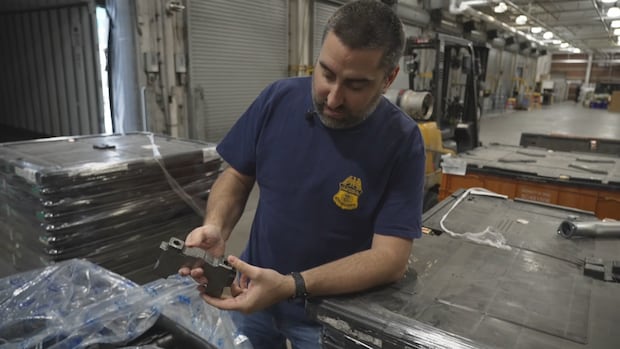
Skids of automotive parts are sitting ready for inspection by U.S. Customs and Border Protection inside a warehouse beside North America’s busiest border crossing.
These are shipments entering the United States from Canada inside of the thousands of trucks that cross the Ambassador Bridge in Windsor, Ont., every day.
Holding a steel rod he’s pulled from a cardboard box, import specialist Marc Ballelli believes he’s found a problem.
“They will classify this as an auto part but this is a steel tube,” said Ballelli.
Whether it’s considered a steel product or an auto part can make a big difference, since there is a tariff on steel of 50 per cent, but Canadian-made auto parts are exempt from tariffs.
Ballelli will now start an investigative process that could trigger a financial penalty in addition to the proper tariff, which can be an expensive surprise to the company’s bottom line.
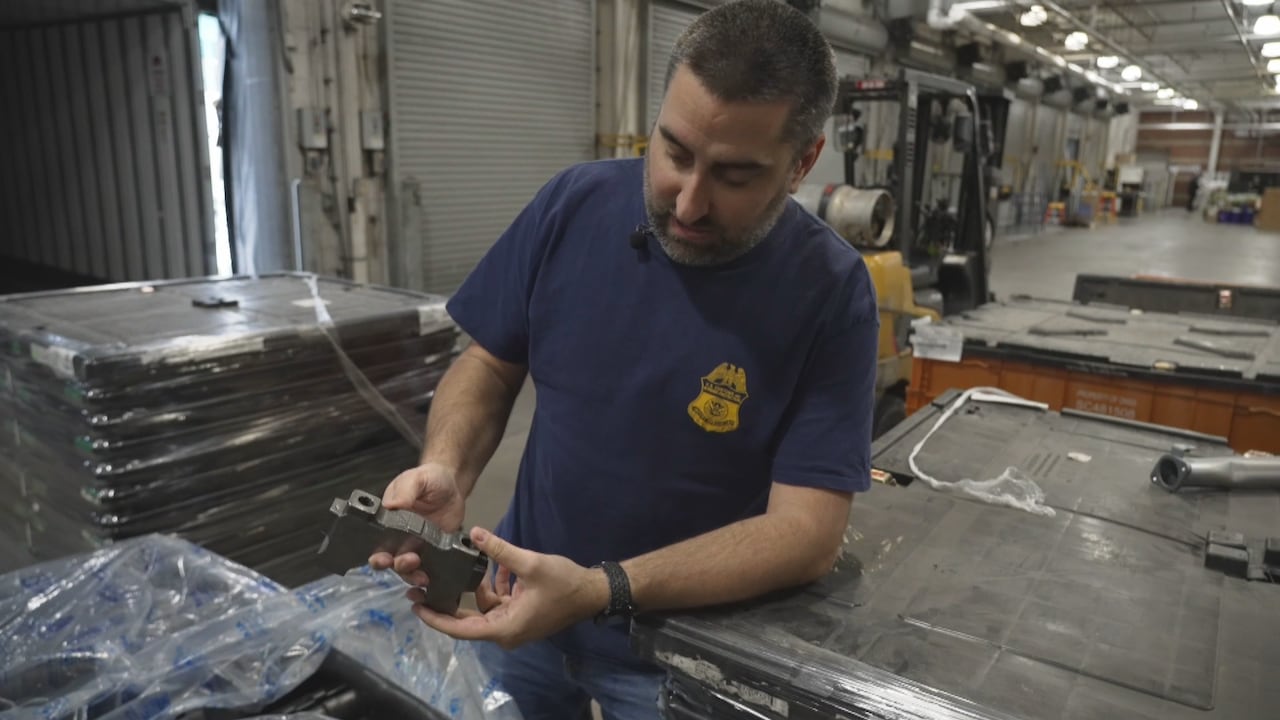
U.S. Customs and Border Protection Import Specialist Marc Ballelli cross check parts with paperwork to make sure company’s are paying the proper tariffs. (Mike Evans/CBC)
Canadian companies dealing with tariffs say the paperwork that import specialists face on both sides of the border was once a routine administrative task.
Now it’s a high-level priority occupying space on desks of the most senior employees.
Tariff paperwork becoming a full-time job
Kaycee Vasudeva owns automotive parts manufacturer Ultra-Form Manufacturing and blames the economic slowdown caused by tariffs for losing a customer.
It’s forced him to lay off a dozen employees while at the same time create two new jobs in his company just to deal with the paperwork.
“If I’m shipping it direct to USA and that’s what we do quite a bit, that’s what gives us the headache,” said Vasudeva, who has been making auto parts for 30 years.
He said the new roles are new costs needed “to make sure we really understand, with every line we put on the custom papers, to match what is required.”
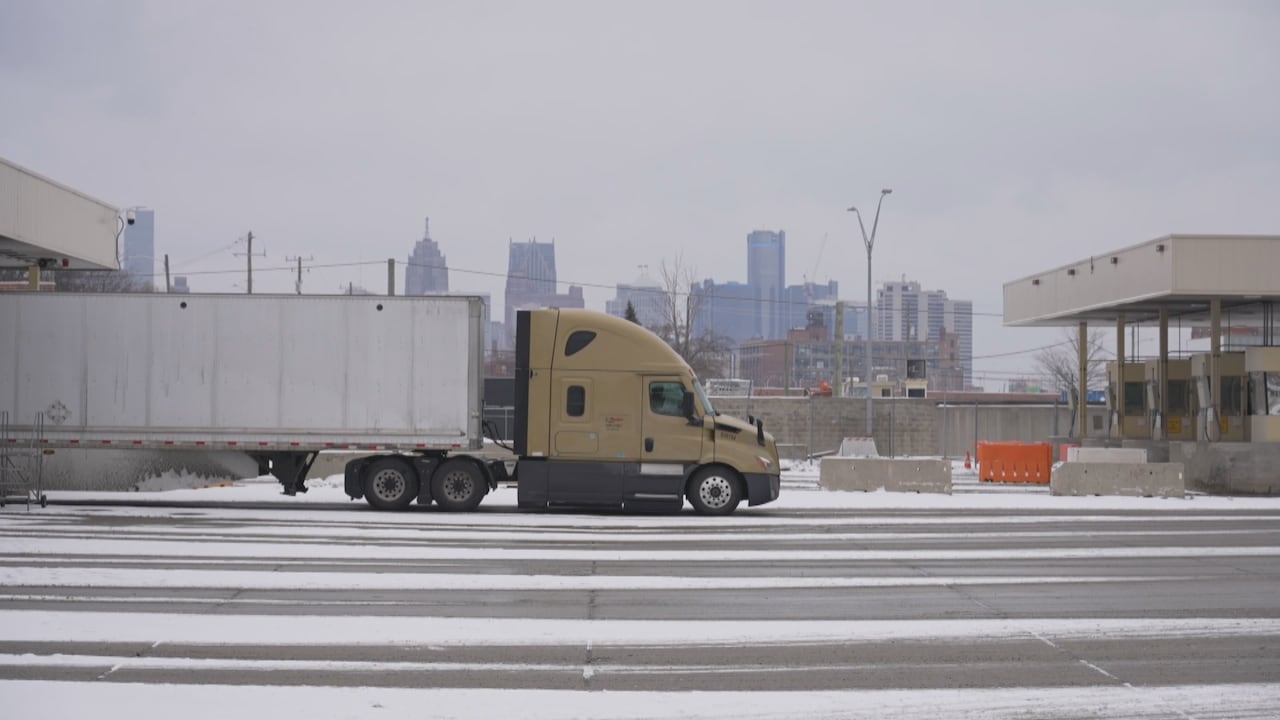
Thousands of trucks cross the Ambassador Bridge every day, carrying goods totaling about $300M, according to estimates. (Mike Evans/CBC)
On top of the expenses, said Vasudeva, are headaches and stress that come with trying to get clarity on what is the correct classification of a product crossing the border.
“This is the first time we are having this challenge of tariff and custom people bothering us,” said Vasudeava.
Between checking skids of dipsticks and other automotive parts, Ballelli and his colleagues will take calls in the office from people trying their best to get it right.
“I have companies that will call me and say, ‘Hey, what is the classification for this? This is how we have it classified currently,” said Ballelli.
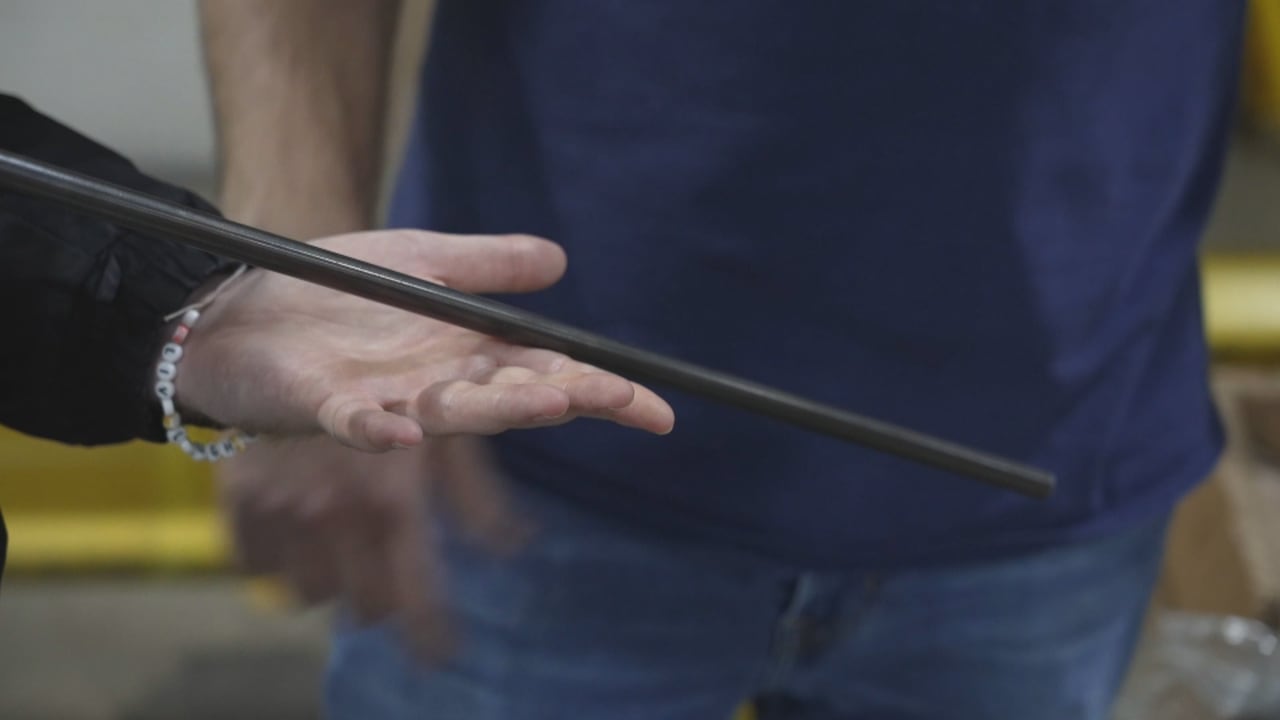
Decisions about valuation, tariff classification and country of origin are made at the CBP Automotive & Aerospace Center of Excellence and Expertise in Detroit. (Mike Evans/CBC)
He’ll go through the paperwork with the company and has, at times, corrected classifications that save the company money.
“So instead of paying 25 per cent, they’re ending up only have to pay 15 per cent.”
Judy Staudt is assistant director of the CBP’s Automotive & Aerospace Centre of Excellence and Expertise.
“The additional tariffs are becoming fast and furious, right? So some of it is genuine mistakes,” said Staudt.
“But then there’s, you know, outright fraud also happening.”
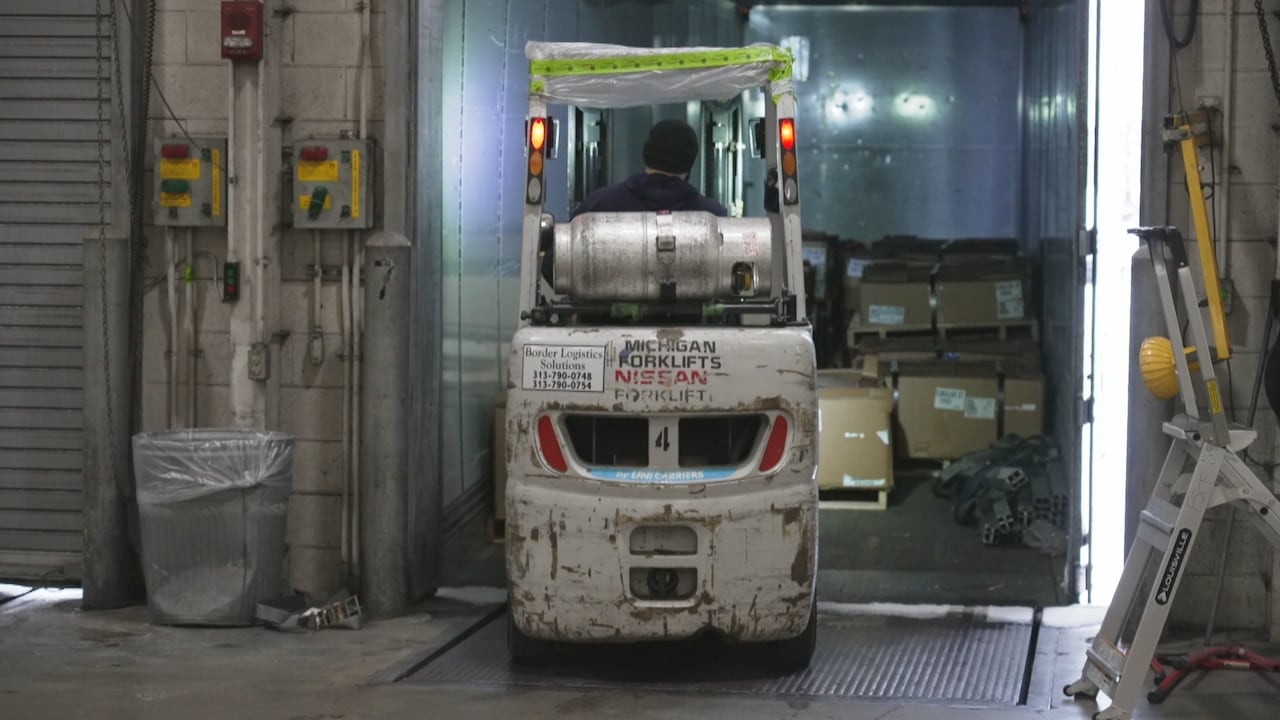
U.S. CBP officials say it’s a balance between enforcement and efficiency at the border because of how many shipments are crossing into the United States every day. (Mike Evans/CBC)
Trade numbers released by the U.S. CBP show that the while the number of trade penalties issued have remained steady, the money recovered has increased exponentially from $667.55-million in fiscal 2024 to $32.95 billion in fiscal 2025.
Canadian companies shipping to the United States are past the “shock and awe” of the initial waves of tariffs, according to trade experts CBC News spoke with.
Now it’s about finding ways to properly value the products they’re shipping to lower tariffs and ensure the paperwork is filled out properly.
“I’ve really noticed lately is that there is a lot of scrutiny by customs officials on both sides of the border, taking a look at the customs paperwork,” said Ray Fischer, senior manger of customs and global trade at Doane Grant Thornton.
Cross border shipping no longer a low risk event
He said customers who have shipped cross border for years are calling with questions about country of origin certifications.
“They said, ‘Well, that’s the way we’ve been doing it for years. We’ve never had a problem,” said Fischer.
“Well, that’s true. You’ve never had a problem because it’s never been questioned.”
He said these are complex trade agreements that require experts in the field to decipher, not a quick online search or an artificial intelligence bot.
“It’s not that the rules have changed. It’s just that the the declarations are being scrutinized a lot more by by customs, not just in the U.S.”
These conditions are a big change from what companies in Canada’s automotive industry have operated within for decades, said Joy Nott, a partner with trade and customs at KPMG.
“There was no risk associated with the border. And if somebody made a mistake on a form, well it was an administrational mistake,” said Nott.
“That environment has changed very much and that needs to be really internalized. And is it going to go away anytime soon? I don’t think it is. I think that this is here for the next few years at the very minimum.”