
Listen to this article
Estimated 5 minutes
The audio version of this article is generated by AI-based technology. Mispronunciations can occur. We are working with our partners to continually review and improve the results.
The price of the benchmark North American crude blend known as West Texas Intermediate, or WTI, slid to a four-year low on Tuesday, dipping to $55 US a barrel after starting the year off around $80.
Oil prices have been on a downward trend since the start of the year, and agencies expect that pressure to continue as global oil inventories continue to rise in 2026. Projections vary, but others see prices headed even lower in 2027.
Drops in oil prices are of particular concern in Canada, and especially Alberta, given how much oil and gas royalties figure into the financial health of governments.
Rory Johnston, energy researcher and founder of the Commodity Context newsletter, says the latest slide in prices is the continuation of a trend that began months ago, driven by a combination of weakening global growth expectations and a surge in supply.
“Demand has actually performed relatively well, funny enough, but there’s just so much supply in the market that prices are going to need to continue grinding lower until we see supply cut somewhere in the world,” he said.
Johnston said the market turned decisively earlier this year when U.S. trade policy announcements hurt global demand assumptions, followed almost immediately by OPEC+ accelerating production increases.
The consequences for Western Canada are unavoidable, Johnston said.
“Lower prices are bad for Western Canadian producers. There’s no two ways about it,” he said.

Rory Johnston, energy researcher and founder of the Commodity Context newsletter, says the market can only rebalance if production is cut in one of three places: sanctioned producers like Russia, Iran and Venezuela, U.S. shale producers, or OPEC itself. (CBC News)
But unlike in past years, the price gap between WTI and the Canadian price of oil, Western Canadian Select (WCS), remains relatively stable. Johnston said we’re seeing a gap of $11 to $13, rather than $50 a barrel.
“So even in that scenario, where we truly see a fall off in prices, it seems unlikely that Canada is going to feel acute additional pain, relative to the rest of the market,” he said.
“We’re just going to experience the same pain as every other producer in the world.”
‘Adult conversation’ needed: economist
Charles St-Arnaud, chief economist at Servus Credit Union, noted Alberta’s sensitivity to oil prices means even modest declines can have large fiscal consequences.
But that impact is partially offset by narrower oil price differentials since the Trans Mountain expansion came online, he said.
“We’ve seen that differential being much narrower than what the government was expecting,” he said.

Servus Credit Union chief economist Charles St-Arnaud, pictured in a file photo. St-Arnaud says Alberta must have an ‘adult conversation’ about its fiscal policy. (Kyle Bakx/CBC)
His estimate right now is for a provincial deficit around $5.4 billion for the 2025-26 fiscal year. But that positive from the narrower oil spread won’t benefit the province in subsequent years, he said.
“The narrowing has already been done. It’s not going to narrow further … WCS will always be sold at a lower price than WTI just because of the changing quality,” he said.
“The analogy I always make is that: let’s pretend WTI is premium gasoline and WCS is regular gasoline. You’re always going to pay more for premium.”
If oil prices continue to be around $55 a barrel, St-Arnaud said the province is looking at a rough road ahead.
“We’re looking probably at a deficit next fiscal year of above $10 billion, if there’s no other changes in terms of revenues or spending,” he said, adding that could potentially be a “very conservative” estimate.
Without an “adult conversation” on Alberta’s fiscal policy, Albertans may continue to experience cycles of austerity and reinvestment tied to the swings of the global oil market, St-Arnaud said.
“There’s not necessarily a lot of good solutions, but we need to have the discussion,” he said.
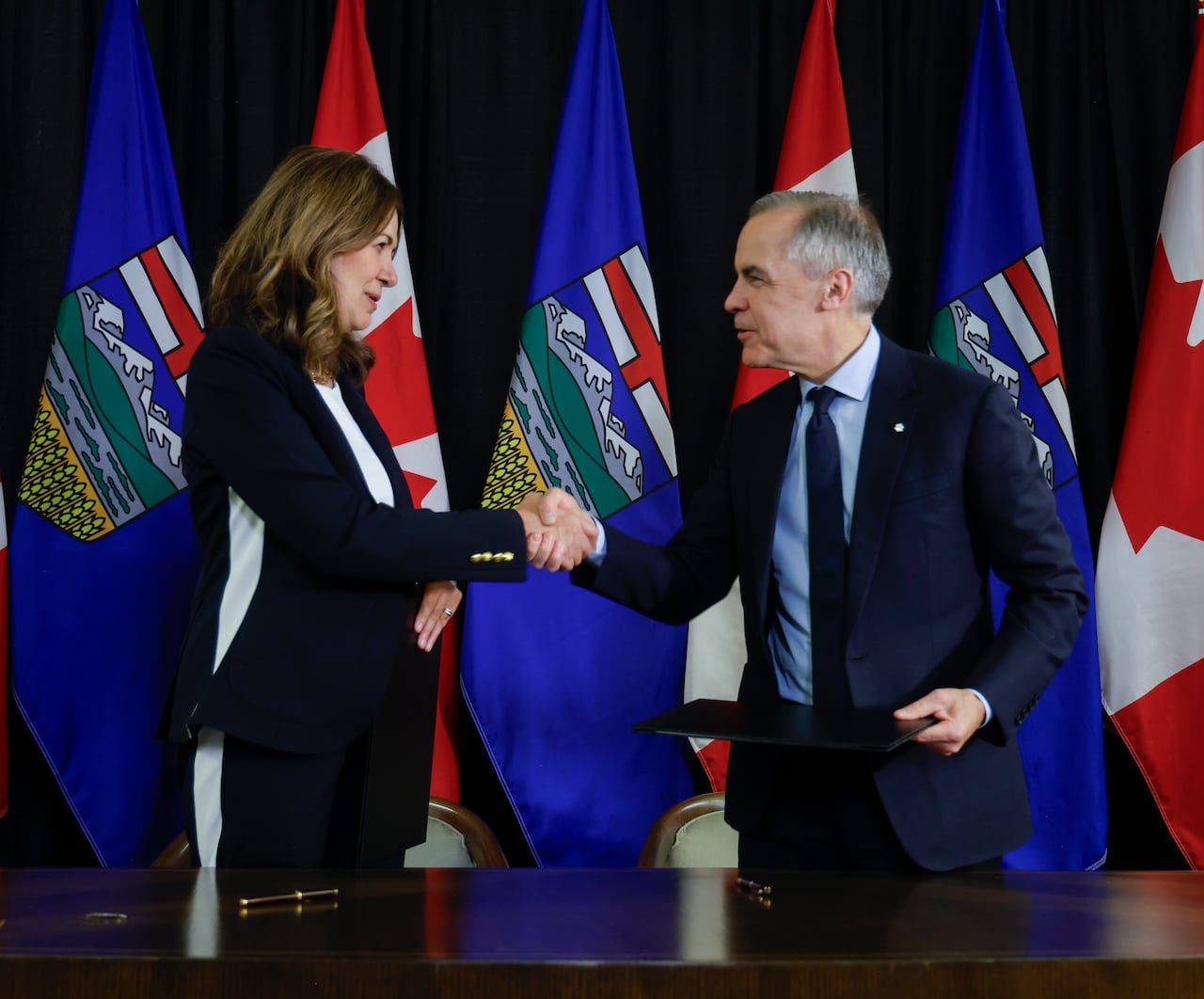
Prime Minister Mark Carney, right, signs an MOU with Alberta Premier Danielle Smith in Calgary on Nov. 27, 2025. (Jeff McIntosh/The Canadian Press)
Speaking to reporters earlier this month after the release of a federal-provincial agreement on energy policy, Alberta Premier Danielle Smith acknowledged that “short-term price fluctuations are painful for governments.”
“But I remain very confident that when we look forward five, 10, 15 years, that there’s going to be more Alberta energy on the market,” Smith said.
In a statement, a spokesperson in Finance Minister Nate Horner’s office wrote that external factors can impact the market price of oil, adding its oil price forecast from the second quarter reflects the weakness it expects to see through the end of the fiscal year.
“Our government took a careful, measured approach to building Budget 2025 and updating our resource revenue forecast through the quarterly fiscal updates. We use conservative assumptions and realistic, built-in contingencies to help deal with the expected revenue volatility,” the statement reads.
It adds that deliberations for next year’s budget, which will be released in February, are underway and will contain updated forecasts.