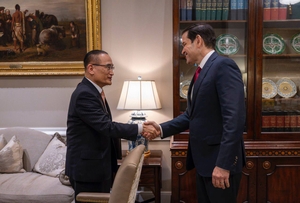
South Korea’s National Security Adviser Wi Sung-lac met US Secretary of State Marco Rubio in Washington on Tuesday, diplomatic sources said Wednesday, as the allies seek to turn momentum from the Korea-US summit into tangible outcomes.
The talks came as Wi arrived in the US capital for discussions on a range of security and strategic issues, including Seoul’s push to develop nuclear-powered submarines, as well as its long-standing bid to secure greater autonomy over uranium enrichment and spent nuclear fuel reprocessing.
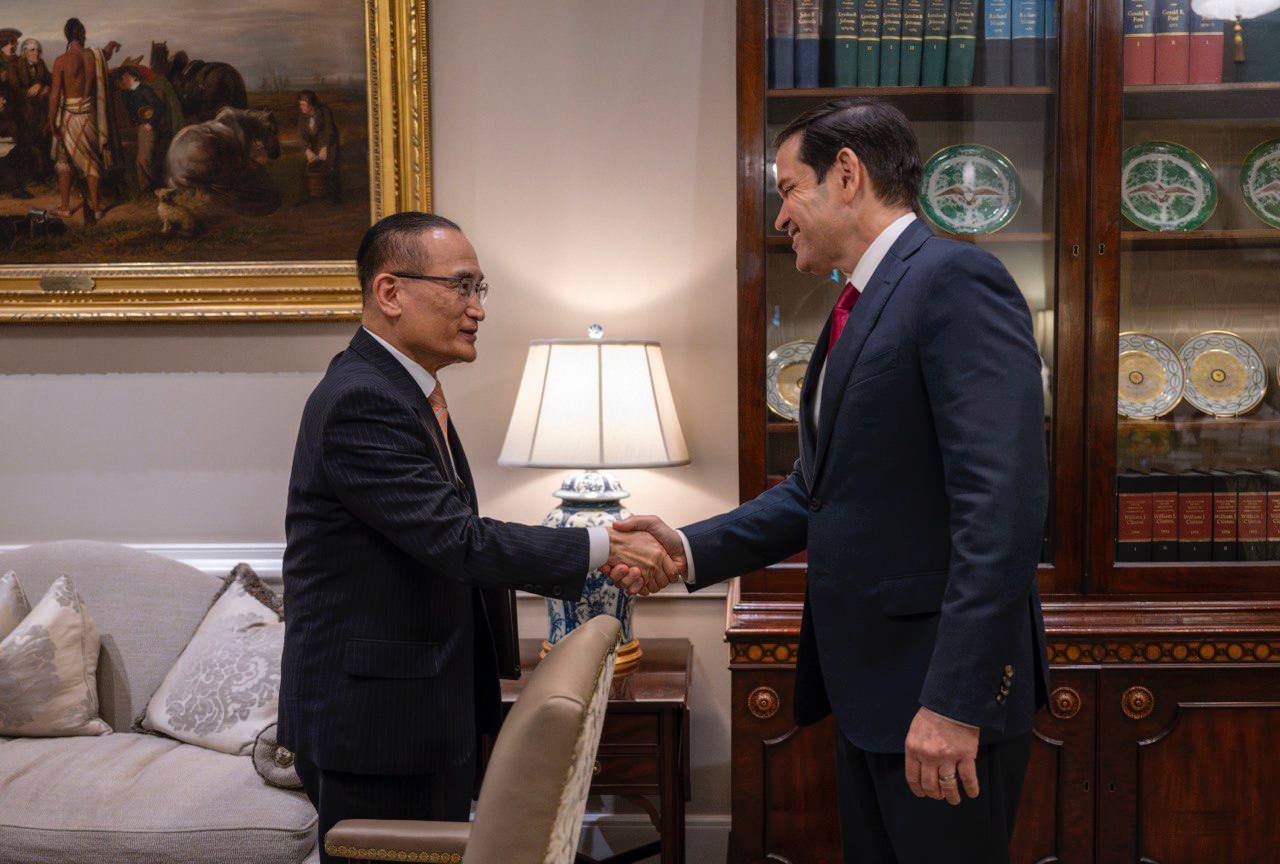 South Korea’s National Security Adviser Wi Sung-lac (left) shakes hands with US Secretary of State Marco Rubio, who also serves as US national security adviser, during their meeting in Washington on July 7. (Presidential office of South Korea)
 The visit follows last month’s release of a joint fact sheet outlining trade and security agreements reached during President Lee Jae Myung and US President Donald Trump’s second summit held on the sidelines of the Asia-Pacific Economic Cooperation summit in late October.
Speaking to reporters upon his arrival near Washington earlier in the day, Wi said he would explore the possibility of negotiating a separate bilateral agreement with the US to support South Korea’s nuclear-powered submarine program.
“In Australia’s case, an exception was granted under Section 91 of the US Atomic Energy Act, which required a separate bilateral agreement,” Wi said. “If such an arrangement is necessary for us as well, that is something I plan to discuss.”
His remarks appeared to refer to the legal framework underpinning the AUKUS partnership, under which Washington granted Canberra an exemption allowing it to pursue nuclear-powered submarines despite existing nuclear cooperation agreements.
South Korea is currently prohibited from using nuclear material for military purposes under its bilateral civil nuclear energy agreement with the United States.
Wi also said he would seek ways to accelerate consultations with Washington, including the potential establishment of dedicated consultative mechanisms to support Seoul’s submarine initiative.
“There are preparations underway on our side, and I will check the status of discussions on the US side,” he said. “While no separate consultative bodies have been launched yet, I will look for ways to speed up coordination.”
On uranium enrichment and spent fuel reprocessing, Wi said further follow-up measures were needed, noting that agreements reached so far remained broad in nature.
He added that discussions during his visit could also touch on North Korea-related issues, including efforts to advance inter-Korean dialogue and coordination between Washington and Pyongyang. Wi said he plans to exchange views on the matter and may meet officials from the United Nations during his stay.
“A favorable atmosphere has taken shape in the South Korea-US alliance, as well as among other US alliances,” Wi said. “This could serve as an opportunity. Under such circumstances, North Korea-related issues must be handled carefully, and close coordination between Seoul and Washington is essential.”
Asked whether North Korea has slipped down Washington’s list of priorities, Wi said he did not fully agree, adding that while Seoul has focused on stabilizing ties with key regional partners, it hopes to see progress in inter-Korean relations going forward.
On Thursday, Wi is scheduled to meet with US Energy Secretary Chris Wright before returning to South Korea via New York.
mkjung@heraldcorp.com