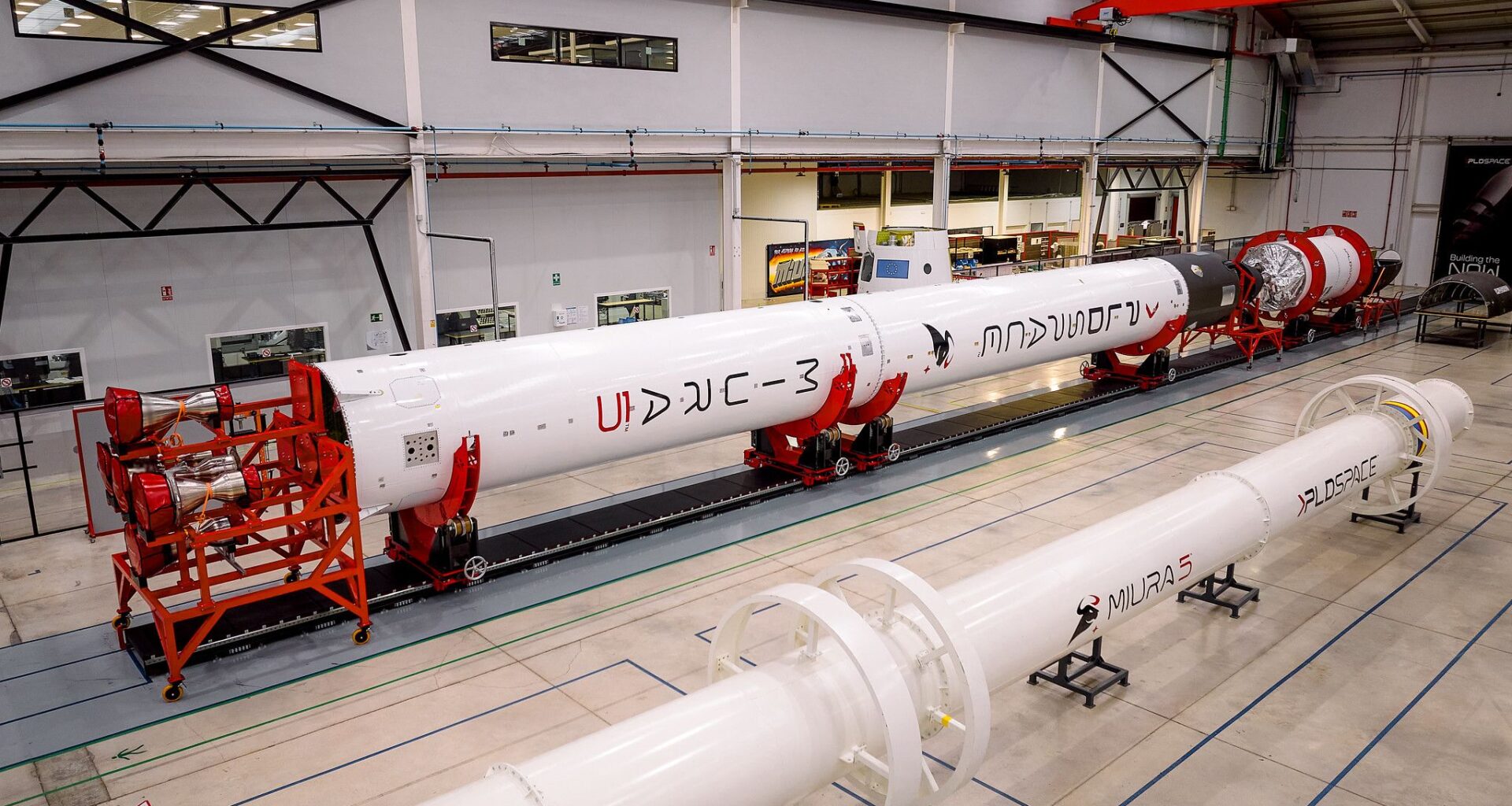
Spanish launcher PLD Space is poised to receive up to €169.1M in funds as part of the European Launcher Challenge.
At ESA’s 2025 ministerial meeting last month, European contributing states were given the option to contribute to as many of the five challengers as they wished. The Spanish government committed to investing the entirety of its €169M ELC funds in the local launcher, while the German government committed the last €100,000.
The European Launcher Challenge is split into two components. The first is for launch services to be performed between 2026 and 2030, while the second is dedicated to capacity upgrades. For PLD, the funds from ELC are heavily weighted towards the latter.
The investment from the Spanish and German governments breaks down as follows:
€36.9M to support demonstration flights of PLD’s Miura 5 launch vehicle;€132.2M to invest in the development of a capacity upgrade, which the company will use to begin to explore reusable launch capabilities.
The real value of the ELC, according to Raúl Verdú, PLD’s chief business development officer, is the doors the challenge opens for PLD to extract knowledge from ESA.
“We want to use ESA…not just the funds,” Verdú told Payload. “We want to use the European Space Agency’s resources, knowledge, heritage, technicians, scientists, [and] experts that can help us to develop our critical next steps in terms of technology. That is reusability.”
Launch year: Before it gets to Component B of the ELC, however, PLD will have to demonstrate an initial launch of its Miura 5 vehicle.
PLD is in the final stages of building its launch facility at the European Spaceport in Guiana Space Centre in Kourou, French Guiana. Once complete, the company is planning to hold its first Miura 5 launch before mid-year—the first of two Miura 5 demo flights expected in 2026.
The company’s production facility has the capacity to produce around six launch vehicles per year, but PLD plans to expand its production capacity to produce as many as 30 vehicles annually going forward, according to Verdú.
Parallel lines: The company has a history of building for the future while focusing on the present. In 2023, as PLD was demonstrating its Miura 1 suborbital rocket, its engineers were starting to work on Miura 5. Similarly, when the company launches Miura 5 for the first time, its engineers will have already begun work developing Miura Next, a heavy-lift reusable rocket.
“Everything is linked to move from a launch vehicle that is expendable to a launch vehicle that is going to be reusable, and the basic technology to develop our Miura Next that is our heavy lift launch vehicle,” Verdú said.
Luckily for PLD, the ELC funding isn’t the only source of money to invest in improvements, and potential customers are clamoring to fly once Miura 5 is operational. PLD already has customers booked for launches in 2027, when it expects to launch four commercial flights, and Verú told Payload that his team is preparing around 12 launch proposals a week.
“We want to start to win heritage,” Verdú said. “I have contracts with penalties if we delay something. So, we are feeling the real pressure of the market, and this is why we are delivering our best.”