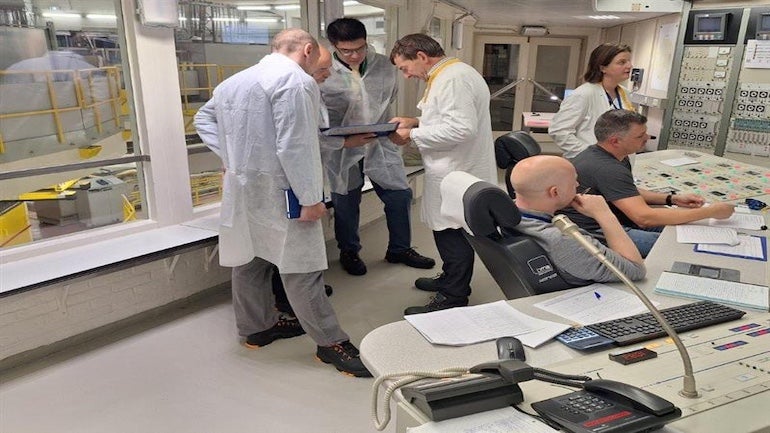
The IAEA team during the Integrated Safety Assessment of Research Reactors mission to Belgium (Credit: IAEA)
An International Atomic Energy Agency (IAEA) Integrated Safety Assessment for Research Reactors (INSARR) team of experts has reviewed enhanced safety since a previous mission in 2023 at the Belgian Research Reactor 2 (BR2).
The four-day follow-up mission was requested by the national regulator, Federal Agency for Nuclear Control (FANC – Federaal Agentschap voor Nucleaire Controle), and was hosted by the operating organisation, Belgian Nuclear Research Centre (SCK-CEN). The mission team comprised two experts from Argentina and Czech Republic, as well as one IAEA official. The team visited the research reactor and associated facilities while meeting with SCK-CEN staff and FANC officials to assess the implemented safety actions since the previous INSARR mission.
BR2 is one of three operating research reactors at the SCK-CEN in Mol, in northeast Belgium. BR” began operating in 1961 and is one of the world’s most powerful research reactors, supplying the world with radioisotopes for medical purposes, including for cancer therapy and medical imaging. It also produces radioisotopes for industrial purposes and develops doped silicon, which forms a semiconductor material that can be found in hybrid cars, and high-speed trains as well as in solar and wind farms. BR2 performs periodic safety reviews every 10 years and is currently undergoing one that is due to be finalised next year.
“SCK-CEN has addressed the majority of the review recommendations made in 2023 and accomplished considerable safety enhancements,” said Kaichao Sun, mission team leader and Nuclear Safety Officer at the IAEA. “Further efforts are needed to finalize the remaining actions and to achieve the highest level of safety for the ongoing periodic safety review.”
The team concluded that SCK-CEN has strengthened the organisational effectiveness and operational programmes through:
Completion of the SCK•CEN restructuring by establishing a BR2 institute with adequate human and financial resources;
Enhancement of safety culture by including mandatory leadership development training for managerial roles across the operating organisation;
Establishment of a verification process by authorised personnel to enhance the effectiveness of reactor operation and maintenance.
The mission indicated the need for further safety improvements in areas that are related to:
Update of the BR2 safety analysis and the acceptance criteria in the frame of the periodic safety review;
Advancement of operational limits and conditions in accordance with the IAEA safety standards.
“We work every day to continuously improve the safety performance of our infrastructure and organisation. It is rewarding to see our efforts paying off”, said Steven Van Dyck, Director of BR2. He highly appreciated the open and constructive discussions with the IAEA review team in this follow-up mission. “We’re thankful for their expertise and guidance that help us move forward and enables us to keep delivering for millions of patients worldwide.”
The mission team made a new recommendation related to specifying the applicability of the BR2 safety limits as part of the ongoing periodic safety review. The IAEA understands that FANC intends to make the results of this mission publicly available on their website.
