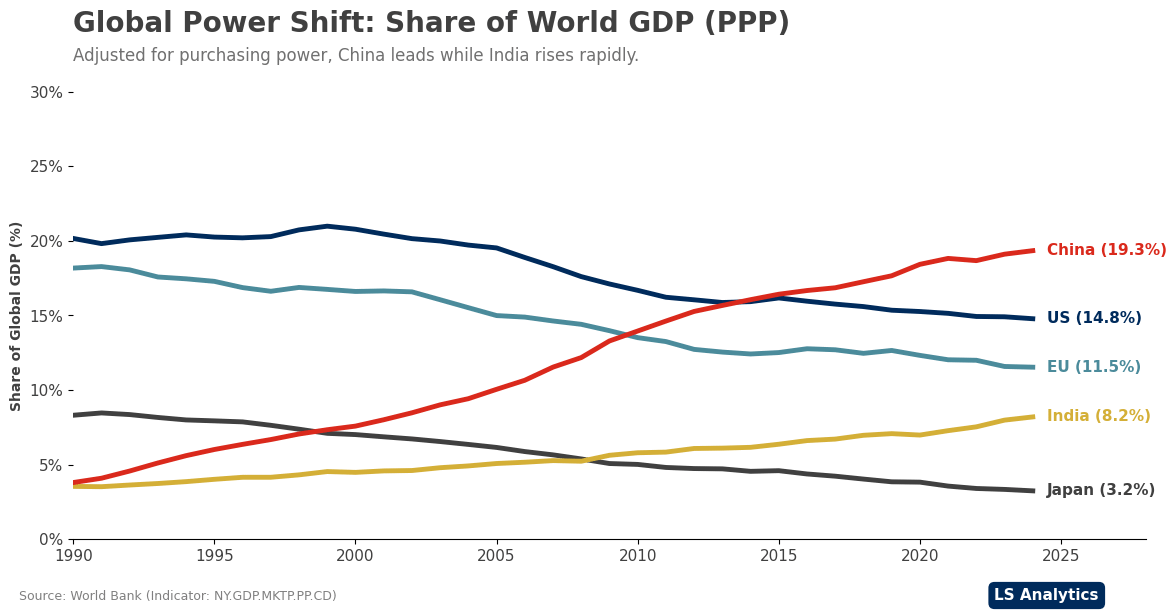
The ‘western’ world is losing its advantage. The bigger population is catching up due to globalisation.
What does PPP have to do with economy size? What is this cope? 😂😂😂
Interesting how China has shot up in PPP despite having a nominal GDP barely over 60% of the US. I would assume lower wages and poorer rural areas contribute to lower prices. I think World Bank measures includes Taiwan as part of China which inflate it a bit, but not significantly.
why on earth do you rank gdp by ppp
Lmao PPP is utterly useless for comparing the sizes of economies. The US as it stands is at 26.3% of world GDP while China is at 16.9%. The US has increased it’s share by about 5% in the last 15 years, and while China has increased much more during the same timeframe, it’s actually down 2% since 2021, during which period the US increased roughly 2%.
u know PPP is a whole load of crap, only with per capita does it have a small meaning, as it reflects the living conditions, but PPP is often measured quite dubiously (often only urban settings…)
Lotta commenters in here seem to have a *very* strong opinion on Purchasing Power Parity despite not understanding what it means.
There is a good reason why economists do not use PPP to make international comparisons. Who believes that India’s economy is 70% as large as that of the EU?
A lot of strong opinions on using nominal or PPP denominated GDP for international comparison here tonight but I need to know only one thing.
OP, are you using current 27 member states for EU applied backwards or some other composition?
Tbh am more interested in Chinese numbers here, they don’t have public statistical data, only data is provided by the cpp machine, which basically means it can be any number they want.
Would be interesting to see the visualization taken back as far as it can be, to show some rises and falls as well as rises or falls.
1990 was the inversion point for Japan following a meteoric rise comparable in angle to China’s current one.
If you just followed the trend line for the years 1960 to 1990 though to present day Japan would currently dwarf the United States and China would still be insignificant, for example.
Lotta western cope in this thread
The best way to test someone’s knowledge in economics is to show them this graph with a straight face
Truth is you can ‘adjust” PPP any way you want. Metrics built on it are useless
The good things of PPP is that it considered the differences in prices, mainly in service related industries. The problem of PPP is that it actually ignored the quality of goods, especially services. For instance, China had very good economy growth before 2020 in terms of nominal and PPP. Both the price and the quality of the service had improved a lot. But after 2020, they started to have a trouble, and the economy experienced deflation. Many of businesses, such as restaurants started to lower the prices and service qualities. But the PPP calculation in the process only considered the price change instead of the quality change. This is why you can see India, and many other third world countries, ranks high in terms of PPP, while nobody, including most of their people really believe that.
15 comments
The ‘western’ world is losing its advantage. The bigger population is catching up due to globalisation.
What does PPP have to do with economy size? What is this cope? 😂😂😂
Interesting how China has shot up in PPP despite having a nominal GDP barely over 60% of the US. I would assume lower wages and poorer rural areas contribute to lower prices. I think World Bank measures includes Taiwan as part of China which inflate it a bit, but not significantly.
why on earth do you rank gdp by ppp
Lmao PPP is utterly useless for comparing the sizes of economies. The US as it stands is at 26.3% of world GDP while China is at 16.9%. The US has increased it’s share by about 5% in the last 15 years, and while China has increased much more during the same timeframe, it’s actually down 2% since 2021, during which period the US increased roughly 2%.
u know PPP is a whole load of crap, only with per capita does it have a small meaning, as it reflects the living conditions, but PPP is often measured quite dubiously (often only urban settings…)
Lotta commenters in here seem to have a *very* strong opinion on Purchasing Power Parity despite not understanding what it means.
There is a good reason why economists do not use PPP to make international comparisons. Who believes that India’s economy is 70% as large as that of the EU?
A lot of strong opinions on using nominal or PPP denominated GDP for international comparison here tonight but I need to know only one thing.
OP, are you using current 27 member states for EU applied backwards or some other composition?
Tbh am more interested in Chinese numbers here, they don’t have public statistical data, only data is provided by the cpp machine, which basically means it can be any number they want.
Would be interesting to see the visualization taken back as far as it can be, to show some rises and falls as well as rises or falls.
1990 was the inversion point for Japan following a meteoric rise comparable in angle to China’s current one.
If you just followed the trend line for the years 1960 to 1990 though to present day Japan would currently dwarf the United States and China would still be insignificant, for example.
Lotta western cope in this thread
The best way to test someone’s knowledge in economics is to show them this graph with a straight face
Truth is you can ‘adjust” PPP any way you want. Metrics built on it are useless
The good things of PPP is that it considered the differences in prices, mainly in service related industries. The problem of PPP is that it actually ignored the quality of goods, especially services. For instance, China had very good economy growth before 2020 in terms of nominal and PPP. Both the price and the quality of the service had improved a lot. But after 2020, they started to have a trouble, and the economy experienced deflation. Many of businesses, such as restaurants started to lower the prices and service qualities. But the PPP calculation in the process only considered the price change instead of the quality change. This is why you can see India, and many other third world countries, ranks high in terms of PPP, while nobody, including most of their people really believe that.
Comments are closed.