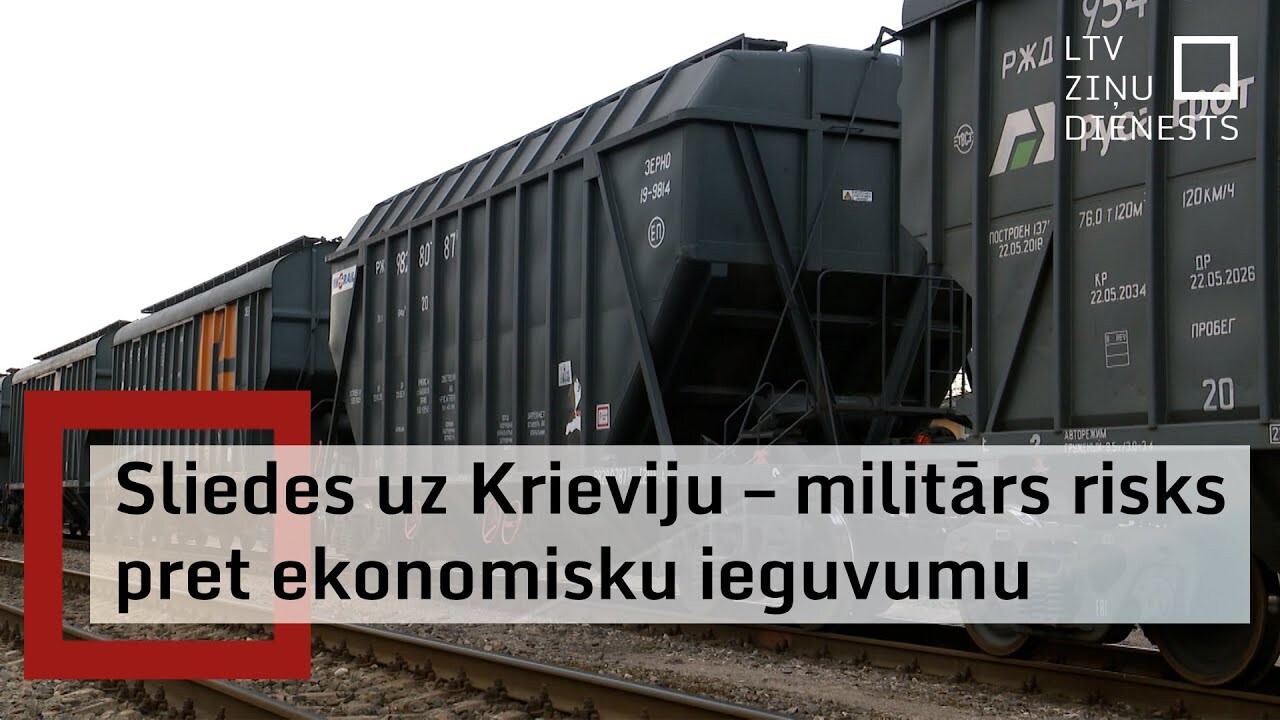
Speaking with Latvian Television’s “Morning Panorama” news show, the minister emphasized that it would make no sense for Latvia to dismantle the tracks unilaterally and there were both theoretical and practical matters to consider. Negotiations with other countries in the region are necessary, and the decision must be a “collective solution” she suggested.
“There must be full readiness to do this. That is, there must be scenarios, capabilities – both people and equipment,” said the minister.
The question of whether Latvia should dismantle its rail links to Russia and, possibly Belarus as well, has prompted a fair degree of discussion among officials and in the media. Some argue that the existence of rail tracks poses a security risk as they could be exploited by invaders. Others argue that the removal of such infrastructure would potentially damage Latvia’s economy if and when relations and trade with Russia eventually improve – particularly if alternative rail links continue to exist via neighbouring countries.
In the east, towards the Russian border, there are two railway corridors: one leading towards Pitalovo and Moscow, and another in the direction of Pskov. Another railway connection with Belarus runs from Daugavpils in the direction of Polotsk.
As Latvian Television reported, a Saeima committee is currently assessing the possible demolition of railway tracks on the Russian border, and heard the views of various institutions on Tuesday. Representatives of the National Armed Forces (NBS) indicated that in a crisis situation, the absence of railways could give more time for action. In turn, the Ministry of Defence emphasized that there is currently no direct threat and the tracks are just one of several anti-mobility elements, the use of which should be evaluated in the event of a specific threat.
The parliamentary secretary of the Ministry of Defence, Liene Gātere (Progressives), repeated what had already been heard – that the ministry and the NBS were still assessing the situation.
“Our focus right now is that planning and the actual work of implementation are taking place in the context of counter-mobility and border strengthening, and in general the goal of counter-mobility is that we stop, defeat, and limit the adversary at the border or as close to the border as possible,” said Gātere.
Gātere emphasized that the issue is not just a decision of the ministry and NBS, but must come from the government and the National Security Council. At the same time, she reminded that there are mechanisms that would allow the rails to be “deactivated” in the event of a threat, but that such a level of threat has not yet been reached.
Meanwhile, Colonel Andris Rieksts of the Joint Staff of the NBS confirmed that various scenarios were being considered, but from a security perspective, it would be best to get rid of the rails for the simple fact that a rail line that does not exist cannot be used.
“We get the best time when this railway is not there. That’s from the military side,” Rieksts said.
Representatives of the Ministry of Foreign Affairs (MFA) said on Tuesday that there are no international obligations that would oblige Latvia to maintain the rails as transit infrastructure. But the ministry is aware that Lithuania and Estonia do not currently plan to close their transit links. At the same time, cooperation in logistics and transport with Central Asia is worth considering, too, said MFA representative Uldis Mikuts.
“It is clear that cooperation in logistics and transport with Central Asia is one of our priorities, and we are interested in this potential attraction of cargo to Latvian ports, and this is also a factor that is certainly also relevant in the other Baltic countries – Lithuania and Estonia,” said Mikuts.
Again, put in extremely simple terms, goods cannot be delivered by rail to central Asia without passing through Russia or Belarus.
In turn, Patriks Markēvičs, Director of the Railway Department of the Ministry of Transport, stated that it is necessary to consult with European partners on this issue, as these tracks are part of the European Transport Network and when relations between the EU and Russia were on a better level than at present, transit trade was worth hundreds of millions of euros and was particularly important for the Latgale region, with many people’s jobs related to it.