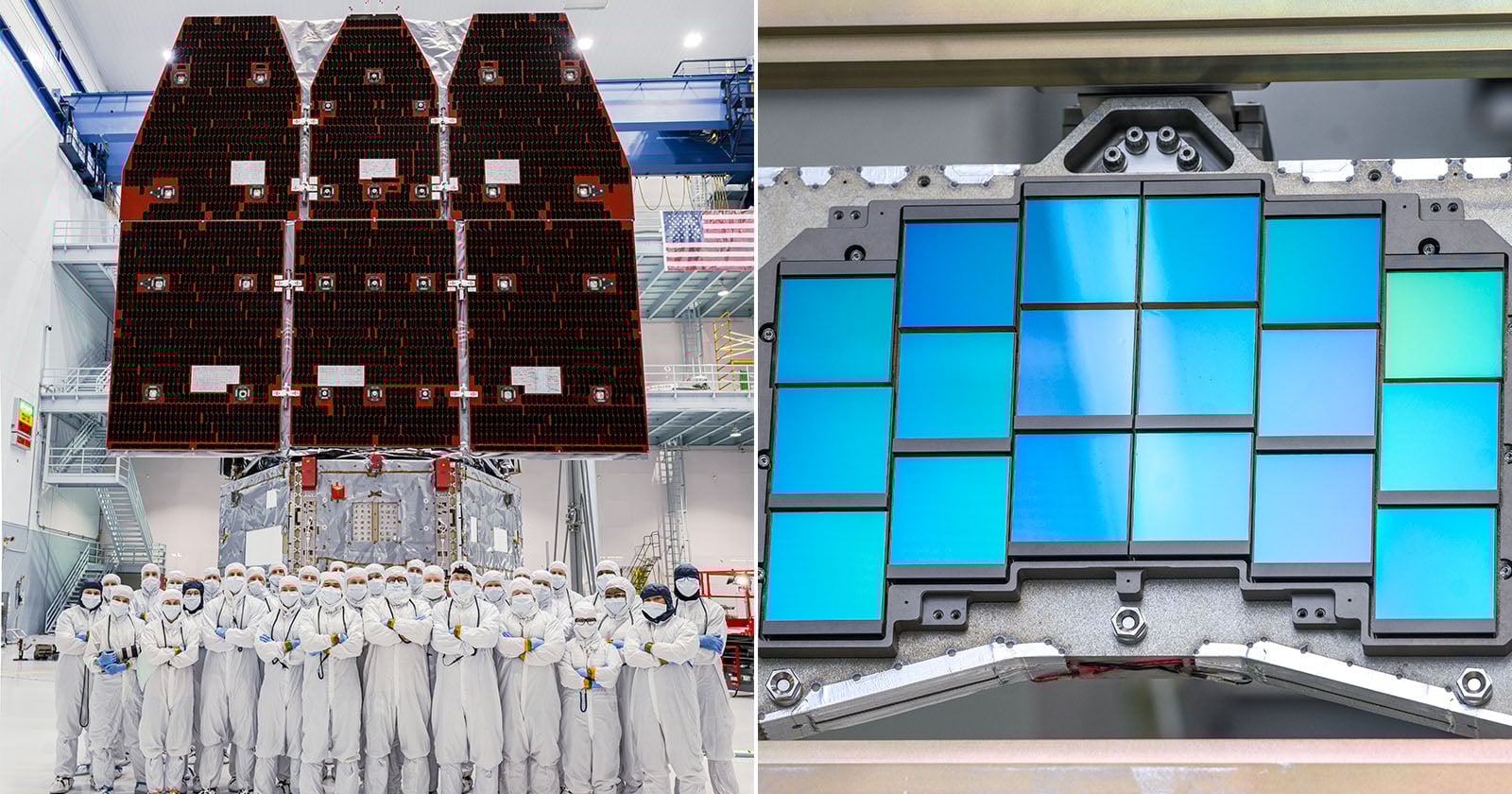
NASA’s Nancy Grace Roman Space Telescope (Roman) has been fully assembled, a momentous occasion for the scientists, engineers, and technicians who have spent years working on the telescope. It is also a significant achievement for humanity at large. Once the Nancy Grace Roman Space Telescope takes flight, it will peer into the cosmos and capture images and data of 80,000 supernovae, 100 billion stars, billions of galaxies, and hundreds of black holes, helping unravel the mysteries of dark energy and dark matter.
“Completing the Roman observatory brings us to a defining moment for the agency,” says NASA Associate Administrator Amit Kshatriya. “Transformative science depends on disciplined engineering, and this team has delivered — piece by piece, test by test — an observatory that will expand our understanding of the Universe. As Roman moves into its final stage of testing following integration, we are focused on executing with precision and preparing for a successful launch on behalf of the global scientific community.”
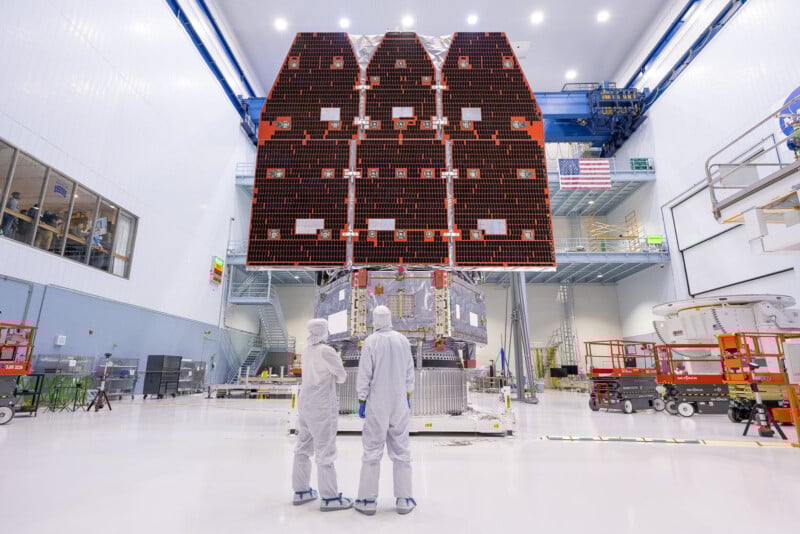 ‘NASA’s Nancy Grace Roman Space Telescope is now fully assembled following the integration of its two major segments on November 25 at the agency’s Goddard Space Flight Center in Greenbelt, Md. The mission is slated to launch by May 2027, but the team is on track for launch as early as fall 2026.’ | Credit: NASA/Jolearra Tshiteya
On November 25, 2025, technicians at NASA’s Goddard Space Flight Center in Maryland integrated Roman’s two major segments, achieving a significant milestone for a project that traces its origins back to initial planning in 2010.
At first glance, Roman looks a bit like the venerable Hubble Space Telescope, which continues to perform exceptional scientific missions in space over 35 years after it launched aboard the Space Shuttle Discovery. Roman and Hubble have the same primary mirror size (7.9 feet, or 2.4 meters) and both capture space with a relatively wide field of view. However, Roman has significant imaging advantages over Hubble, which is unsurprising given that Roman is cutting-edge, and Hubble is long in the tooth, even after multiple successful in-orbit upgrade missions.
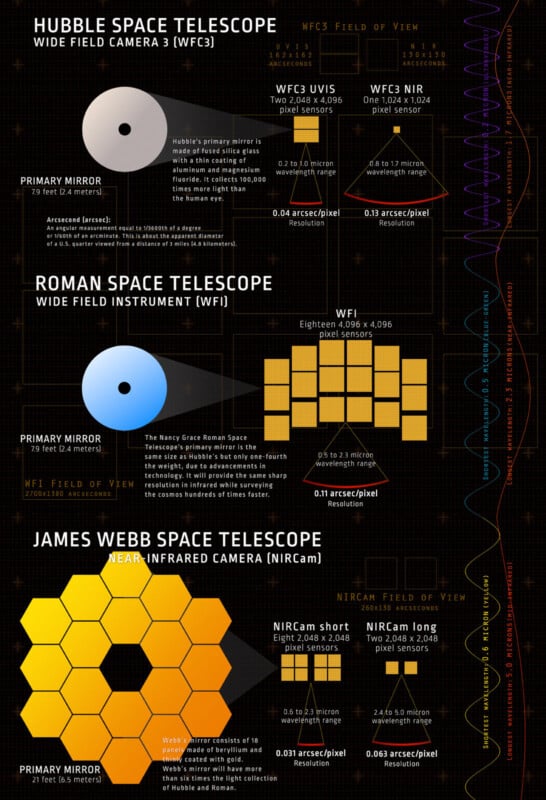 ‘his infographic shows the complementary capabilities of select instruments on three of NASA’s flagship missions: the Hubble Space Telescope and the currently under development Nancy Grace Roman Space Telescope and James Webb Space Telescope. Hubble views the cosmos in infrared, visible and ultraviolet light, providing a more comprehensive, high-resolution view of individual objects. The Roman Space Telescope will expand on Hubble’s infrared observations specifically, using a much larger field of view to create enormous panoramas of the Universe with the same high resolution. Webb will also conduct high-resolution infrared observations, peering across farther stretches of space with a narrower field of view.’ | Credit: NASA Goddard Space Flight Center
Hubble’s Wide Field Camera 3 (WFC3) sports a pair of 2,048 x 4,096-pixel sensors for ultraviolet imaging with 0.04 arcsecond/pixel resolution. It also has a near-infrared camera with a single 1,024 × 1,024-pixel sensor and 0.13 arcsec/pixel resolution.
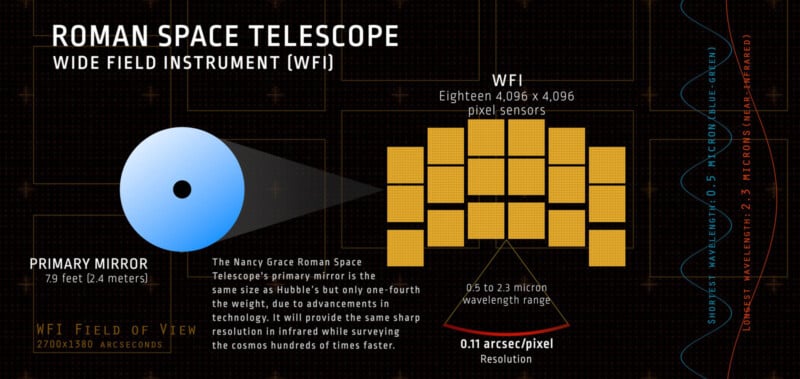 ‘The Nancy Grace Roman Space Telescope, formerly known as WFIRST, will create enormous cosmic panoramas. This infographic shows how the mission’s primary detector, the Wide Field Instrument (WFI), will help astronomers explore the infrared Universe. The Roman Space Telescope’s expansive surveys will help answer some of the most compelling questions in astrophysics and reveal many interesting targets for follow up by other missions.’ | Credit: NASA Goddard Space Flight Center
Roman, on the other hand, has a single camera, the Wide Field Instrument (WFI). This camera has 18 4,096 × 4,096-pixel sensors with 0.11 arcsec/pixel resolution. The Nancy Grace Roman Space Telescope captures 288-megapixel images “all the way from our solar system to near the edge of the observable Universe,” NASA explains. With its WFI, Roman will capture “a patch of the sky bigger than the apparent size of a full Moon.”
“The [Roman] mission will gather data hundreds of times faster than NASA’s Hubble Space Telescope, adding up to 20,000 terabytes (20 petabytes) over the course of its five-year primary mission,” NASA says. Roman’s WFI provides a view 100 times larger than Hubble’s, and it includes a coronagraph that can block starlight when observing very dim exoplanets.
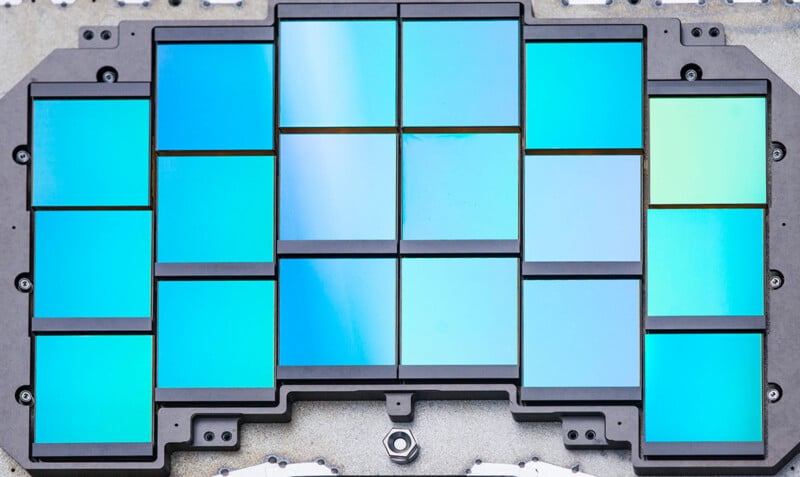 NASA’s Nancy Grace Roman Space Telescope mosaic plate assembly. | Credit: NASA/Chris Gunn
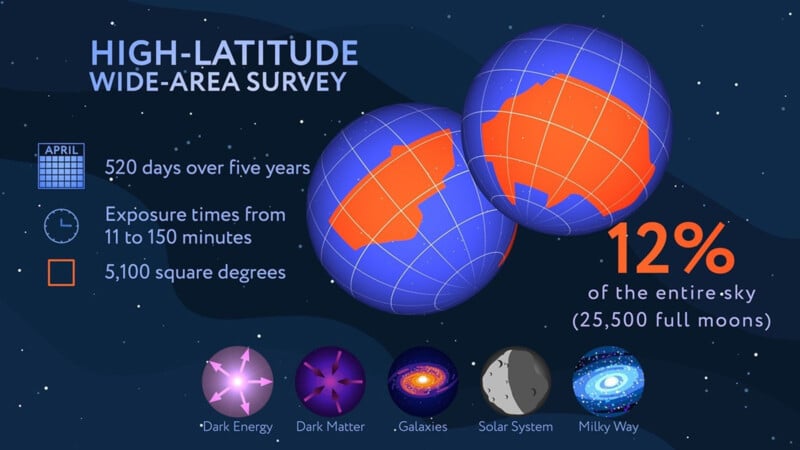
Roman will conduct three “core surveys” that will comprise 75% of its primary mission objectives. The High-Latitude Wide-Area Survey will combine raw imaging data with spectroscopy to analyze over a billion galaxies “strewn across a wide swath of space and time.” This will help astronomers better understand how the Universe evolved and investigate dark matter.
 Credit: NASA Goddard Space Flight Center
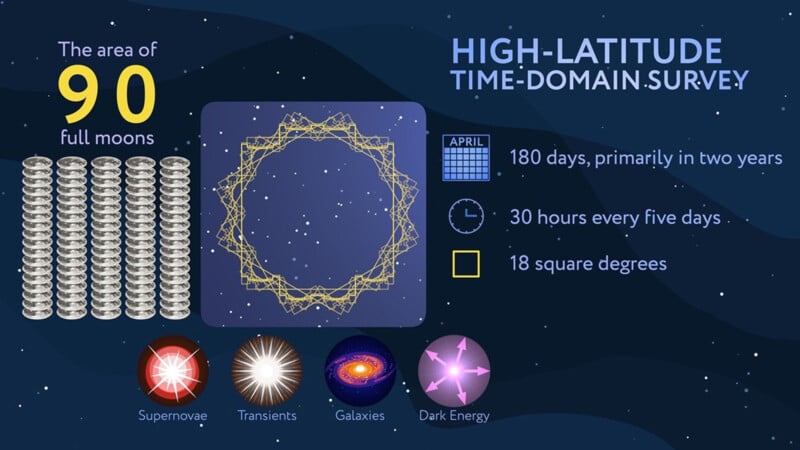
The High-Latitude Time-Domain Survey will observe one region of the cosmos repeatedly throughout Roman’s mission. By combining these observations into timelapse movies, scientists will be able to study how celestial objects and phenomena evolve over days and years. This is expected to provide key insights into dark energy.
 Credit: NASA Goddard Space Flight Center
Dark energy and dark matter are also key focuses of a groundbreaking new telescope on Earth: the LSST camera at the Vera C. Rubin Observatory in Chile. PetaPixel visited this year ahead of the team sharing the telescope’s first photo, a five-gigapixel composite that captured 10 million galaxies.
 Credit: NASA Goddard Space Flight Center
Roman’s third primary survey, the Galactic Bulge Time-Domain Survey, promises to deliver one of the deepest views ever captured of the heart of the Milky Way galaxy. Scientists will scour hundreds of millions of stars in search of microlensing signals, which are “gravitational boosts of a background star’s light caused by the gravity of an intervening object.” Through these signals, scientists will investigate planets, exoplanets, isolated black holes, and much more. NASA believes this dataset will “reveal 100,000 worlds that transit, or pass in front of, their host stars.”
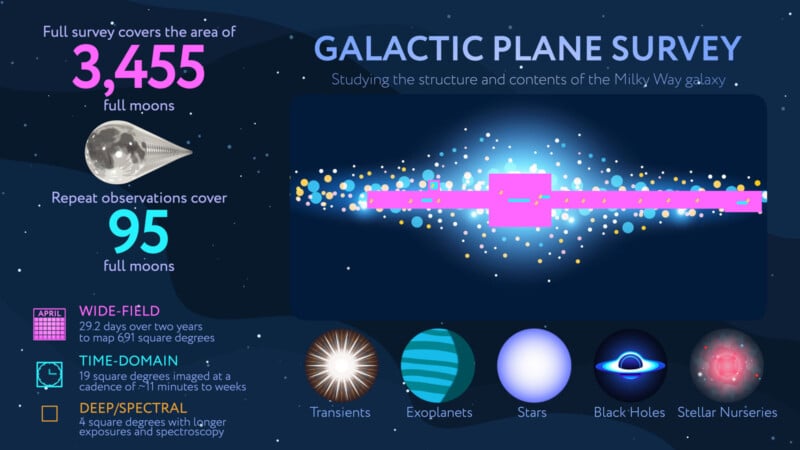
The remaining 25% of Roman’s primary mission duration will be focused on other observations and scientific investigations determined through input from the broader scientific community. The first of these programs has already been selected, the Galactic Plane Survey.
 Credit: NASA Goddard Space Flight Center
The survey will take only 29 days of observation time spread over the first two years of the Roman mission and will map up to 20 billion stars.
“The Galactic Plane Survey will revolutionize our understanding of the Milky Way,” says Julie McEnery, Roman’s senior project scientist at NASA’s Goddard Space Flight Center in Greenbelt, Maryland. “We’ll be able to explore the mysterious far side of our galaxy and its star-studded heart. Because of the survey’s breadth and depth, it will be a scientific mother lode.”
It is also worth discussing how the space telescope got its name. Known initially as WFIRST, the Nancy Grace Roman Space Telescope is named for NASA’s first chief astronomer, Nancy Grace Roman, who dedicated her life to ensuring that future generations could investigate the cosmos through space-based telescopes.
“The mission will acquire enormous quantities of astronomical imagery that will permit scientists to make groundbreaking discoveries for decades to come, honoring Dr. Roman’s legacy in promoting scientific tools for the broader community,” explains Jackie Townsend, Roman’s deputy project manager at NASA Goddard. “I like to think Dr. Roman would be extremely proud of her namesake telescope and thrilled to see what mysteries it will uncover in the coming years.”
As of now, the Nancy Grace Roman Space Telescope may launch into space aboard a SpaceX rocket as soon as October 2026.
Image credits: NASA/NASA Goddard Space Flight Center