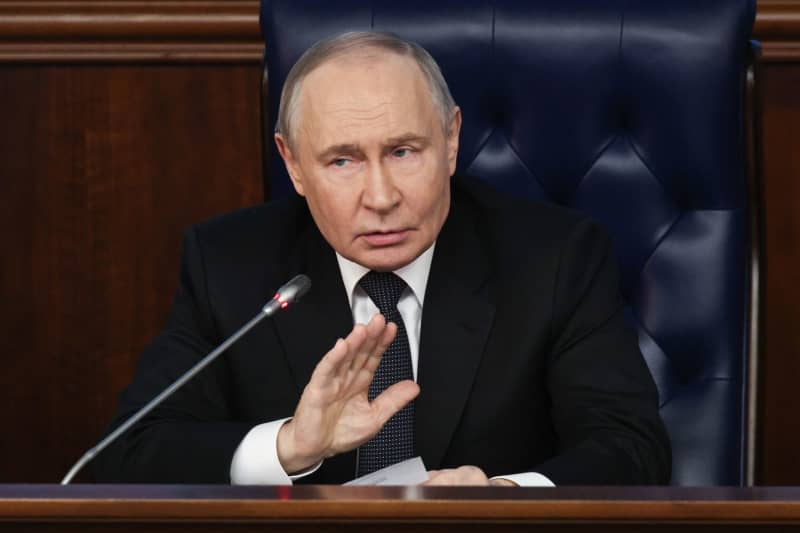
Russian President Vladimir Putin expressed confidence in victory for his war in Ukraine during a meeting with senior military officials on Wednesday amid a renewed diplomatic push to achieve a peaceful solution to the conflict.
He said that more than 300 localities in the neighbouring country have been conquered this year alone. “Among them are also large cities that have been turned by the enemy into fortress nodes with permanent defensive installations,” Putin said.
The Russian president said his country’s army is on the rise, in contrast to the Ukrainian forces.
The pace of conquests will only increase thanks to experience, the 73-year-old said. While Russia prefers diplomacy, Putin said it is ready to “regain [Russia’s] historical territories by military means.”
He also reiterated his intention to establish a “buffer zone,” that is, to occupy a strip about 30 kilometres long in northern Ukraine along the Russian border.
Putin praises army and arms industry
Russian troops invaded Ukraine in February 2022. Ukraine has since been defending itself against the invasion with Western support.
In this context, Putin praised not only his own army, which he said has proven superior despite Western support for Kiev, but also his own arms industry.
As examples, he cited successful tests of the strategic cruise missile Burevestnik (Storm Petrel) and the underwater apparatus Poseidon, as well as the mobile intermediate-range missile Oreshnik (Hazel Shrub), which is to be delivered to the armed forces by the end of the year.
During the session, Putin also once again praised US President Donald Trump. Negotiations with the new US government are making progress, Putin said, but he once again blamed the collective West for the war he ordered against Ukraine: “Basically, the West itself started the war. We are just trying to end it.”
Russia leaves room for talks on foreign forces in Ukraine
The Kremlin earlier signalled a willingness to discuss the possible deployment of Western troops in Ukraine, despite its long-standing opposition to such a move.
The TASS news agency quoted Kremlin spokesman Dmitry Peskov as saying that Russia’s position on the stationing of foreign forces was “well-known, consistent and clear” – but it could nevertheless be “a subject for discussion.”
The proposal resurfaced during talks in Berlin this week involving US, European and Ukrainian officials. So far, there is no publicly known position from the US side, and Washington has not signed a paper on this published by the German government.
Peskov left open which negotiations he was referring to and did not say that Russia was ready to discuss troops from NATO countries. However, he made it clear that Russia’s position of categorical rejection of such troops remains unchanged.
Security guarantees against renewed attack
According to the vision of the Europeans, a European-led multinational force could be stationed in Ukraine after a ceasefire is concluded and monitor its compliance. It would thus be part of the security guarantees demanded by Kiev against a renewed Russian attack.
The composition of the force is unknown – even on Wednesday, German Chancellor Friedrich Merz left open whether the Bundeswehr would be involved.
According to Peskov, Russia has not yet been officially informed about the status of the talks between the United States, Europe and Ukraine. He said that Trump’s special envoy, Steve Witkoff, is not expected in Moscow this week. Therefore, Russia will not publicly discuss individual points of conflict regulation, he said.
Russia previously against deployment of Western troops
In the past, Russia has sharply criticized the idea of deploying Western troops. Russian Foreign Minister Sergei Lavrov raised alarm last week when he said that peacekeeping troops stationed in Ukraine could become “legitimate targets.”
Politicians in Moscow have also warned of a potential World War III if troops from NATO countries are indeed stationed in Ukraine.
Putin has justified the war as necessary to prevent Ukraine’s NATO membership and the presence of alliance troops that Moscow considers hostile.
At the military meeting in Moscow, Putin once again emphasized that Russia insists on the non-expansion promise once given by NATO.
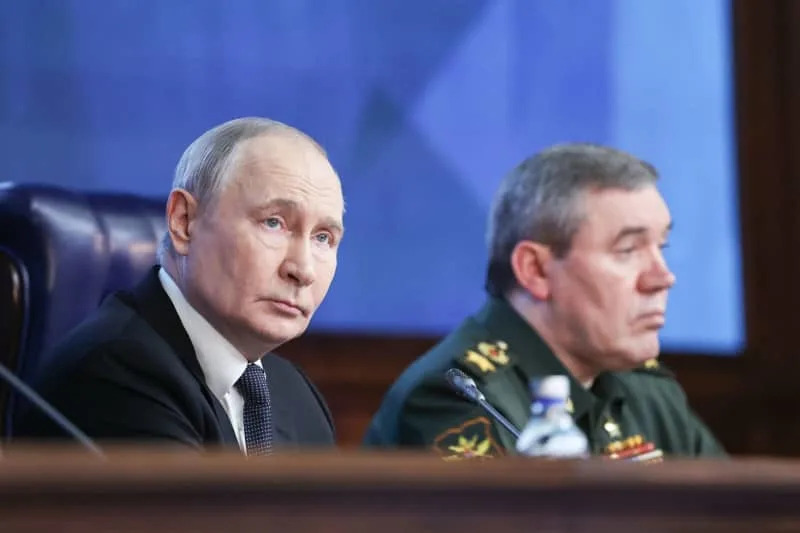
Russia’s President Vladimir Putin (L) and Russia’s First Deputy Defence Minister Valery Gerasimov, Chief of the General Staff of the Russian Armed Forces, attend an expanded meeting of the Defence Ministry Board. Alexander Kazakov/TASS via ZUMA Press/dpa